What Are the Implications of the Indigenous Combat Parachute System Successfully Tested at 32,000 Feet?
Synopsis
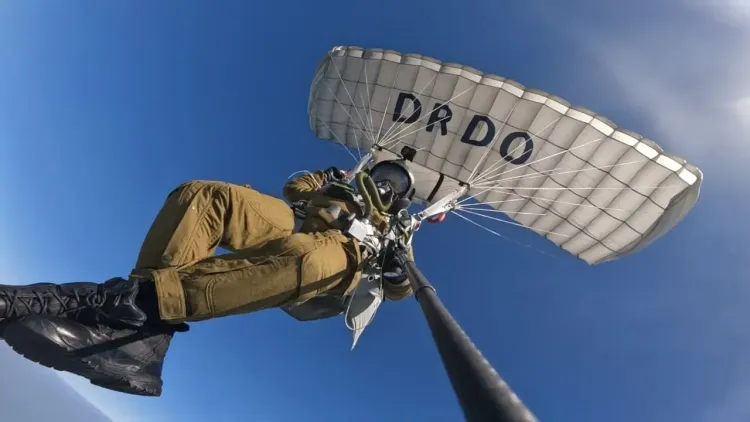
In a remarkable achievement for India's defence sector, the indigenous Military Combat Parachute System (MCPS) has successfully completed a free-fall jump from 32,000 feet. This milestone, acknowledged by Defence Minister Rajnath Singh, signifies a leap towards self-reliance in aerial delivery systems and enhances operational capabilities of the Indian Armed Forces.
Key Takeaways
MCPS successfully tested at 32,000 feet.
Developed by DRDO for the Indian Armed Forces.
Features advanced tactical capabilities.
Reduces reliance on foreign equipment.
Enhances self-reliance in defence technology.
New Delhi, Oct 15 (NationPress) In a significant advancement, the Military Combat Parachute System (MCPS), developed locally by DRDO, has successfully completed a combat free-fall jump from a height of 32,000 feet, as announced by the Ministry of Defence (MoD) on Wednesday.
Defence Minister Rajnath Singh extended his congratulations to DRDO, the Armed Forces, and the Industry for this successful demonstration, labeling it a crucial milestone in enhancing India's indigenous defence capabilities.
The MoD stated that the jump was carried out by test jumpers from the Indian Air Force, demonstrating the efficiency, reliability, and advanced design of this indigenous system.
As per the MoD's press release, “This accomplishment renders the MCPS the sole parachute system currently operational within the Indian Armed Forces that is capable of deployment at altitudes exceeding 25,000 feet.”
Importantly, the MCPS was crafted by DRDO laboratories - Aerial Delivery Research and Development Establishment in Agra and Defence Bioengineering and Electromedical Laboratory in Bengaluru.
The MoD elaborated that it features several enhanced tactical capabilities, such as a lower descent rate and superior steering abilities, allowing paratroopers to exit aircraft safely, deploy parachutes at set altitudes, navigate with precision, and land in designated areas.
Furthermore, the system is compatible with Navigation with Indian Constellation, granting operational flexibility against any adversary of our choosing, and is resilient against interference or denial of service from external entities or nations.
The ministry underscored that the success of this system paves the way for the adoption of Indigenous parachute systems.
This will also maximize the utility of the parachute system throughout its lifespan, due to minimal turnaround times for routine maintenance and repairs when compared to imported alternatives, while also reducing reliance on other nations for serviceability during conflicts.
The Secretary of the Department of Defence R&D and Chairman of DRDO, Samir V Kamat, praised the DRDO team involved in the demonstration, calling it a major step toward self-sufficiency in aerial delivery systems.
Point of View
I acknowledge this achievement as a pivotal moment for India's defence sector. The successful test of the MCPS not only showcases our advancements in technology but also reinforces our commitment to self-reliance in military capabilities. It is a step towards reducing dependency on foreign equipment, ensuring we have the tools necessary to defend our nation.
NationPress
6 Oct 2026
Frequently Asked Questions
What is the Military Combat Parachute System?
The Military Combat Parachute System (MCPS) is an indigenous parachute system developed by DRDO, designed for high-altitude combat parachuting.
What altitude was the MCPS tested at?
The MCPS was successfully tested at an altitude of 32,000 feet.
Who congratulated DRDO for this achievement?
Defence Minister Rajnath Singh congratulated DRDO, the Armed Forces, and the industry on this significant milestone.
What are the advantages of the MCPS?
The MCPS features enhanced tactical capabilities, including a lower descent rate, superior steering, and compatibility with Navigation with Indian Constellation.
How does the MCPS impact India's defence capabilities?
The successful testing of the MCPS enhances India's self-reliance in military capabilities and reduces dependency on foreign parachute systems during conflicts.