How Will Indo-German Cooperation Impact COP30 Outcomes?

Synopsis
Germany's Ambassador to India, Philipp Ackermann, emphasizes that Indo-German collaboration is pivotal for successful implementation of COP30 outcomes. This vital partnership aims to transform climate commitments into tangible actions, addressing urgent challenges of adaptation and resilience across South Asia.
Key Takeaways
Cooperation between India and Germany is essential for achieving climate goals from COP30.
The Green and Sustainable Development Partnership translates climate commitments into action.
Germany exceeded its climate-finance commitments, contributing €11.8 billion .
Implementation, not abstraction, is central to global climate action.
Adaptation strategies must cater to the diverse realities of different nations.
New Delhi, Dec 2 (NationPress) Philipp Ackermann, the Ambassador of Germany to India, has highlighted that the collaboration between India and Germany is crucial for realizing the outcomes of COP30.
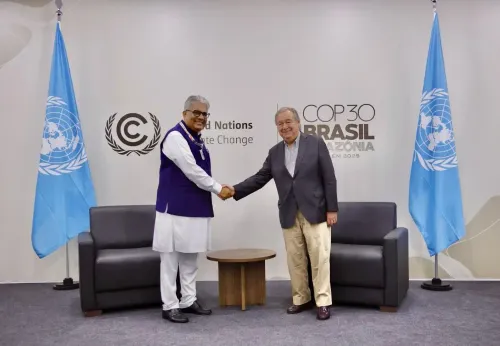
During a high-level session of the ‘Climate Talks’ series, themed 'COP30: Reflections from Belem' and hosted by the German Embassy in India, Ackermann recounted the discussions between Union Minister of Environment, Forest and Climate Change Bhupender Yadav and Germany’s Environment Minister Carsten Schneider in Belem, emphasizing new opportunities for collaboration.
He pointed out that through the Green and Sustainable Development Partnership (GSDP), both nations are actively putting climate promises into practice. In addition, Germany has initiated a new IKI Large Grant call for proposals aimed specifically at India, to support its forthcoming National Adaptation Plan and bolster the resilience of forests, ecosystems, and biodiversity.
Reflecting on two weeks of discussions in Belem, Ackermann underscored the necessity of multilateralism and cooperative efforts. He mentioned that Germany not only met but exceeded its international climate-finance commitments in 2024, contributing €11.8 billion, which includes €6.1 billion in budgetary resources, thereby fulfilling its pledge to provide at least €6 billion annually.
“COP30 has reminded us that tackling climate change is not a challenge any one nation can face alone. The decision made in Belem - the ‘Global Mutirao’ or collective endeavor, is especially apt,” Ackermann stated, reflecting on both the progress made and the challenges that lie ahead.
During the event, Arunabha Ghosh, Founder-CEO of CEEW and South Asia Envoy to COP30, highlighted that COP30 signifies a transition towards implementation after years of theoretical discussions. He stressed that adaptation and resilience are urgent priorities shaped by diverse realities in countries like Sri Lanka, Nepal, Maldives, and Bangladesh.
“COP30 emphasized that action, not theory, is at the forefront of global climate initiatives. Across South Asia, the clarity is undeniable: adaptation and resilience are pressing issues influenced by distinct realities in Nepal, Sri Lanka, Maldives, or Bangladesh. Nations need the flexibility to report on what is genuinely significant for them, for credible climate action cannot adopt a one-size-fits-all approach. Despite its flaws, multilateralism remains vital. In a COP of diverse truths, securing even an imperfect agreement was crucial to demonstrate that collective action is still achievable.
“A just transition must prioritize people: while we can repurpose physical assets and redesign financial structures, we cannot forsake human resources whose livelihoods depend on coal today. Furthermore, we should not perceive trade solely as a barrier; co-developing technology and investing in each other’s markets can serve as significant catalysts for climate ambition. Genuine progress will arise not merely from two weeks of negotiations, but from what we collaboratively construct in the remaining fifty weeks of the year, translating the directives from Belem into fairer systems, enhanced resilience, and lasting climate cooperation for the region,” he added.
COP30 in Belem commemorated a decade since the Paris Agreement, intensifying the urgency to close the gap toward the 1.5°C pathway. The climate conference in Brazil's Belem, which concluded on November 22, resulted in an agreement advocating for a tripling of funding for developing nations to shield their populations from the escalating effects of the climate crisis, alongside increasing support for workers and communities during the transition to clean energy.
Frequently Asked Questions
What role does Germany play in COP30?
Germany, through its Ambassador and government commitments, is working closely with India to implement climate action strategies discussed during COP30.
How are adaptation and resilience prioritized in COP30?
Adaptation and resilience are prioritized as urgent issues that need to be tailored to the unique realities of different nations, as emphasized during COP30 discussions.
What is the Green and Sustainable Development Partnership?
The Green and Sustainable Development Partnership (GSDP) is an initiative between India and Germany aimed at translating climate commitments into actionable projects.
What were the major outcomes of COP30?
Major outcomes of COP30 included agreements on increasing funding for developing nations and a focus on collective efforts to address climate change.