Jaishankar Greets Cambodia on National Day, Cites Civilizational Bonds
Synopsis
External Affairs Minister Dr. S. Jaishankar greeted Cambodia's Deputy PM and FM Prak Sokhonn on Cambodia's National Day (9 November), highlighting the shared civilizational heritage — including Hindu-Buddhist cultural links — that underpins India-Cambodia ties.
Key Takeaways
Jaishankar extended National Day greetings to Cambodia on 9 November 2026 .
The message was addressed directly to DPM and FM Prak Sokhonn , Cambodia's top diplomat.
Jaishankar cited 'strong bonds built on shared civilizational linkages' — a reference to the Hindu-Buddhist heritage common to both cultures.
Cambodia's National Day marks its independence from France, achieved in 1953 .
India has maintained diplomatic relations with Cambodia since shortly after independence, deepening ties through ASEAN frameworks from the 1990s onward.
The greeting reflects India's broader cultural diplomacy approach toward Southeast Asian partners.
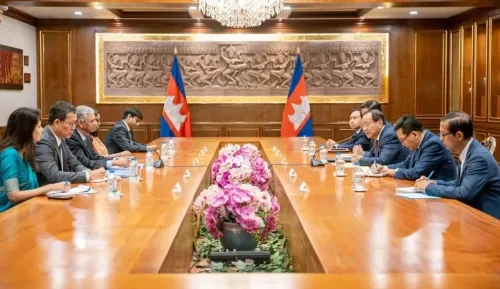
On Cambodia's National Day, 9 November, Union External Affairs Minister Dr. S. Jaishankar extended warm greetings to Deputy Prime Minister and Foreign Minister Prak Sokhonn, the Cambodian government, and its people — invoking the deep civilizational thread that ties the two nations across centuries.
A Bond Written in Stone — from Angkor Wat to New Delhi
The greeting was brief, but its reference to 'shared civilizational linkages' carries real weight. Cambodia's cultural identity is inseparable from Hindu-Buddhist heritage — nowhere more visibly than in Angkor Wat, the twelfth-century temple complex built in the Khmer tradition of Vaishnavism that remains one of the largest religious monuments on earth. India and Cambodia do not merely share diplomatic files; they share a civilizational vocabulary, and Jaishankar's post makes that point explicitly. India established diplomatic relations with Cambodia shortly after the latter gained independence from France in 1953, and the two countries have maintained steady engagement through ASEAN mechanisms since the 1990s.Routine Diplomacy, Consistent Signal
The greeting is part of India's well-established practice of marking ASEAN partners' national days at the ministerial level — a form of cultural diplomacy that keeps bilateral warmth alive between larger summits. With the next ASEAN-India Summit and East Asia Summit cycles on the horizon, such messaging keeps the channel warm and the goodwill on record. For Prak Sokhonn, who serves as Cambodia's chief diplomat in addition to his role as Deputy Prime Minister, the acknowledgement from New Delhi is a signal of consistent, respectful engagement from one of Southeast Asia's most consequential partners. India's Southeast Asia strategy has long rested on the twin pillars of institutional engagement through ASEAN and the softer, stickier power of shared heritage. Monday's post from Jaishankar is a small but deliberate stitch in that larger fabric.Point of View
Not merely transactional. It fits a consistent diplomatic pattern where New Delhi uses heritage diplomacy — Angkor Wat, Buddhist circuits, Sanskrit influence in Khmer culture — as a soft-power foundation alongside ASEAN institutional ties. As India deepens its Act East Policy, keeping these bilateral warmth signals alive between summits ensures Cambodia remains a receptive partner in a region where China's footprint is large and growing.
NationPress
9 Nov 2026
Frequently Asked Questions
Why does India celebrate Cambodia's National Day?
Cambodia's National Day on 9 November marks its independence from France in 1953. India, as a long-standing diplomatic partner and fellow nation with shared civilizational heritage, marks the occasion with official greetings as part of its cultural diplomacy toward ASEAN nations.
Who is Prak Sokhonn?
Prak Sokhonn is Cambodia's Deputy Prime Minister and Minister of Foreign Affairs and International Cooperation, making him the country's chief diplomat.
What are the civilizational links between India and Cambodia?
India and Cambodia share deep Hindu-Buddhist heritage. Khmer culture was shaped by Indian religious and artistic traditions, most visibly in monuments like Angkor Wat, originally a Vaishnavite temple built in the twelfth century.
When did India and Cambodia establish diplomatic relations?
India established diplomatic relations with Cambodia shortly after the latter's independence in 1953, and the two countries have maintained consistent engagement through ASEAN mechanisms since the 1990s.
What is India's Act East Policy and how does Cambodia fit in?
India's Act East Policy prioritises deeper political, economic, and cultural engagement with Southeast and East Asian nations. Cambodia, as an ASEAN member with strong civilizational ties to India, is a natural partner in this framework.