CM Hemant Soren's Vision Drives 28% Milk Output Rise in Jharkhand
Synopsis
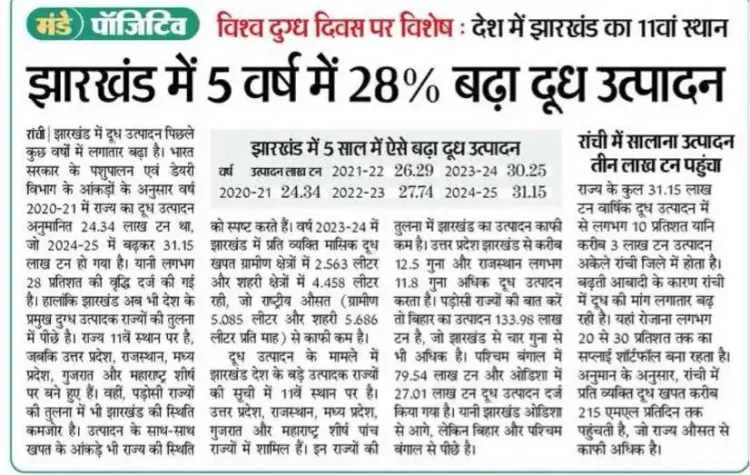
The Chief Minister's Office of Jharkhand says the state recorded a 28 per cent rise in milk production over five years under CM Hemant Soren's policy direction, pushing Jharkhand to 11th place in the national dairy rankings.
Key Takeaways
The Chief Minister's Office of Jharkhand announced a 28% rise in milk production over the past five years on 1 June 2026 .
Jharkhand has moved to 11th position nationally in milk output, up from a historically lower rank.
The growth is attributed to the policy vision of Chief Minister Hemant Soren and his government's focus on rural and animal husbandry programmes.
The National Programme for Dairy Development and the National Dairy Development Board have provided central and statutory support to the state's dairy sector.
Jharkhand has historically been a net importer of milk products ; rising local output reduces dependence on supply from other states.
Independent verification of the figures is expected through the next Basic Animal Husbandry Statistics report by the Union Ministry.
The Chief Minister's Office of Jharkhand announced on Monday, 1 June 2026 that the state has recorded a 28 per cent rise in milk production over the past five years, attributing the growth to the policy vision of Chief Minister Hemant Soren. The CMO further stated that Jharkhand has now climbed to the 11th position nationally in milk output.
Context
The post by the official CMO handle reads: 'Mukhyamantri Hemant Soren ke vision ka parinaam hai ki pichhle 5 varshon mein rajya mein dugdh utpadan mein 28% ki vriddhi darj ki gayi hai. Jharkhand ab desh mein 11ven sthan par pahunch chuka hai.' ['The result of Chief Minister Hemant Soren's vision is that in the last 5 years, the state has recorded a 28% increase in milk production. Jharkhand has now reached 11th position in the country.'] The claim frames the dairy sector's performance as a direct outcome of the current government's rural and agricultural priorities.
Jharkhand is an eastern Indian state with a predominantly tribal and rural population, where agriculture and animal husbandry have long served as critical supplements to the mining-driven formal economy. Historically, the state ranked well outside the top ten milk-producing states, trailing behind established dairy powerhouses such as Uttar Pradesh, Rajasthan, and Madhya Pradesh.
Policy Backdrop
The dairy sector in Jharkhand has received sustained support through the National Programme for Dairy Development, a centrally funded scheme that has extended milk infrastructure, cold-chain facilities, and breed improvement support to the state since the early 2010s. The National Dairy Development Board, the statutory apex body for dairy promotion, has also worked in the state on cooperative strengthening and cattle productivity programmes.
Under Hemant Soren's tenure, the state government has sought to integrate animal husbandry more closely into rural livelihood schemes, aiming to diversify income sources for farming households beyond rain-fed crop cultivation. Improved cattle breeds, better access to veterinary services, and enhanced marketing linkages have been cited as pillars of this approach.
Stakeholders and Impact
The primary beneficiaries of rising milk output are dairy farmers and rural households across Jharkhand's districts, many of whom depend on livestock as a secondary income stream. A sustained increase in production volumes, if matched by organised procurement and processing capacity, can translate into higher farm-gate prices and reduced dependence on milk imports from neighbouring states.
Jharkhand has historically been a net importer of milk products, and any structural improvement in local supply helps reduce that gap. The reported advance to 11th place nationally signals incremental but meaningful progress for a state that has long been at the periphery of India's organised dairy economy.
What's Next
The authoritative benchmark for state-level dairy rankings is the Basic Animal Husbandry Statistics report published annually by the Union Ministry of Fisheries, Animal Husbandry and Dairying. The next edition of this report will provide independently verified figures on Jharkhand's production volumes and national standing, allowing a full assessment of the claimed progress.
For the gains to be sustainable, analysts note that investment in milk processing plants, cooperative networks, and cold-chain logistics will be as important as raw production growth. The trajectory of Jharkhand's dairy sector in the coming years will be a key indicator of whether rural income diversification under the current administration translates into lasting structural change.
Point of View
But the underlying trend — an eastern state climbing into the national top twelve in dairy — does reflect a real shift in policy emphasis toward non-mining rural livelihoods. The claim aligns with a broader pattern across several state governments of using animal husbandry metrics to demonstrate inclusive growth beyond GDP figures. Independent verification through official Union Ministry statistics will determine how much of the gain is structural versus cyclical.
NationPress
22 Sept 2026
Frequently Asked Questions
How much has milk production increased in Jharkhand in the last 5 years?
According to the Chief Minister's Office of Jharkhand, the state recorded a 28 per cent increase in milk production over the past five years. The figures are attributed to policies under Chief Minister Hemant Soren and are expected to be independently verified in the next Union Ministry dairy statistics report.
What is Jharkhand's current rank in milk production in India?
The CMO of Jharkhand states that the state now stands at 11th position nationally in milk production, up from a historically lower ranking. Jharkhand had long trailed major dairy states such as Uttar Pradesh, Rajasthan, and Madhya Pradesh.
What schemes support dairy development in Jharkhand?
The National Programme for Dairy Development, a centrally funded initiative, has supported milk infrastructure and breed improvement in Jharkhand since the early 2010s. The National Dairy Development Board has also worked on cooperative strengthening and cattle productivity in the state.
Who is Hemant Soren and what is his role in Jharkhand's dairy growth?
Hemant Soren is the Chief Minister of Jharkhand and a leader of the Jharkhand Mukti Morcha. His government has prioritised rural and tribal development, including animal husbandry, as part of an effort to diversify livelihoods beyond the state's mining economy.
Why is dairy sector growth important for Jharkhand?
Jharkhand has historically been a net importer of milk products, with a largely rural and tribal population that depends on livestock for secondary income. Increased local milk production can raise farm-gate incomes, reduce dependence on external supply, and strengthen rural household economies.