Dr. Jitendra Singh Hails Amarjit's Sacrifice in Kathua Terror Alert
Synopsis
Union Minister Dr. Jitendra Singh on June 10, 2026, highlighted how Amarjit's sacrifice in Kathua, Jammu and Kashmir, triggered a security alert against terrorist activities, spotlighting civilian contributions to counter-terrorism in the border district.
Key Takeaways
Jitendra Singh shared a report on June 10, 2026 about a local civilian named Amarjit whose sacrifice alerted security agencies in Kathua, J&K .
The post highlights the role of civilian sacrifices in generating actionable intelligence for counter-terrorism operations in the Jammu division .
Kathua is a border district in Jammu and Kashmir that has seen periodic infiltration attempts and militant activity.
Since the abrogation of Article 370 in 2019 , security deployments and inter-agency coordination in J&K have been significantly expanded.
Ministerial social-media amplification of such incidents is part of a broader post-2019 public communication strategy on counter-terrorism in Jammu and Kashmir.
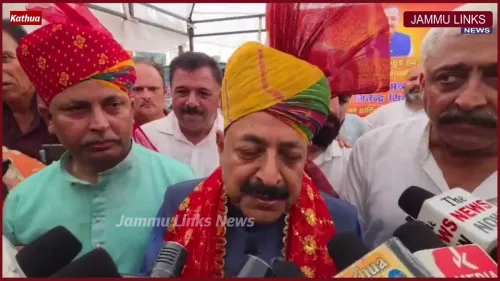
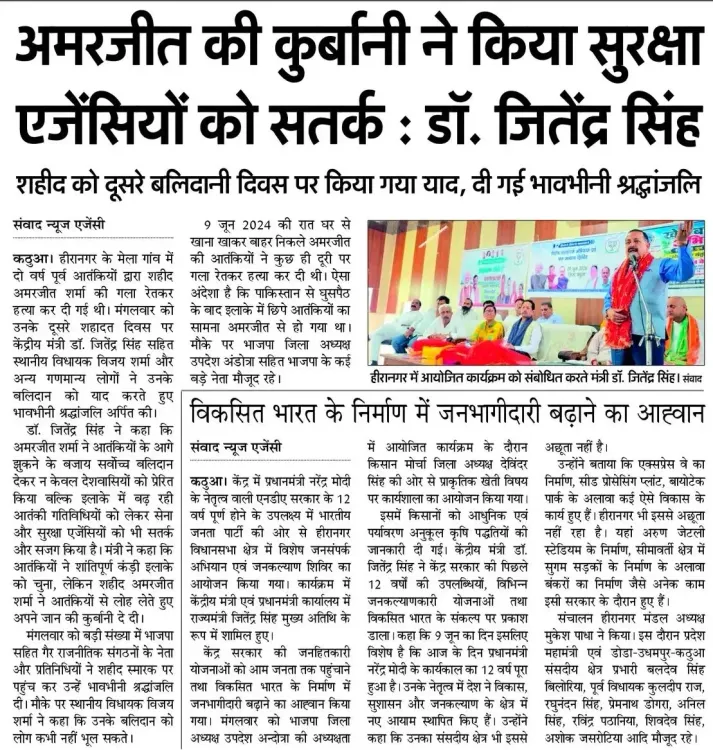
Union Science and Technology Minister Dr. Jitendra Singh on Wednesday, June 10, 2026, shared a report highlighting how the sacrifice of a local civilian named Amarjit in Kathua, Jammu and Kashmir, alerted security agencies to terrorist activities in the region.
Context
The post, shared from Dr. Jitendra Singh's official X account, references a report whose headline translates to: 'Amarjit ki kurbani ne aatanki gatividhiyon ko lekar suraksha ejensiyon ko kiya satark' ('Amarjit's sacrifice alerted security agencies to terrorist activities'). The minister's act of amplifying this report underscores the significance attached to local contributions in the ongoing counter-terrorism effort in Kathua district.
Kathua is a border district in the Jammu division of the Union Territory of Jammu and Kashmir, which has periodically witnessed infiltration attempts and the activation of militant modules along its frontier areas.
Policy Backdrop
Since the abrogation of Article 370 in August 2019 and the reorganisation of the erstwhile state into two Union Territories, the central government has significantly enhanced security force deployments and intelligence coordination across Jammu and Kashmir, including in districts such as Kathua.
Ministerial communication on social media highlighting local sacrifices and their role in triggering security alerts has become a recognisable feature of the post-2019 public narrative around counter-terrorism. Such posts are widely seen as reinforcing the message that ground-level intelligence, often sourced from civilians, remains central to disrupting terrorist networks.
Stakeholders and Impact
Security agencies operating in the Jammu division — including the J&K Police, Central Reserve Police Force (CRPF), and intelligence units — stand as the primary institutional stakeholders in any alert of this nature. For the residents of Kathua, the sacrifice of a local figure such as Amarjit carries deep community significance, symbolising civilian courage in a conflict-affected border district.
Dr. Jitendra Singh, who represents the Udhampur constituency in the Jammu region, has consistently used his public platform to acknowledge such acts of bravery and to draw national attention to security conditions in his home region. His post adds political visibility to an incident that might otherwise remain confined to local coverage.
What's Next
Observers will watch for any follow-up statements from the Ministry of Home Affairs or J&K Police regarding specific counter-terrorism operations or alerts linked to the Kathua incident. Parliamentary discussions on internal security in Jammu and Kashmir are also likely to reference ground-level intelligence contributions of this kind.
The broader pattern suggests that civilian sacrifices in border districts will continue to be woven into the official and political narrative around security in Jammu and Kashmir, reinforcing calls for sustained vigilance and inter-agency coordination along the region's porous frontier.
Point of View
He simultaneously honours local bravery and reinforces the narrative that civilian-security agency cooperation is delivering results in Jammu and Kashmir. This fits squarely into the post-2019 BJP-led government's messaging architecture, which frames the removal of Article 370 as having unlocked more effective security coordination in the region. For a minister who represents the Jammu region, such posts also serve a constituency-facing function, signalling continued attention to border-district security concerns. The broader implication is that ground-level sacrifices in districts like Kathua are increasingly being elevated to the national political conversation, raising the stakes for institutional follow-through.
NationPress
26 Oct 2026
Frequently Asked Questions
Who is Amarjit and what happened in Kathua?
Amarjit is a local figure in Kathua, Jammu and Kashmir, whose sacrifice reportedly alerted security agencies to terrorist activities in the district. Specific details of the incident have not been officially verified beyond the report shared by Dr. Jitendra Singh on June 10, 2026.
Why did Dr. Jitendra Singh post about Kathua?
Dr. Jitendra Singh shared a report about Amarjit's sacrifice to highlight civilian contributions to counter-terrorism efforts in Kathua, a border district in the Jammu division that he has long advocated for as a representative of the Jammu region.
What is the security situation in Kathua, Jammu and Kashmir?
Kathua is a border district in the Jammu division that has witnessed periodic infiltration attempts and militant activity. Since 2019, the central government has enhanced security deployments and intelligence coordination across Jammu and Kashmir, including in Kathua.
What role do civilians play in counter-terrorism in Jammu and Kashmir?
Civilians in border districts like Kathua have historically contributed to counter-terrorism by providing ground-level intelligence to security agencies. Incidents like Amarjit's sacrifice illustrate how local information can trigger formal security alerts.
What happened to Article 370 and how did it affect J&K security?
Article 370, which granted special status to Jammu and Kashmir, was abrogated in August 2019. Following this, the region was reorganised into two Union Territories and the central government significantly increased security force deployments and inter-agency intelligence coordination.