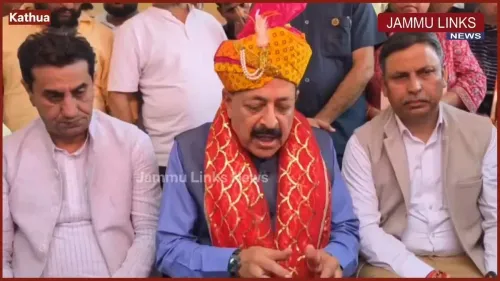
Dr. Jitendra Singh calls Kathua ideological fountainhead of BJS
Synopsis
Union Minister Dr. Jitendra Singh amplified a historical claim on 25 May 2026 that Kathua district in Jammu and Kashmir is the ideological fountainhead of the Bharatiya Jana Sangh, the direct predecessor of the BJP, linking the region's grassroots nationalist movement to the party's present-day governance agenda.
Key Takeaways
Jitendra Singh , Union Minister of State (Independent Charge) for Science and Technology, shared the post on 25 May 2026 .
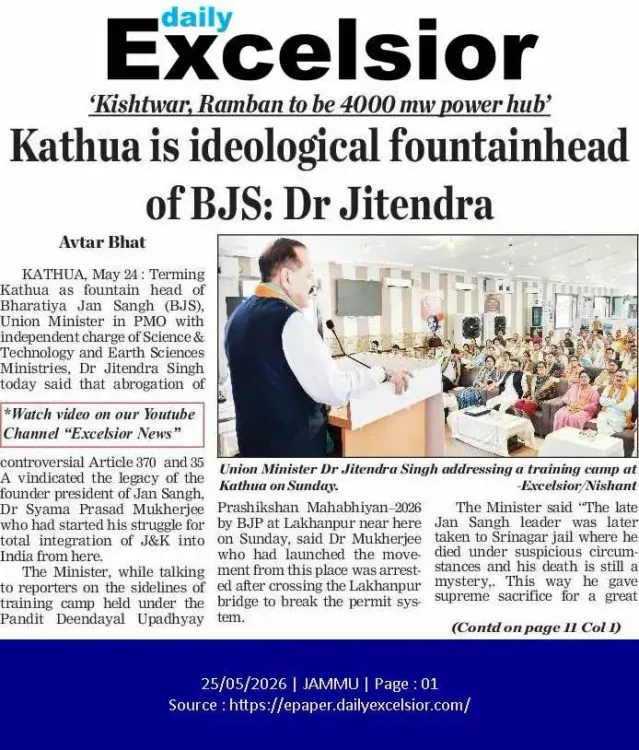
The shared article describes Kathua district as the ideological fountainhead of the Bharatiya Jana Sangh (BJS) .
The BJS was founded in 1951 by Syama Prasad Mookerjee and is the direct predecessor of the BJP .
A central BJS position — full integration of Jammu and Kashmir — was fulfilled with the revocation of Article 370 in 2019 .
The post is consistent with a post-2019 pattern of BJP messaging highlighting the party's historical footprint in the Jammu region.
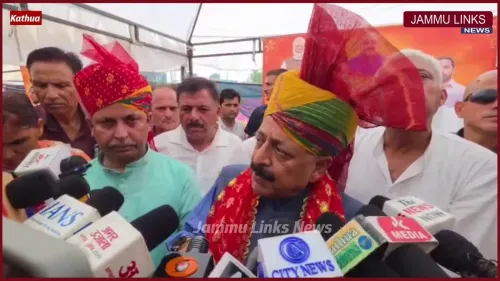
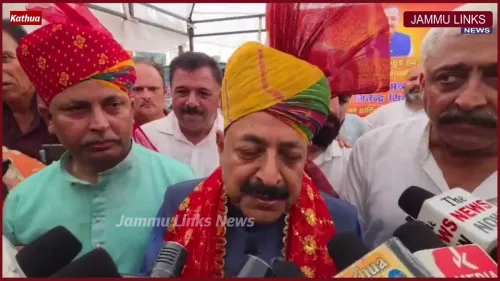
Union Science and Technology Minister Dr. Jitendra Singh on Monday, 25 May 2026 shared an article describing Kathua district in Jammu and Kashmir as the ideological fountainhead of the Bharatiya Jana Sangh (BJS), amplifying a historical claim about the region's centrality to the nationalist party that preceded the BJP.
Context
The post by Dr. Jitendra Singh, who represents the Jammu region politically and serves as Union Minister of State (Independent Charge) for Science and Technology and Earth Sciences, shared a piece from a Jammu-based English daily under the headline: 'Kathua is ideological fountainhead of BJS.' The minister did not add independent commentary, letting the headline and link stand as his endorsement of the historical framing.
Kathua, a district in the Jammu division, has long been cited in regional political discourse as a cradle of early Jana Sangh activity in the erstwhile state of Jammu and Kashmir.
Policy Backdrop
The Bharatiya Jana Sangh was founded in 1951 by Syama Prasad Mookerjee with an explicit focus on the fuller integration of Jammu and Kashmir with India — a position that remained a cornerstone of its successor, the BJP, for nearly seven decades. That ideological arc culminated in the revocation of Article 370 in 2019, which the BJP described as the fulfilment of a founding promise.
Tracing the party's roots to specific districts such as Kathua is part of a broader post-2019 effort to document and celebrate the historical political movements in the Jammu region that advocated for complete national integration long before it became government policy.
Stakeholders and Impact
BJP workers and party historians in the Jammu division are the primary audience for such messaging, which reinforces a sense of regional pride and ideological continuity. For the broader party, it serves as a reminder that the integration of Jammu and Kashmir was not a sudden political decision but the product of decades of grassroots ideological work anchored in districts like Kathua.
Historians and academics studying post-partition political movements in Jammu and Kashmir may also find the renewed public attention to early BJS activity in the region worth examining against archival records.
What's Next
The post may be a precursor to wider commemorations or publications marking BJS anniversaries or regional party-history programmes in Jammu. Dr. Jitendra Singh's consistent public messaging on the ideological heritage of the Jammu region suggests further events or statements linking the district's political legacy to the BJP's current governance agenda in the Union Territory are likely in the months ahead.
Point of View
Situating the Jammu region at the centre of the BJP's founding narrative. Coming in the post-2019 environment where Article 370's revocation is framed as ideological fulfilment, such messaging reinforces a continuity argument: that today's governance in Jammu and Kashmir is the logical conclusion of a seven-decade-old grassroots movement. For a minister who represents the Jammu constituency, it also serves a local identity function, elevating the region's historical contribution to national politics. Expect this historical framing to intensify ahead of any Jammu-focused political events or BJS anniversary commemorations.
NationPress
9 Oct 2026
Frequently Asked Questions
Why is Kathua called the ideological fountainhead of BJS?
Kathua district in Jammu is described as the ideological fountainhead of the Bharatiya Jana Sangh because of its early and active role in the party's grassroots nationalist movement in Jammu and Kashmir after BJS was founded in 1951.
What is the Bharatiya Jana Sangh?
The Bharatiya Jana Sangh (BJS) was a nationalist political party founded in 1951 by Syama Prasad Mookerjee. It is the direct predecessor of the Bharatiya Janata Party (BJP) and advocated for the full integration of Jammu and Kashmir with India.
What did Dr. Jitendra Singh post about Kathua?
On 25 May 2026, Dr. Jitendra Singh shared an article headlined 'Kathua is ideological fountainhead of BJS' along with the hashtags #Kathua and #JammuAndKashmir, highlighting the district's historical significance to the Jana Sangh movement.
How is BJS history connected to Article 370?
The BJS was founded partly to advocate for the complete integration of Jammu and Kashmir with India. The revocation of Article 370 in 2019 by the BJP government is widely described as the fulfilment of that founding ideological position.
Who is Dr. Jitendra Singh?
Dr. Jitendra Singh is the Union Minister of State (Independent Charge) for Science and Technology and Earth Sciences, and also holds charge in the Prime Minister's Office and the Ministry of Personnel. He politically represents the Jammu region.