Did the Higher Reaches of J&K Experience Light Snowfall While the Valley Plains Missed Out?
Click to start listening
Synopsis
Jammu and Kashmir's higher regions saw light snowfall, while the valley plains missed the season's first snow. A significant weather event is on the horizon, with moderate to heavy snowfall expected from January 22 to 24. The implications for agriculture and water resources are profound. Stay informed about this developing winter weather situation.
Key Takeaways
- Light snowfall occurred in higher regions of Jammu and Kashmir.
- The plains have yet to receive any snowfall this season.
- Moderate to heavy snowfall is forecasted from January 22 to 24.
- The lack of snow could impact water resources during summer.
- Travelers and farmers are advised to prepare accordingly.
Srinagar, Jan 17 (NationPress) While the higher elevations of Jammu and Kashmir recorded light snowfall, the plains of the Valley were left without the season's initial snowfall on Saturday.
Weather experts have predicted moderate to heavy snowfall across the Valley from January 22 to 24.
The Meteorological Department indicated that light to moderate snowfall was observed in the higher elevations over the past 12 hours, while the plains did not see any snowfall, disappointing many residents eagerly awaiting this season's first snowfall.
Due to an active Western Disturbance expected from the afternoon of January 22 to January 24, widespread rain and snow are anticipated.
“The Valley, including its plains, will experience moderate to heavy snowfall during this timeframe,” stated officials from the Meteorological Department.
Farmers have been advised to pause their farming activities during this period, while travelers should plan their journeys accordingly.
So far this winter, Srinagar city and other towns in the Valley have not experienced snowfall, as the 40-day-long period of severe winter known as 'Chillai Kalan' concludes on January 30.
A lack of significant snowfall during Chillai Kalan could lead to critical water shortages, as all water bodies in Jammu and Kashmir rely on this snowfall to replenish the essential reservoirs that support rivers, streams, lakes, wells, and springs during the summer months.
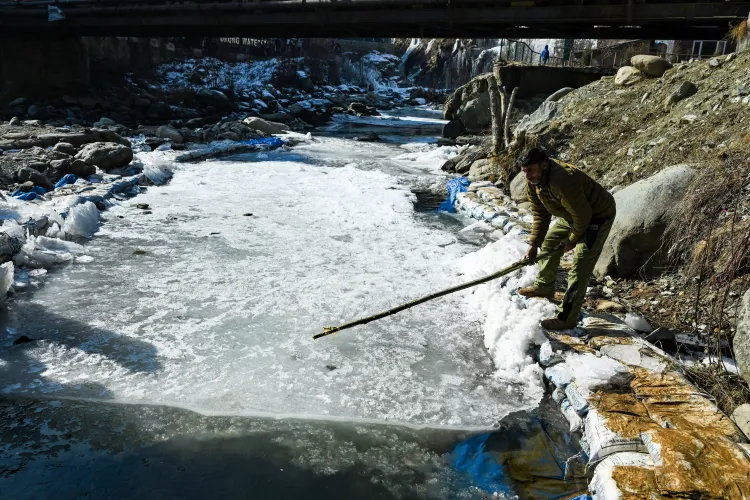
Major water bodies, including Dal Lake in Srinagar, have partially frozen, complicating navigation for fishermen and tourists.
Elders in the Valley have reported that they have never witnessed a Chillai Kalan devoid of snowfall in the plains.
Srinagar recorded a minimum temperature of -3.2 degrees Celsius, while Gulmarg saw -4.2 degrees Celsius, and Pahalgam -2.6 degrees Celsius.
The city of Jammu reported a minimum temperature of 4.6 degrees Celsius, Katra 7.4 degrees Celsius, Batote 5.7 degrees Celsius, Banihal 0.6 degrees Celsius, and Bhaderwah 1.5 degrees Celsius.
Point of View
The situation in Jammu and Kashmir regarding snowfall is concerning. The lack of snowfall in the plains during this critical winter period could lead to dire consequences for water supply during the warmer months. It is essential to closely monitor weather patterns and their impact on agriculture and water resources in the region.
NationPress
17/01/2026
Frequently Asked Questions
What is the expected snowfall in Jammu and Kashmir?
Moderate to heavy snowfall is anticipated from January 22 to 24.
How has the weather affected farmers in the Valley?
Farmers have been advised to halt farming activities due to the expected snowfall.
What is Chillai Kalan?
Chillai Kalan is a 40-day period of severe winter in Jammu and Kashmir, ending on January 30.
Why is snowfall important for Jammu and Kashmir?
Snowfall is critical for replenishing water bodies that sustain rivers, lakes, and streams during summer.
What were the recorded temperatures in Srinagar?
Srinagar recorded a minimum temperature of -3.2 degrees Celsius.