Joshi Cites CAG Report, Slams Karnataka Congress Over Gruha Lakshmi Lapses
Synopsis
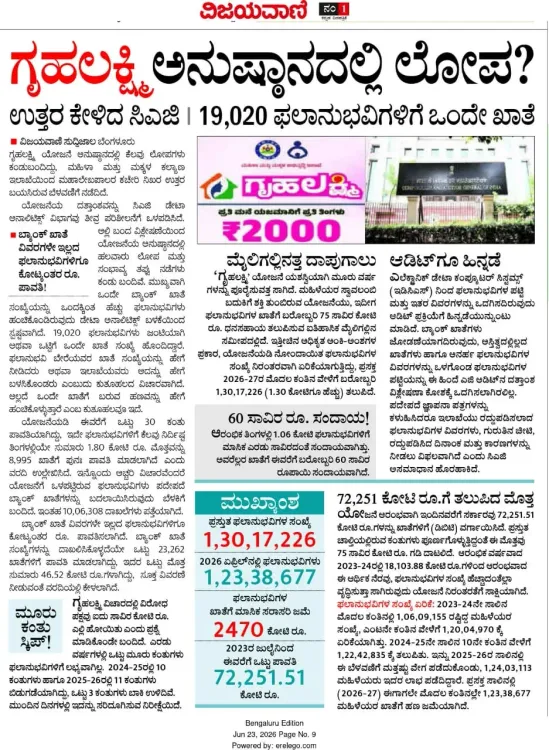
Union Minister Pralhad Joshi has cited a CAG report to allege that Karnataka's Congress government transferred Rs 46.52 crore to 23,262 bank accounts lacking basic details under Gruha Lakshmi Yojane, and linked 19,020 beneficiaries to a single account, calling it brazen misgovernance.
Key Takeaways
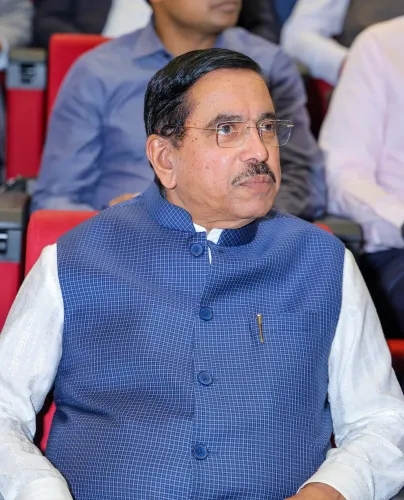
Pralhad Joshi , Union Minister and senior BJP leader from Karnataka , posted the allegations on June 23, 2026 .
A CAG report is cited as the source, alleging Rs 46.52 crore was paid to 23,262 accounts with missing bank details under Gruha Lakshmi Yojane .
19,020 beneficiaries were allegedly linked to a single bank account, with crores transferred jointly.
Joshi accused the Karnataka Congress government of implementing guarantees without any policy or regulatory framework.
The Karnataka Congress government has not yet formally responded to the specific CAG observations cited.
The controversy is part of a broader BJP narrative questioning the fiscal sustainability of Congress-run state welfare schemes.
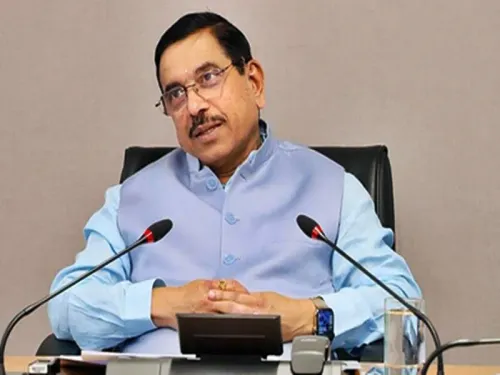
Union Consumer Affairs Minister Pralhad Joshi on Tuesday, June 23, 2026, launched a sharp attack on the Karnataka Congress government, citing a Comptroller and Auditor General (CAG) report to allege large-scale irregularities in the implementation of the state's flagship Gruha Lakshmi Yojane welfare scheme.
What Joshi Alleged
Posting in Kannada on X, Joshi accused the Congress administration of bringing the state to the brink of financial ruin through what he called 'unscientific guarantees' rolled out without any policy framework. ('ಅವೈಜ್ಞಾನಿಕ ಗ್ಯಾರಂಟಿಗಳನ್ನೇ ಬಂಡವಾಳ ಮಾಡಿಕೊಂಡು' — 'having capitalised on unscientific guarantees'), he wrote, adding that the government had 'bankrupted the state and looted public money brazenly.'
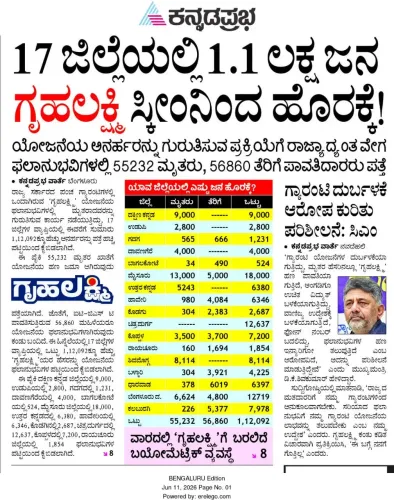
The minister specifically pointed to two sets of figures attributed to the CAG report. He alleged that under Gruha Lakshmi Yojane, payments worth crores of rupees were routed jointly to a single bank account linked to 19,020 beneficiaries. He further alleged that Rs 46.52 crore was transferred in haste to 23,262 accounts that lacked even basic bank-account details, without adequate verification of beneficiaries.
Context: Karnataka's Guarantee Schemes
The Karnataka Congress government, which came to power in May 2023 after winning the state assembly elections on a platform of five welfare guarantees, has positioned these schemes as direct support to households across the state. Gruha Lakshmi Yojane provides monthly financial assistance to women heads of households and is among the most visible of the five guarantees.
The scheme has been both a political flagship and a point of fiscal contention, with the opposition repeatedly questioning its delivery mechanism and the state's ability to sustain the expenditure. Joshi, a senior BJP leader from Karnataka, has been among the most vocal central ministers in scrutinising the Congress administration in his home state.
Policy Backdrop: CAG as a Political and Audit Instrument
The Comptroller and Auditor General of India is a constitutional authority that audits central and state government accounts, and its reports are tabled in the respective legislatures. CAG observations on welfare scheme implementation — covering issues such as beneficiary verification, direct-benefit-transfer compliance, and financial controls — carry statutory weight and are routinely cited by opposition parties.
At the national level, the BJP has consistently contrasted its direct-benefit-transfer architecture with what it characterises as leakage-prone state-level welfare delivery in Congress-governed states. Joshi's post fits squarely within this broader political pattern, using an audit finding to question not just implementation quality but the fiscal prudence of the entire guarantee model.
Stakeholders and Impact
The primary stakeholders are Karnataka's women beneficiaries enrolled under Gruha Lakshmi Yojane, whose entitlements and the integrity of their accounts are at the centre of the allegations. If the CAG observations cited by Joshi are borne out in the full report, they would raise questions about the robustness of the state's beneficiary-management system.
The Karnataka exchequer is also a key stakeholder: the state's fiscal position has been a recurring point of debate, with the ruling Congress maintaining that the guarantees are fully funded while the opposition argues they are straining public finances. Any formal audit indictment could have implications for the state's credit profile and future welfare outlays.
What's Next
The Karnataka government is yet to formally respond to the specific CAG observations cited in Joshi's post. The opposition is likely to press for a detailed discussion when the CAG report is taken up in the state legislature. Whether the government tables a point-by-point rebuttal or initiates a corrective audit of the accounts in question will determine the political and administrative trajectory of this controversy.
Point of View
Lending it a layer of statutory credibility beyond ordinary partisan criticism. The specific figures cited (Rs 46.52 crore, 23,262 incomplete accounts, 19,020 beneficiaries on one account) are designed to make the allegation concrete and verifiable, raising the political cost of a non-response from the Karnataka government. This fits a wider BJP strategy of using audit findings to question the direct-benefit-transfer hygiene of Congress-governed states, particularly ahead of any electoral cycle in Karnataka. The Congress will need to either rebut the numbers with its own data or demonstrate corrective action to neutralise the narrative.
NationPress
22 Sept 2026
Frequently Asked Questions
What did Pralhad Joshi say about Karnataka's Gruha Lakshmi Yojane?
Joshi alleged, citing a CAG report, that Rs 46.52 crore was paid to 23,262 accounts lacking basic bank details, and that 19,020 beneficiaries were linked to a single bank account under the Gruha Lakshmi Yojane scheme.
What is Gruha Lakshmi Yojane in Karnataka?
Gruha Lakshmi Yojane is a Karnataka state scheme that provides monthly financial assistance to women heads of households. It is one of five welfare guarantees on which the Congress party won the 2023 Karnataka assembly elections.
What does the CAG report say about Karnataka's welfare schemes?
According to Joshi's post, the CAG report found that funds were transferred to accounts with incomplete details and that a large number of beneficiaries were linked to a single bank account under Gruha Lakshmi Yojane, raising questions about beneficiary verification.
Has the Karnataka government responded to these CAG findings?
As of June 23, 2026, the Karnataka Congress government had not issued a formal response to the specific CAG observations cited by Joshi in his post.
Why is the BJP citing CAG reports against Karnataka's Congress government?
The BJP has consistently used CAG audit findings to question the implementation quality and fiscal sustainability of welfare schemes in Congress-ruled states, contrasting them with the central government's direct-benefit-transfer systems.