Pralhad Joshi Pays Tribute to Dharmendra Pradhan on Stepping Down
Synopsis
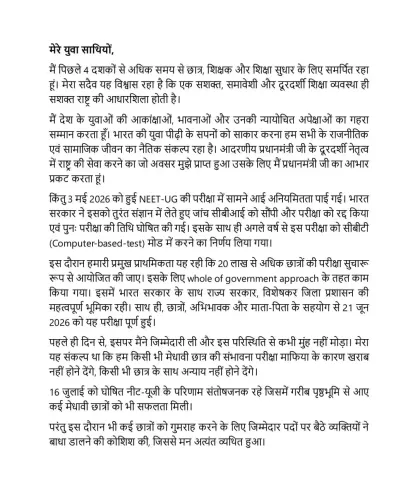
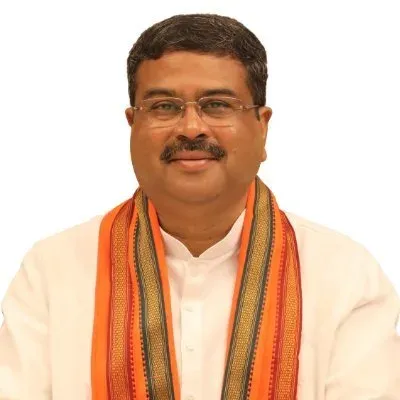
Union Consumer Affairs Minister Pralhad Joshi on 25 July 2026 paid tribute to Dharmendra Pradhan on his stepping down, praising his decades of service and the implementation of the National Education Policy 2020 during his tenure as Education Minister.
Key Takeaways
Pralhad Joshi posted a tribute to Dharmendra Pradhan on 25 July 2026 as Pradhan stepped down from his ministerial role.
Joshi credited Pradhan with 'successful implementation of NEP 2020 ' during his tenure as Union Minister of Education.
The National Education Policy 2020 replaced the 1986 policy and restructured school, higher, and vocational education across India.
Joshi stated Pradhan's resignation 'does not in any way stop him from contributing to the Nation's development.' Attention now shifts to the appointment of Pradhan's successor and continuity of pending NEP implementation steps.
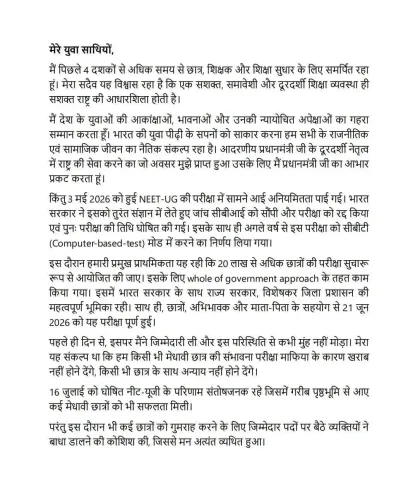
Union Consumer Affairs Minister Pralhad Joshi on Saturday, 25 July 2026 paid tribute to senior BJP leader Dharmendra Pradhan, acknowledging his decades-long political career and his stewardship of education reforms, including the rollout of the National Education Policy 2020, as Pradhan stepped down from his ministerial role.
Context
Joshi, writing on X, said Pradhan's 'commitment to the development of the Nation will always be remembered' and that his 'decision to step down does not in any way stop him from contributing to the Nation's development.' The tribute underscores the significance attached to Pradhan's exit within BJP circles, with Joshi closing with the line: 'Our paths will cross again in the line of development of the Nation.'
Dharmendra Pradhan served as Union Minister of Education from 2021 and was among the most prominent faces associated with implementing the National Education Policy 2020, a sweeping framework approved by the Union Cabinet in July 2020 to replace the 1986 National Policy on Education.
Policy Backdrop
The National Education Policy 2020 represents the most comprehensive restructuring of India's education system in over three decades, covering school education, higher education, and vocational training. It introduced a new 5+3+3+4 curricular structure, emphasis on mother-tongue instruction in early years, and a revamped regulatory architecture for higher education institutions.
Joshi's post credits Pradhan's tenure with 'successful implementation of NEP 2020 along with over 100 big and small reforms in the field of education.' While the breadth of reforms undertaken during Pradhan's tenure in the Education Ministry is widely acknowledged, NationPress is not independently verifying the specific count of reforms cited in the post.
Stakeholders and Impact
The NEP 2020 directly affects millions of students, teachers, and educational institutions across India, from primary schools to central universities. Regulatory bodies such as the University Grants Commission and the National Council of Educational Research and Training have been central to translating the policy into operational guidelines.
Pradhan's departure raises questions about the pace and continuity of pending NEP implementation steps, including curriculum overhauls at the state level and the operationalisation of the proposed Higher Education Commission of India. Stakeholders in the education sector will be watching closely to see whether the incoming leadership sustains the reform momentum.
What's Next
Attention will now turn to the formal announcement of Pradhan's successor at the Education Ministry and the new leadership's stated priorities on NEP implementation. Within the BJP, such transitions are typically accompanied by public assurances of policy continuity, a pattern reflected in Joshi's own tribute.
Pradhan himself remains a senior figure within the party, and Joshi's remark that 'our paths will cross again' signals an expectation of continued engagement in national development work, whether in a party or public capacity.
Point of View
In this case the National Education Policy 2020. The warm tone and forward-looking close — 'our paths will cross again' — suggest Pradhan's exit is framed within the party as a transition rather than a departure, keeping his political capital intact. For the Education Ministry, the real test will be whether the incoming leadership sustains the regulatory and curricular momentum NEP 2020 requires. Cabinet reshuffles in the education portfolio have historically created implementation lags, a risk that stakeholders will be alert to in the weeks ahead.
NationPress
24 Oct 2026
Frequently Asked Questions
Why did Dharmendra Pradhan step down as Education Minister?
The specific reason for Dharmendra Pradhan stepping down has not been officially stated in the post or verified public record as of this report. The development is widely understood to be part of a cabinet reshuffle.
What is the National Education Policy 2020?
The National Education Policy 2020 is a landmark framework approved by the Union Cabinet in July 2020 , replacing the 1986 policy. It restructures school, higher, and vocational education, introducing a new curricular structure and revised regulatory bodies.
What did Pralhad Joshi say about Dharmendra Pradhan?
Pralhad Joshi praised Pradhan's 'illustrious political career spanning decades' and credited him with the successful implementation of NEP 2020 . He added that Pradhan's decision to step down would not stop him from contributing to national development.
Who will replace Dharmendra Pradhan as Education Minister?
As of this report, no formal announcement has been made regarding Pradhan's successor at the Union Education Ministry . An official appointment is expected to follow the cabinet reshuffle.
What reforms did Dharmendra Pradhan carry out in education?
During his tenure as Union Minister of Education from 2021 , Pradhan oversaw the implementation of NEP 2020 , which introduced a new school curriculum structure, mother-tongue-based early education, and higher education regulatory reforms. The post by Joshi references 'over 100 big and small reforms,' though this specific figure is unverified independently.