Pralhad Joshi Pays Tribute to Vachana Scholar F.G. Halakatti
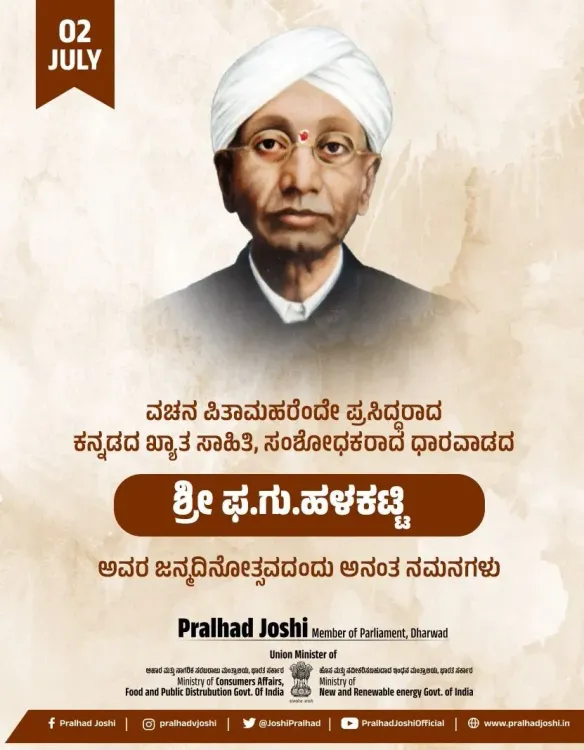
Synopsis
Union Minister Pralhad Joshi marked the birth anniversary of F.G. Halakatti, the Kannada scholar titled Vachana Pitamaha, praising his work in rescuing 12th-century Sharana Vachanas from extinction and his service as president of the Karnataka Ekikarana Parishat, Akhila Bharata Veerashaiva Mahasabha, and the 12th Kannada Sahitya Sammelana.
Key Takeaways
Union Minister Pralhad Joshi paid tribute to F.G.
Halakatti on his birth anniversary on 2 July 2026 .
Halakatti is honoured as Vachana Pitamaha for compiling and printing thousands of 12th-century Sharana Vachanas that were at risk of being lost.
He served as president of the Karnataka Ekikarana Parishat , the Akhila Bharata Veerashaiva Mahasabha , and the 12th Kannada Sahitya Sammelana .
The British Indian government conferred the Rao Bahadur title on Halakatti for his contributions to research, journalism, and literature.
Halakatti's multi-faceted career spanned law, research, education, politics, and the cooperative sector.
His preservation work remains foundational to Kannada literary scholarship and the Veerashaiva-Lingayat cultural tradition.
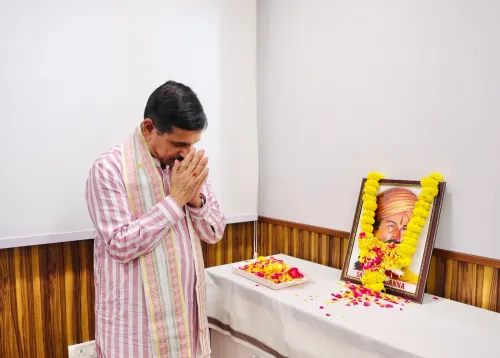
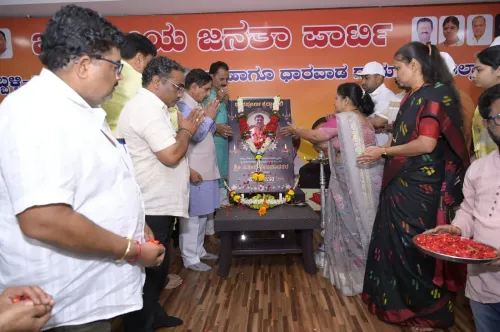
Union Consumer Affairs Minister Pralhad Joshi on Thursday, 2 July 2026, paid tribute to F.G. Halakatti, the revered Kannada scholar known as Vachana Pitamaha (Father of Vachana Literature), on the occasion of his birth anniversary, honouring the scholar's lifelong contribution to preserving Karnataka's 12th-century Sharana literary heritage.
Context
Posting in Kannada on X, Minister Joshi described Halakatti as 'an eternal source of inspiration' who served society as a lawyer, researcher, educationist, politician, and cooperative sector worker. He wrote that Halakatti's contribution — 'seva karya aganita' (service beyond measure) — in promoting Sharana literature was immeasurable. The minister specifically noted that Halakatti 'printed and preserved Vachanas that were on the verge of extinction,' a feat that secured an irreplaceable corpus of medieval Kannada devotional poetry for future generations.
Policy Backdrop
F.G. Halakatti compiled, edited, and published thousands of Vachanas — lyrical compositions by 12th-century Sharana saints including Basavanna — at a time when the manuscripts faced the real risk of being lost. His editorial and scholarly labour earned him the title Vachana Pitamaha, meaning the patriarch of Vachana literature. The British Indian government recognised his contributions to research, journalism, and literature with the honorary Rao Bahadur title, awarded for distinguished public service.
Halakatti also served as president of three prominent institutions: the Karnataka Ekikarana Parishat, which campaigned for the unification of Kannada-speaking territories before independence; the Akhila Bharata Veerashaiva Mahasabha, the pan-India apex body of the Veerashaiva-Lingayat community; and the 12th Kannada Sahitya Sammelana, the prestigious annual conclave of Kannada writers and intellectuals. The Karnataka Ekikarana Parishat's advocacy was ultimately vindicated with the States Reorganisation Act of 1956, which unified Kannada-speaking regions into the state of Karnataka.
Stakeholders and Impact
Halakatti's preservation work holds enduring significance for the Veerashaiva-Lingayat community, one of Karnataka's most influential socio-religious groups, as well as for the broader Kannada literary world. The Vachanas he rescued from obscurity are today studied in universities and recited in religious settings across Karnataka and beyond. His scholarship helped establish Vachana literature as a distinct and celebrated strand of Indian devotional writing.
For Karnataka's political landscape, marking the birth anniversaries of such scholars carries symbolic weight. Senior leaders from the state, cutting across parties, regularly pay public tribute to figures who shaped Kannada cultural identity — a practice that underscores the intersection of literary heritage and political identity in the region.
What's Next
The tribute by a senior Union minister draws fresh attention to ongoing discussions around state and central government support for Vachana manuscript digitisation and the publication of classical Kannada texts. The next annual Kannada Sahitya Sammelana is expected to once again spotlight the preservation of Karnataka's medieval literary legacy. Scholars and community organisations are likely to renew calls for a dedicated digital archive of Halakatti's compiled Vachana corpus, building on the foundation he laid over a century ago.
Point of View
Directed squarely at the Veerashaiva-Lingayat community — a numerically and politically significant constituency in the state. By invoking Halakatti's role in Karnataka's unification movement alongside his Sharana literary legacy, the minister links regional identity, religious heritage, and national belonging in a single gesture. Such tributes from Union ministers also serve to keep the Centre's visibility alive in Karnataka's cultural calendar, particularly ahead of any electoral cycle. The renewed attention may also nudge government agencies toward concrete action on Vachana manuscript digitisation, an area where policy intent has historically outpaced delivery.
NationPress
1 Oct 2026
Frequently Asked Questions
Who is F.G. Halakatti and why is he called Vachana Pitamaha?
F.G. Halakatti was a Kannada scholar, lawyer, and educationist who compiled, edited, and published thousands of 12th-century Sharana Vachanas that were at risk of being lost forever. His monumental work in rescuing and printing this devotional literature earned him the title Vachana Pitamaha, meaning the patriarch or grandfather of Vachana literature.
What did Pralhad Joshi say about F.G. Halakatti?
Minister Pralhad Joshi posted in Kannada on X, describing Halakatti as an eternal source of inspiration who served as a lawyer, researcher, educationist, politician, and cooperative sector worker. He praised Halakatti for printing and preserving Vachanas on the verge of extinction and called his contribution to Sharana literature immeasurable.
What is the Rao Bahadur title that Halakatti received?
Rao Bahadur was an honorary title awarded by the British Indian government to individuals for distinguished public service. F.G. Halakatti received this title in recognition of his contributions to research, journalism, and Kannada literature.
What is the Karnataka Ekikarana Parishat?
The Karnataka Ekikarana Parishat was a pre-independence organisation that campaigned for the unification of all Kannada-speaking territories into a single state. Its advocacy contributed to the formation of the unified state of Karnataka under the States Reorganisation Act of 1956. F.G. Halakatti served as its president.
What is the Kannada Sahitya Sammelana?
The Kannada Sahitya Sammelana is an annual gathering of Kannada writers, scholars, and literary figures, considered the premier event in the Kannada literary calendar. F.G. Halakatti presided over its 12th session, a mark of his stature in the Kannada intellectual world.