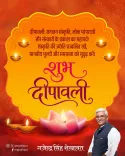
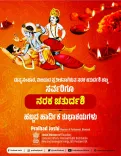
Pralhad Joshi's Diwali Wishes Invoke Viksit Bharat Vision
Synopsis
Union Consumer Affairs Minister Pralhad Joshi marked Diwali 2026 with a multilingual message in English, Sanskrit, and Kannada, linking the festival of lights to the BJP government's Viksit Bharat 2047 vision of a developed India.
Key Takeaways
Union Minister Pralhad Joshi posted Diwali greetings on 8 November 2026 .
The message was multilingual — English, Kannada, and Sanskrit — reflecting both national and regional outreach.
Joshi explicitly linked Diwali's symbolism to the Viksit Bharat @2047 government vision.
The Viksit Bharat goal — making India a developed nation by 2047 — was articulated by PM Narendra Modi in 2023.
The post included traditional Sanskrit and Kannada verses saluting the lamp as a symbol of knowledge, divinity, and victory of good over evil.
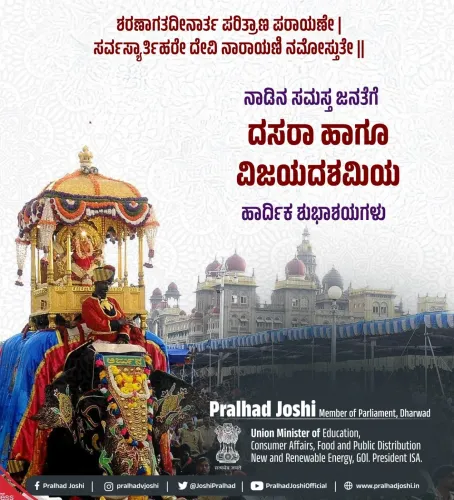
On the auspicious occasion of Diwali 2026, Union Consumer Affairs Minister Pralhad Joshi extended warm wishes to the nation, weaving together ancient Sanskrit and Kannada verses with a call for unity and collective progress toward a developed India.
Light as metaphor — and a national mission
Joshi's message opened with a Sanskrit invocation — 'Shubham Karoti Kalyanam' — a traditional Diwali prayer that salutes the lamp as a destroyer of ignorance and an embodiment of the divine. He paired it with Kannada verses wishing the people of the country happiness, peace, prosperity, and renewed hope, underscoring his roots as a senior BJP leader from Karnataka.
The English portion of the post framed Diwali's symbolism in explicitly national terms: 'May the divine light of this festival illuminate every home with happiness, peace and prosperity, inspiring us to uphold the values of unity, harmony and collective progress as we work towards building a #ViksitBharat.' The hashtag is not incidental — it anchors a cultural moment to a stated government ambition.
Viksit Bharat @2047 — the goal behind the greeting
The Viksit Bharat vision — making India a fully developed nation by 2047, the centenary of independence — was articulated by Prime Minister Narendra Modi in 2023 and has since become a recurring frame for BJP-led government communication. Invoking it on Diwali is deliberate: the festival of lights, traditionally marking the triumph of dharma over adharma and knowledge over ignorance, maps naturally onto the rhetoric of national transformation.
Joshi's Kannada lines make this explicit — 'adharmavannu dharma gellali, kattaleyanu belaku gellali, ajnanada viruddha jnanada gellu' (let righteousness triumph over unrighteousness, let light conquer darkness, let knowledge defeat ignorance) — before turning to the aspiration that the festival fill every life with joy and peace.
A pattern of festive outreach with a policy undertone
Indian cabinet ministers routinely use major festivals for public outreach on social media, and Diwali — the most widely observed festival across the country — draws the densest volume of such messages. What distinguishes this post is the bilingual reach: English for a national audience, Kannada for his home constituency, and Sanskrit verses that carry pan-Indian cultural resonance. It is a calibrated communication that speaks to multiple publics simultaneously.
As fireworks light up the sky across India, Joshi's message is a reminder that for the BJP, every festival is also a conversation about where the country is headed — and by when.
Point of View
Kannada, English) is also politically shrewd: it signals civilisational continuity, regional identity, and national ambition in a single post. For a senior Karnataka leader ahead of any state political cycle, the Kannada verses serve as a direct constituency signal. The broader pattern suggests that for the ruling party, festival greetings are not ceremonial noise but a consistent, low-cost instrument of brand reinforcement around its flagship development narrative.
NationPress
8 Nov 2026
Frequently Asked Questions
What did Pralhad Joshi post for Diwali 2026?
Pralhad Joshi posted multilingual Diwali greetings in English, Kannada, and Sanskrit, wishing citizens happiness, peace, and prosperity while linking the festival to the Viksit Bharat 2047 national vision.
What is Viksit Bharat that Joshi mentioned in his Diwali message?
Viksit Bharat is the BJP-led central government's vision to make India a fully developed nation by 2047, the centenary of independence. It was articulated by Prime Minister Narendra Modi in 2023.
What do the Sanskrit verses in Joshi's Diwali post mean?
The Sanskrit verses are traditional Diwali prayers saluting the lamp as a bringer of auspiciousness, health, and wealth, and as a destroyer of ignorance and enmity — invoking the divine presence in the festival's light.
Why did Pralhad Joshi post in Kannada for Diwali?
Joshi is a senior BJP leader from Karnataka, and posting in Kannada allows him to directly connect with his home state constituency while also reaching a national audience through English and Sanskrit.
Is it common for Indian ministers to link Diwali greetings to government schemes?
Yes. Indian cabinet ministers frequently use major festivals like Diwali for social media outreach that blends traditional wishes with references to government priorities, a pattern particularly visible among BJP leaders who regularly invoke the Viksit Bharat vision.