Karnataka CM Office Pays Tribute to Gokak on Birth Anniversary
Synopsis
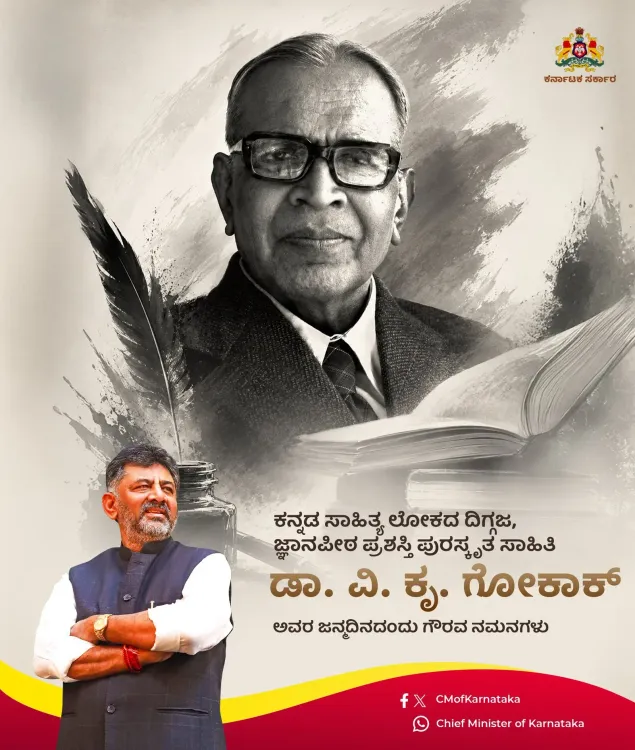
On Dr. Vinayak Krishna Gokak's birth anniversary, Karnataka's Chief Minister's Office paid tribute to the Jnanpith laureate whose 1981 report and the resulting 1982 Gokak Movement compelled the state to mandate Kannada instruction in all schools from Class 3 to Class 10 — a landmark in India's language-rights history.
Key Takeaways
Vinayak Krishna Gokak was a Jnanpith award-winning Kannada poet and the chair of the committee that produced the landmark Gokak Report.
The Gokak Report (1981) recommended compulsory Kannada instruction from Class 3 to Class 10 in all Karnataka schools, including non-Kannada-medium institutions.
The Gokak Chaluvali (1982) was a mass street movement by Kannadigas demanding implementation of the report — described as an unprecedented language revolution in Karnataka's history.
The movement succeeded: Karnataka enacted a policy making Kannada a mandatory subject in all state schools across the specified classes.
The Chief Minister's Office of Karnataka marked Gokak's birth anniversary on 9 August 2026 with a formal tribute on X.
A Jnanpith laureate who turned a government report into a street revolution — on his birth anniversary, the Chief Minister's Office of Karnataka honoured Dr. Vinayak Krishna Gokak, the poet and scholar whose name became a rallying cry for Kannada identity across the state.
The poet behind the protest movement
Dr. Vinayak Krishna Gokak was not merely a literary figure. As chair of a state-appointed committee, he submitted the Gokak Report in 1981, recommending that Kannada be made a compulsory subject from Class 3 to Class 10 in all schools across Karnataka — including institutions that taught in other languages. The recommendation was straightforward; its implementation was anything but.
When Karnataka took to the streets
The government's reluctance to act on the report ignited the Gokak Chaluvali — the Gokak Movement — of 1982, described by the CMO as an unprecedented language revolution (ಅಭೂತಪೂರ್ವ ಭಾಷಾ ಕ್ರಾಂತಿ) in Karnataka's history. Kannadigas across the state, speaking with one voice (ಒಕ್ಕೊರಲಿನಿಂದ), poured into the streets in a mass agitation that stands among the most organised language movements in post-independence India. The pressure worked. The state government enacted the compulsory Kannada instruction policy, making the language a mandatory subject in non-Kannada-medium schools from Class 3 through Class 10.
A legacy written into classrooms
The CMO's tribute notes that Gokak's contributions to the survival and future of the state's language remain forever memorable. That is not sentiment — it is statutory fact. Millions of students in Karnataka, regardless of the medium of their schooling, have learned Kannada in a classroom because of a movement that bears one man's name. In a multilingual federal country where regional languages have repeatedly had to fight for space, the Gokak Movement's concrete, lasting outcome sets it apart.
On his birth anniversary, the movement's architect is remembered not just as a Jnanpith-winning poet, but as the unlikely catalyst of a language policy that has endured for over four decades.
Point of View
A consensus forged under street pressure in 1982 and still constitutionally sensitive. Karnataka's ruling establishment has consistently used Gokak anniversary moments to signal continuity on language policy, particularly as debates over the National Education Policy's three-language formula resurface. The tribute also implicitly frames the Gokak Movement as a template: that popular mobilisation, not just legislative intent, is what secures language rights. In a state where Kannada identity politics remains electorally potent, the gesture carries weight well beyond the literary.
NationPress
23 Sept 2026
Frequently Asked Questions
Who was Dr. Vinayak Krishna Gokak?
Dr. Vinayak Krishna Gokak was a celebrated Kannada poet and scholar who received the Jnanpith Award — India's highest literary honour — for his contributions to Kannada literature. He also chaired the government committee that produced the Gokak Report on language education in Karnataka.
What was the Gokak Report?
The Gokak Report, submitted in 1981 , was a set of official recommendations by a Karnataka government committee chaired by Dr. Gokak. It advocated making Kannada a compulsory subject from Class 3 to Class 10 in all schools in the state, including those teaching in other languages.
What was the Gokak Movement or Gokak Chaluvali?
The Gokak Chaluvali was a mass protest movement in 1982 in which Kannadigas took to the streets demanding that the state government implement the Gokak Report. It is regarded as one of the most significant and successful language agitations in post-independence India, resulting in the mandatory Kannada instruction policy.
What was the outcome of the Gokak Movement?
As a direct result of the Gokak Movement, the Karnataka government made Kannada a compulsory subject from Class 3 to Class 10 in all state schools, including non-Kannada-medium institutions. This policy has remained in force for over four decades.
Why did Karnataka's CMO post a tribute to Gokak in 2026?
The Chief Minister's Office of Karnataka posted the tribute on 9 August 2026 to mark the birth anniversary of Dr. Vinayak Krishna Gokak, honouring his literary legacy and his foundational role in securing Kannada's place in the state's school curriculum.