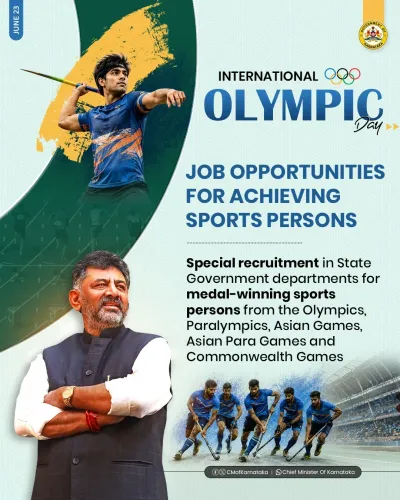
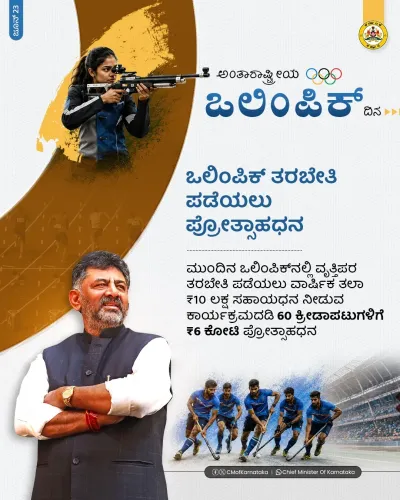
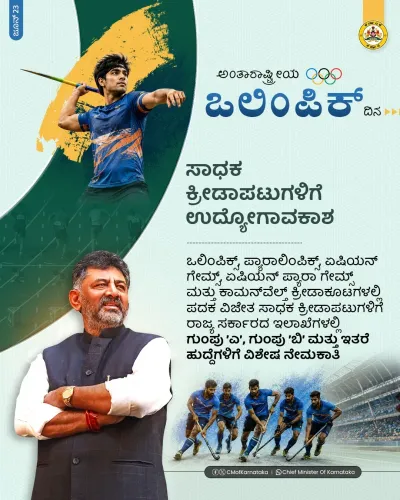
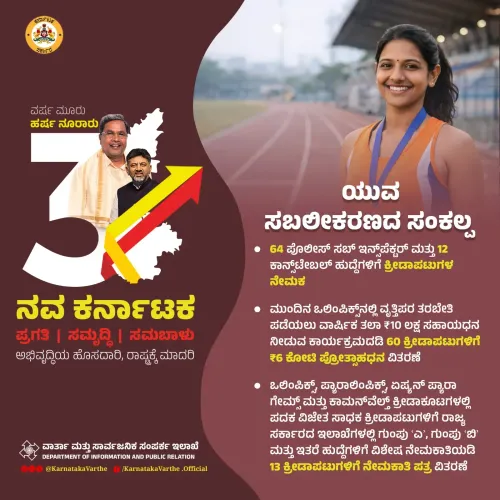
Karnataka reserves 3% police posts for international medal winners
Synopsis
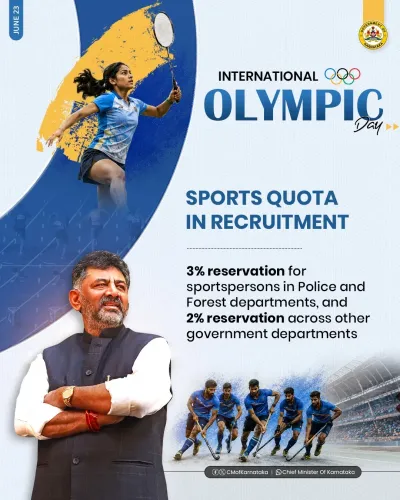
The Chief Minister's Office of Karnataka confirmed that the state has reserved 3% of Karnataka Police Department posts and 2% of other department posts for direct recruitment of athletes who win medals at international sporting competitions, reaffirming the policy on International Olympic Day, June 23, 2026.
Key Takeaways
The Government of Karnataka has decided to directly recruit medal-winning athletes from international sporting events into state government service.
The Karnataka Police Department has reserved 3% of its posts specifically for such athletes.
All other state departments have reserved 2% of their posts for international medal-winning sportspersons.
The announcement was made on International Olympic Day, June 23, 2026 , and tagged under the #GuaranteeSarkara campaign.
The policy aligns with long-standing central government guidelines encouraging states to reserve 1–2% of public employment for sportspersons, with Karnataka exceeding that floor in the police department.
Formal recruitment notifications specifying eligible competitions and post categories are awaited from relevant departments.
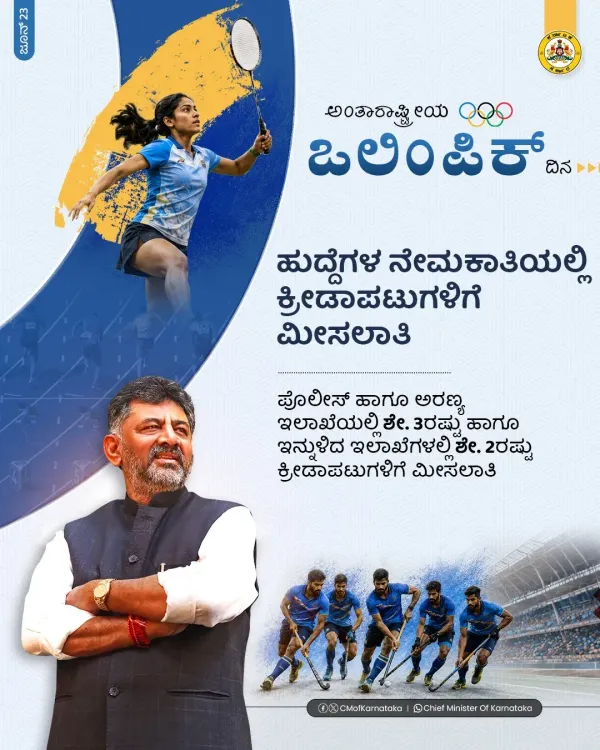
The Chief Minister's Office of Karnataka announced on Tuesday, June 23, 2026 that the state government has decided to directly recruit medal-winning athletes from international sporting events into government service, reserving 3% of posts in the Karnataka Police Department and 2% of posts in other state departments for such sportspersons.
The official post, shared in Kannada, stated: 'ಅಂತಾರಾಷ್ಟ್ರೀಯ ಕ್ರೀಡಾಕೂಟಗಳಲ್ಲಿ ಪದಕ ವಿಜೇತ ಕ್ರೀಡಾಪಟುಗಳಿಗೆ ಪೊಲೀಸ್ ಇಲಾಖೆಯಲ್ಲಿ ನೇರ ನೇಮಕಾತಿ' ['direct recruitment of medal-winning athletes from international competitions into the police department']. The government noted the decision had already been taken and the quota allocations were in place.
Context
The announcement was tagged with #InternationalOlympicDay and #GuaranteeSarkara, positioning the policy as part of the ruling government's broader commitment to fulfilling electoral guarantees. International Olympic Day is observed every year on June 23 to mark the founding of the International Olympic Committee in 1894.
The Karnataka government's move to publicly reaffirm this policy on Olympic Day signals an intent to link sports welfare with the state's governance agenda, offering athletes a concrete career pathway beyond competitive sport.
Policy Backdrop
Central government guidelines dating to the 1990s have long encouraged states to reserve 1–2% of public-sector vacancies for sportspersons who win medals at recognised international competitions. Karnataka's new framework goes further, assigning a higher 3% quota specifically to the Police Department while maintaining a 2% reservation across all other state departments.
Multiple Indian states already maintain sports quotas ranging between 2% and 5% in government recruitment, a mechanism designed to provide post-career financial stability to athletes who often have limited earning windows. Karnataka's differentiated approach — a higher share for police — is consistent with the department's tradition of absorbing athletes into its cadre, where physical fitness standards align with sporting backgrounds.
Stakeholders and Impact
The primary beneficiaries are medal-winning athletes who have represented India or Karnataka at international sporting events. For many athletes, especially those from economically weaker backgrounds, a guaranteed government job represents a safety net that allows them to pursue competitive sport without financial anxiety.
The policy also affects the broader pool of state government job applicants, as the reserved quota reduces the number of open-competition posts. However, such quotas are standard practice across Indian states and are generally accepted as a legitimate form of sports promotion. Recruitment notifications specifying eligible competitions and post categories will be the next critical step for athletes seeking to benefit from the scheme.
What's Next
The immediate priority will be the publication of formal recruitment notifications by the Karnataka Police Department and other state departments, detailing which international competitions qualify, the rank of medal required, and the categories of posts available under the 3% and 2% quotas.
Watchers of Karnataka's sports and employment policy will track how many posts are actually filled under this scheme in the next hiring cycles, as the gap between announced quotas and actual recruitment has historically been a point of scrutiny in similar state-level programmes across India.
Point of View
Tying a welfare policy to the ruling government's 'Guarantee Sarkara' brand. The differentiated quota — a higher 3% for police versus 2% elsewhere — reflects a pragmatic acknowledgement that law-enforcement roles are a natural fit for athletes and carry strong social prestige in Karnataka. More broadly, this move fits a national pattern where state governments use sports quotas as low-cost, high-visibility tools to signal support for athletes without significant fiscal outlay. The real test will be whether recruitment notifications follow swiftly and the quota posts are actually filled, or whether the announcement remains largely symbolic.
NationPress
21 Sept 2026
Frequently Asked Questions
What is Karnataka's sports quota in government jobs?
Karnataka has reserved 3% of posts in the Police Department and 2% of posts in other state departments for direct recruitment of athletes who win medals at international sporting competitions.
Who is eligible for direct recruitment under Karnataka's sports quota?
Medal-winning athletes who have participated in recognised international sporting events are eligible for direct recruitment under this Karnataka government policy.
Which department has the highest sports quota in Karnataka?
The Karnataka Police Department has the highest sports quota at 3%, compared to 2% reserved in other state government departments.
When did Karnataka announce the sports recruitment quota?
The Chief Minister's Office of Karnataka publicly reaffirmed the policy on June 23, 2026, which is International Olympic Day.
Do other Indian states have sports quotas in government jobs?
Yes, multiple Indian states maintain sports quotas ranging between 2% and 5% in government recruitment, in line with central government guidelines that have encouraged such reservations since the 1990s.