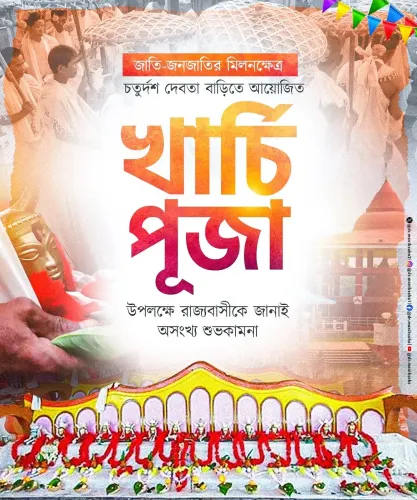
Kharchi Puja 2025 begins in Tripura with 'Ek Ped, Maa Ke Naam' theme
Synopsis
Tripura's Kharchi Puja — a centuries-old festival where 14 deities are worshipped simultaneously, represented only by their sacred heads — launched on 22 July with a new green twist: free sapling distribution under the 'Ek Ped, Maa Ke Naam' initiative. The festival's royal-era roots are backed by a legal state obligation dating to Tripura's 1949 merger with India.
Key Takeaways
Kharchi Puja 2025 commenced on 22 July at Puran Habeli (Khayerpur), about 8 km north of Agartala .
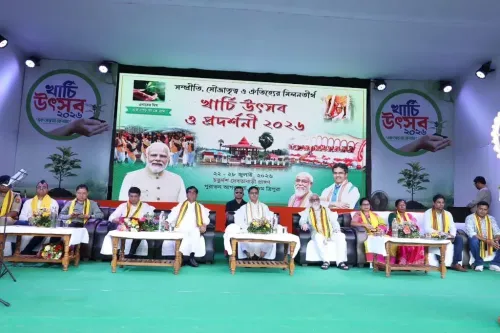
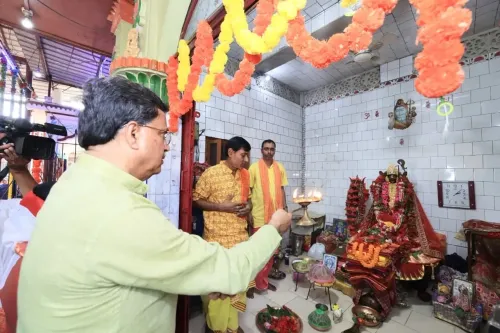
Tripura Chief Minister Manik Saha inaugurated the seven-day festival, during which 14 deities are worshipped simultaneously.
This year's theme is 'Ek Ped, Maa Ke Naam' — free saplings to be distributed to all visitors across the fair.
Cross-border visitors from Bangladesh are expected to be fewer than in previous years due to the prevailing situation there.
The Tripura government is legally obligated to fund the festival under the 1949 merger agreement with the Government of India.
The deities are represented by sacred heads only — not full-bodied idols — a feature unique to this tradition.
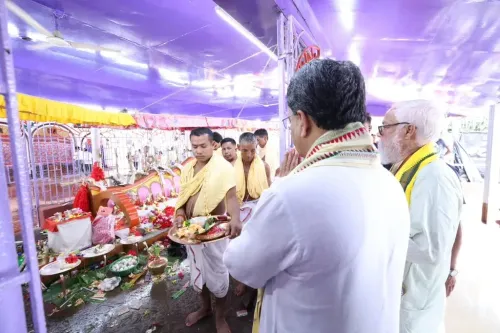
The centuries-old Kharchi Puja commenced on Wednesday, 22 July at Puran Habeli — the former capital of the erstwhile princely state of Tripura, now called Khayerpur, roughly 8 km north of Agartala — marking the start of one of the Northeast India's most distinctive religious festivals. Tripura Chief Minister Manik Saha, accompanied by senior dignitaries, formally inaugurated the seven-day fair and worship of 14 deities simultaneously, an arrangement found in few other Hindu traditions in the country.
Green Theme at the Heart of This Year's Festival
This edition of Kharchi Puja carries the environmental theme 'Ek Ped, Maa Ke Naam' (A Tree in Mother's Name), with saplings of various species to be distributed free of cost to all visitors across the seven-day fair through a government-backed initiative. Kharchi Puja and Mela Committee Chairman Ratan Chakraborty, a former Minister and former Speaker of the Tripura Legislative Assembly, said the objective is to build a greener Tripura alongside the spiritual celebrations.
Chakraborty expressed hope that, weather permitting, attendance this year would surpass that of previous editions. He did, however, note that the prevailing situation in neighbouring Bangladesh is likely to reduce cross-border visitors compared to earlier years.
The 14 Deities and Unique Ritual Traditions
At the core of Kharchi Puja is the simultaneous worship of 14 deities: Shiva, Durga, Vishnu, Lakshmi, Saraswati, Kartik, Ganesha, Brahma, Abadhi (God of Water), Chandra, Ganga, Agni, Kamdev and Himadri (the Himalayas). A defining feature that sets this festival apart from most Hindu worship traditions is that all fourteen deities are represented solely by their sacred heads rather than full-bodied idols.
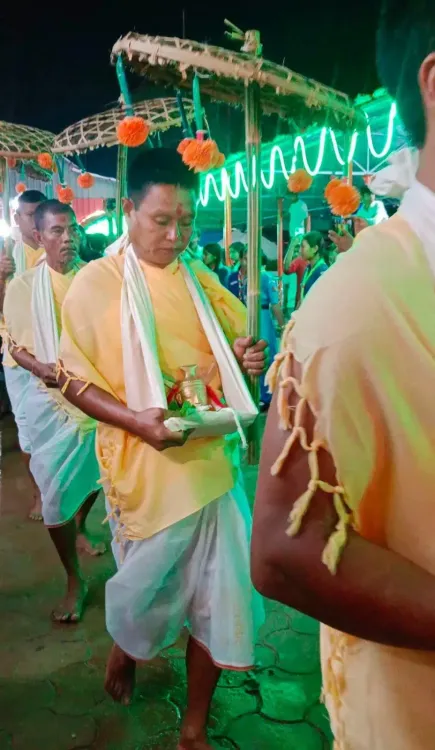
Animal sacrifice forms an integral part of the rituals. The week-long festival opens with a ceremonial procession in which the deity idols are brought out, accompanied by the Tripura Police band. Police personnel escort the deities and priests, and a formal guard of honour is presented to the Chief Royal Priest, popularly known as the Raj Chantaia — a practice that underscores the festival's deep royal lineage.
Historical Roots: From Royal Patronage to State Obligation
For more than 78 years, until 1838, Puran Habeli served as the capital of the undivided kingdom of Tripura, whose territory then encompassed large parts of present-day Sylhet, Brahmanbaria and Comilla districts of Bangladesh. King Krishna Manikya Bahadur (1760–1783) relocated the capital from Udaipur in southern Tripura to Puran Habeli in 1760, constructing the temple of the 14 deities during his reign. In 1838, King Krishna Kishore Manikya Bahadur (1830–1849) shifted the capital to Agartala, which has remained the state capital since.
On 15 October 1949, Tripura merged with the Government of India under an agreement signed between the then Regent Maharani Kanchan Prabha Devi and the Governor-General of India. That merger agreement made it mandatory for the Tripura government to continue sponsoring 14 temples and their associated ceremonies, including Kharchi Puja and the Mata Tripura Sundari Temple — one of the country's 51 Shakti Peethas. The state government has honoured this obligation for several decades since.
A Festival of Communal Harmony
Originally rooted in the indigenous Tripuri community, Kharchi Puja has evolved over generations into a celebration that draws people of all communities, castes, tribes and religions. Chief Minister Saha said in his greeting message that the festival has long symbolised communal harmony, goodwill, unity and social integration, and has earned special recognition across the Northeastern region.
Tripura Governor Indra Sena Reddy Nallu described Kharchi Puja as one of the state's most popular festivals and expressed hope that it would bring joy, peace, prosperity and a spirit of brotherhood. Lakhs of devotees and tourists from across the country are expected to participate in the week-long celebrations, which are marked by colourful marquees, decorative illumination, Vedic chanting and the rhythmic beats of traditional drums.
As the seven-day festival unfolds, all eyes will be on whether this year's green-themed initiative translates into measurable sapling distribution — and whether the festival's cross-community appeal holds strong despite reduced cross-border participation.
Point of View
A fact that rarely surfaces in coverage. The 'Ek Ped, Maa Ke Naam' green overlay is a smart political signal from the Saha government, but the real test is whether sapling distribution is tracked or is simply a photo-opportunity. The anticipated drop in Bangladeshi visitors is also worth watching: it is a quiet indicator of how cross-border cultural ties in the Northeast are fraying under geopolitical pressure, a trend that mainstream festival coverage tends to underplay.
NationPress
21 Oct 2026
Frequently Asked Questions
What is Kharchi Puja and where is it celebrated?
Kharchi Puja is a centuries-old festival celebrated at Puran Habeli (Khayerpur), about 8 km north of Agartala in Tripura, during which 14 Hindu deities are worshipped simultaneously over seven days. Originally a festival of the indigenous Tripuri community, it has evolved into a celebration embraced by people of all communities and religions.
When did Kharchi Puja 2025 begin?
Kharchi Puja 2025 commenced on Wednesday, 22 July, and runs for seven days. Tripura Chief Minister Manik Saha inaugurated the festival along with other dignitaries.
What is the theme of Kharchi Puja 2025?
The 2025 edition carries the green theme 'Ek Ped, Maa Ke Naam' (A Tree in Mother's Name). As part of this initiative, saplings of various species will be distributed free of cost to visitors attending the seven-day fair through a government initiative.
Why does the Tripura government fund Kharchi Puja?
The Tripura government is legally obligated to fund Kharchi Puja and 14 associated temples under the merger agreement signed on 15 October 1949 between Regent Maharani Kanchan Prabha Devi and the Governor-General of India. The agreement made state sponsorship of these religious ceremonies mandatory.
Which 14 deities are worshipped during Kharchi Puja?
The 14 deities worshipped are Shiva, Durga, Vishnu, Lakshmi, Saraswati, Kartik, Ganesha, Brahma, Abadhi (God of Water), Chandra, Ganga, Agni, Kamdev and Himadri (the Himalayas). Uniquely, all 14 are represented by sacred heads only, not full-bodied idols.