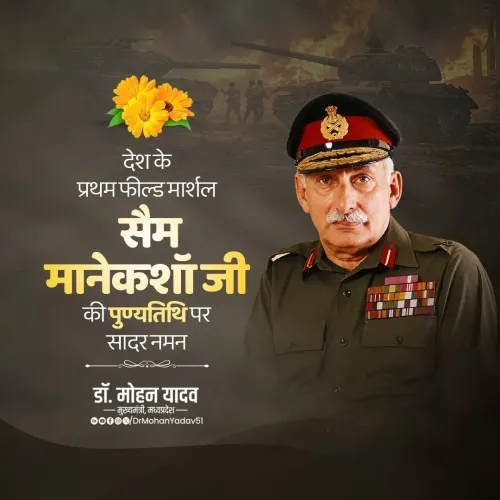
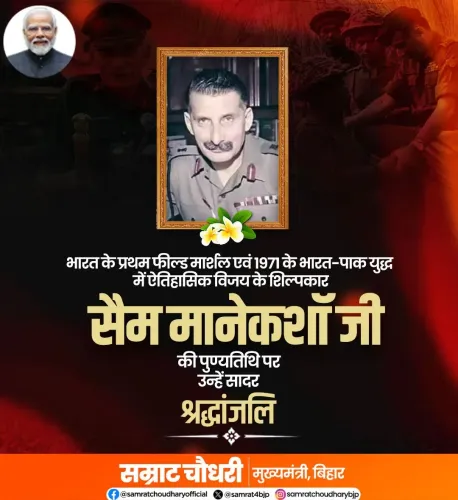
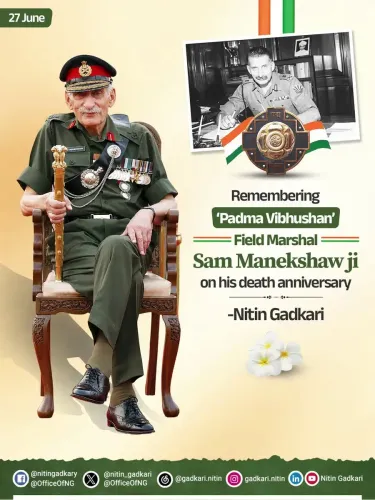
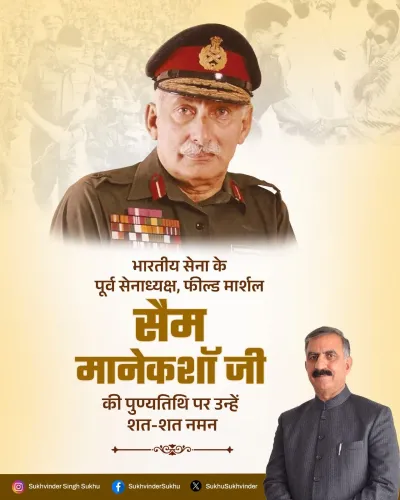
Khattar pays tribute to Field Marshal Sam Manekshaw on death anniversary
Synopsis
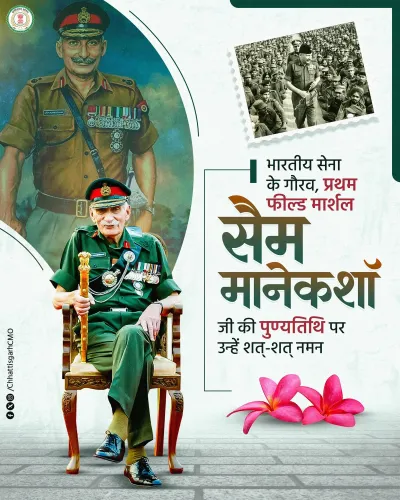
Union Power Minister Manohar Lal Khattar on 27 June 2026 paid homage to Field Marshal Sam Manekshaw, India's first five-star army officer, on his death anniversary, honouring his leadership in the 1971 India-Pakistan War that led to the creation of Bangladesh and the surrender of over 93,000 Pakistani troops.
Key Takeaways
Union Power Minister Manohar Lal Khattar posted a tribute to Field Marshal Sam Manekshaw on his death anniversary, 27 June 2026 .
Sam Manekshaw was India's first Field Marshal , elevated to the five-star rank in 1973 after commanding the 1971 India-Pakistan War .
The 1971 war resulted in the surrender of over 93,000 Pakistani troops and the creation of Bangladesh .
Manekshaw served as Chief of the Army Staff from 1969 to 1973 and was awarded the Padma Vibhushan .
Annual tributes on his death anniversary are part of India's official pattern of military remembrance, complementing Vijay Diwas on 16 December .
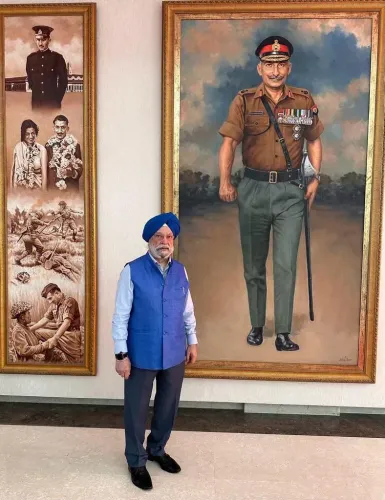
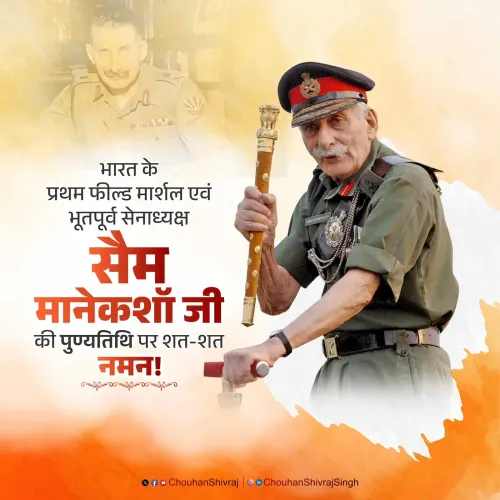
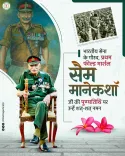
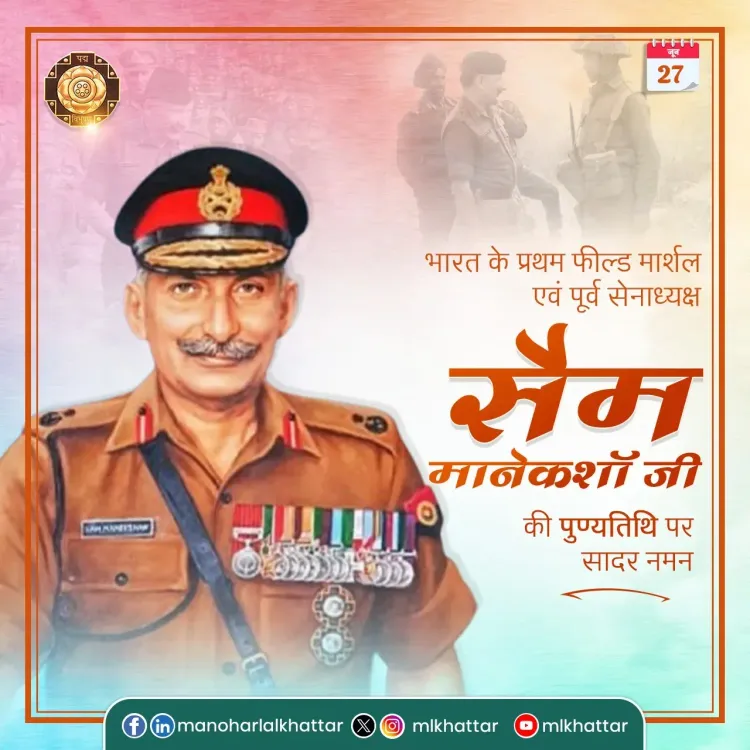
Union Power Minister Manohar Lal Khattar on Saturday, 27 June 2026 paid homage to Field Marshal Sam Manekshaw, India's first five-star army officer and the architect of the 1971 India-Pakistan War victory, on the occasion of his death anniversary.
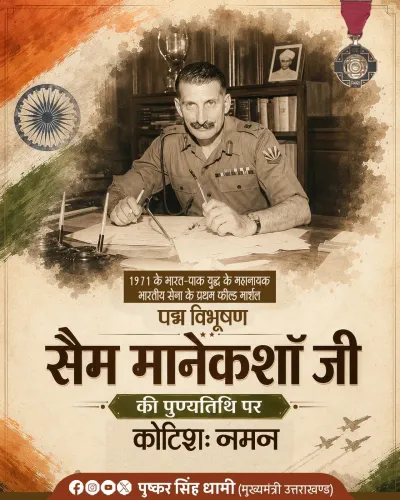
Posting in Hindi on X, Khattar wrote: 'सन् 1971 के भारत-पाकिस्तान युद्ध में अपने प्रेरणादायी नेतृत्व और अद्वितीय युद्ध कौशल से देश को अभूतपूर्व विजय दिलाने वाले महान सेनानायक' — 'the great military commander who secured an unprecedented victory for the country through his inspirational leadership and unmatched battlefield skills in the 1971 India-Pakistan War.' He described Manekshaw as India's first 'Field Marshal' and former Chief of the Army Staff, and saluted him on his death anniversary, adding the honorific 'Padma Vibhushan.'
Context
Sam Hormusji Framji Jamshedji Manekshaw, popularly known as Sam Bahadur, served as Chief of the Army Staff from 1969 to 1973. He commanded Indian forces during the 1971 war, which culminated in the creation of Bangladesh and the surrender of over 93,000 Pakistani troops — one of the largest military surrenders since World War II. His death anniversary falls on 27 June each year.
In 1973, the Government of India elevated Manekshaw to the rank of Field Marshal, making him the first officer to hold that five-star rank in independent India's history. He was also awarded the Padma Vibhushan, the country's second-highest civilian honour, in recognition of his distinguished service.
Policy Backdrop
The 1971 India-Pakistan War remains a defining moment in India's post-independence military history and continues to shape the country's strategic self-image. Official remembrance of the war's commanders is a consistent feature of India's political and defence calendar, with Vijay Diwas observed every year on 16 December to mark the day Pakistan's forces surrendered in Dhaka.
Tributes on Manekshaw's death anniversary are part of a broader pattern of official acknowledgement for the officers who oversaw that campaign. Such observances also carry diplomatic undertones given India's ongoing relationships with both Pakistan and Bangladesh.
Stakeholders and Impact
The tribute resonates most directly with Indian Army veterans, serving personnel, and military families who regard Manekshaw as a symbol of professional excellence and battlefield courage. His legacy is frequently invoked in discussions around veterans' welfare, military honours, and national security policy.
For the BJP and the broader ruling establishment, public tributes to war heroes also serve as an affirmation of nationalist sentiment and respect for the armed forces — a theme that recurs across party communications on defence anniversaries.
What's Next
The Defence Ministry and Indian Army are expected to mark Vijay Diwas on 16 December 2026 with commemorations that will again spotlight the 1971 victory and Manekshaw's role in it. Any announcements related to war memorials, veterans' welfare schemes, or regimental honours in the intervening months will be watched closely by the defence community. Manekshaw's legacy continues to inform conversations about military leadership standards and the recognition of five-star ranks in India.
Point of View
Whose legacy cuts across partisan lines, signals a broader national-unity framing rather than a narrowly ideological one. The tribute also arrives at a time when the 1971 war's legacy remains diplomatically active, given India's complex relationships with both Pakistan and Bangladesh. Such posts function as low-cost, high-visibility signals of institutional respect for the armed forces.
NationPress
27 Jun 2026
Frequently Asked Questions
Who was Field Marshal Sam Manekshaw?
Sam Manekshaw was India's first Field Marshal and the commander of Indian forces during the 1971 India-Pakistan War . He served as Chief of the Army Staff from 1969 to 1973 and was awarded the Padma Vibhushan . He was promoted to the five-star Field Marshal rank in 1973 .
When did Sam Manekshaw die?
Sam Manekshaw passed away on 27 June , and his death anniversary is observed on that date each year. He is remembered for his decisive leadership in the 1971 India-Pakistan War .
What was Sam Manekshaw's role in the 1971 war?
Sam Manekshaw commanded the Indian Army during the 1971 India-Pakistan War , which resulted in the surrender of over 93,000 Pakistani troops and the creation of Bangladesh . His strategic planning and leadership are credited with securing one of India's most significant military victories.
Why did Manohar Lal Khattar pay tribute to Sam Manekshaw?
Union Power Minister Manohar Lal Khattar posted a tribute on 27 June 2026 to mark the death anniversary of Field Marshal Sam Manekshaw , honouring his role in the 1971 war and his legacy as India's first five-star army officer.
What is Vijay Diwas and how does it relate to Manekshaw?
Vijay Diwas is observed on 16 December each year to commemorate India's victory in the 1971 India-Pakistan War and the surrender of Pakistani forces in Dhaka. Field Marshal Sam Manekshaw commanded Indian forces during that conflict, making him a central figure in Vijay Diwas commemorations.