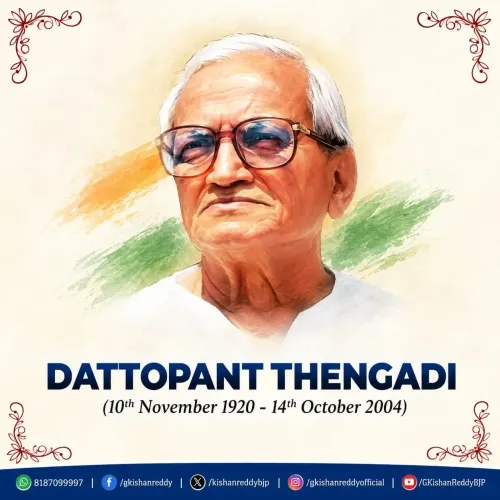
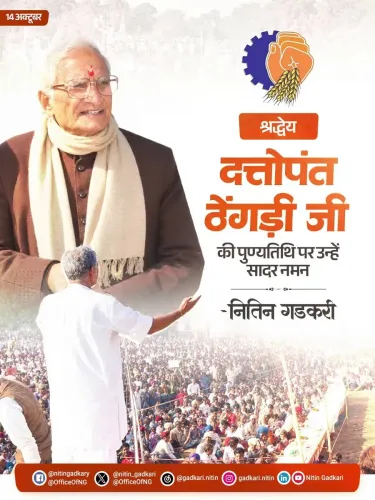
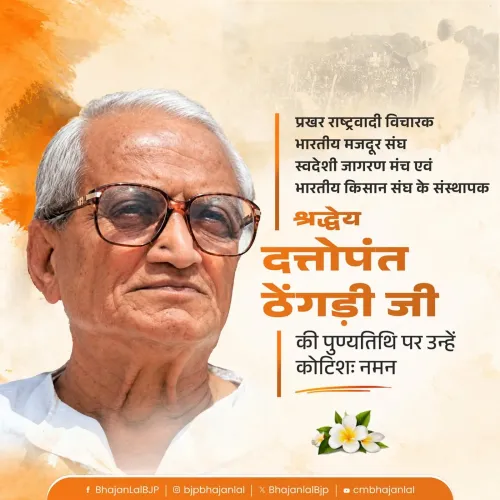
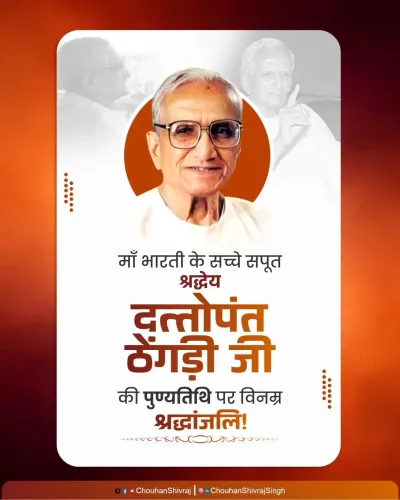
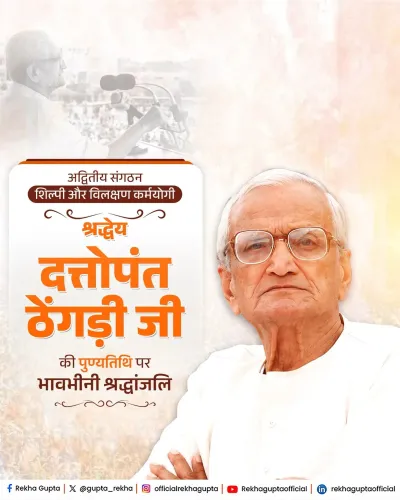
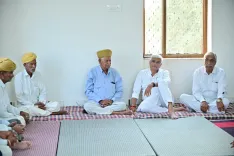
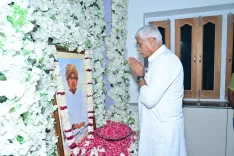
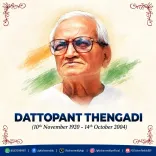
Khattar pays tribute to RSS ideologue Dattopant Thengdi
Synopsis
Union Power Minister Manohar Lal Khattar paid tribute to Dattopant Thengdi on his death anniversary, saluting the RSS pracharak who founded Bharatiya Mazdoor Sangh, Bharatiya Kisan Sangh and Swadeshi Jagran Manch and dedicated his life to workers, farmers and Swadeshi ideals.
Key Takeaways
Union Power Minister Manohar Lal Khattar paid tribute to Dattopant Thengdi on his death anniversary on October 14, 2026 .
Thengdi was a senior RSS pracharak and founder of three major Sangh Parivar organisations.
He established the Bharatiya Mazdoor Sangh in 1955 , now among India's largest trade union federations.
He also founded Bharatiya Kisan Sangh and Swadeshi Jagran Manch to organise farmers and promote economic nationalism.
Khattar highlighted Thengdi's Swadeshi philosophy as a continuing source of ideological guidance.
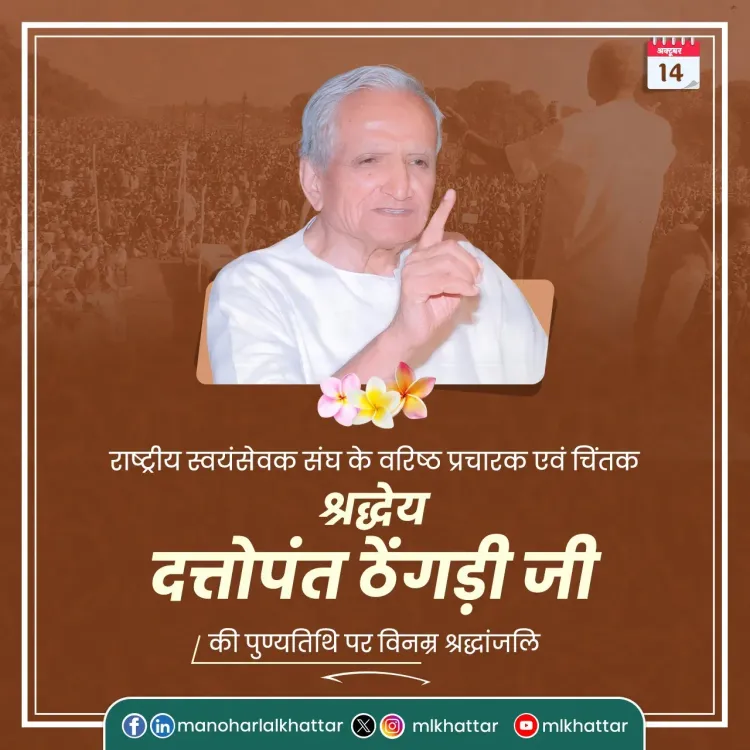
On the death anniversary of one of the Sangh Parivar's most consequential organizers, Union Power Minister Manohar Lal Khattar on Wednesday, October 14 offered a solemn tribute to Dattopant Thengdi — the RSS pracharak who built three of India's most influential labour, agrarian and economic-nationalist institutions from the ground up.
Khattar's post, written in Hindi, read: 'Rashtriya Swayamsevak Sangh ke varishtha pracharak rahe evam kushal sangathankarta, shraddhey Dattopant Thengdi ji ki punyatithi par unhe vinamra shraddhanjali arpit karta hoon.' — 'I offer humble tribute on the death anniversary of revered Dattopant Thengdi Ji, a senior RSS pracharak and skilled organizer.' The minister went on to credit Thengdi with founding Bharatiya Mazdoor Sangh (BMS), Bharatiya Kisan Sangh (BKS) and Swadeshi Jagran Manch (SJM), calling his life a complete dedication to the nation and to the upliftment of farmers and workers.
The man who organised India's workers on nationalist lines
Dattopant Thengdi founded the Bharatiya Mazdoor Sangh in 1955 as the labour wing of the Sangh Parivar — a deliberate counter to communist-aligned trade unions that dominated the organised workforce at the time. Today, the BMS is counted among India's largest trade union federations by membership. His model was distinctive: anchor worker interests not in class conflict, but in national interest and economic self-reliance.
The Bharatiya Kisan Sangh extended that template to India's agrarian base, organising rural communities on explicitly nationalist lines. The Swadeshi Jagran Manch, meanwhile, became the RSS ecosystem's primary platform for challenging foreign capital, opposing liberalisation and championing indigenous industry — a voice that has grown louder in recent years as 'Make in India' and 'Atmanirbhar Bharat' entered mainstream policy language.
Why the tribute resonates beyond ceremony
BJP leaders routinely mark the death anniversaries of RSS ideologues, and Thengdi's holds particular weight: his three organisations collectively represent the Sangh's structured reach into labour markets, farm households and economic-policy debates. When Khattar closes his tribute with the line that Thengdi's Swadeshi-infused ideas 'will always guide us,' he is doing more than mourning a predecessor — he is signalling a living ideological inheritance.
For a sitting Union Minister who oversees both Power and Housing portfolios, invoking Thengdi's self-reliance philosophy carries an implicit policy note: the emphasis on domestic industry and worker welfare sits squarely within the current government's stated economic framework.
Point of View
Naming all three organisations and foregrounding the Swadeshi philosophy, places it within a broader pattern of the current government tying policy rhetoric to Sangh Parivar intellectual lineage. With 'Atmanirbhar Bharat' as a central economic plank, invoking Thengdi is not merely commemorative — it is a claim of continuity. For a minister holding both Power and Urban Affairs portfolios, the nod to worker and farmer upliftment also serves as a reminder that the BJP's social-coalition instincts trace back to organised labour and agrarian movements, not just capital-friendly reform.
NationPress
14 Oct 2026
Frequently Asked Questions
Who was Dattopant Thengdi?
Dattopant Thengdi was a senior RSS pracharak and skilled organizer who founded the Bharatiya Mazdoor Sangh in 1955, the Bharatiya Kisan Sangh and the Swadeshi Jagran Manch, dedicating his life to workers, farmers and the cause of economic self-reliance.
What did Dattopant Thengdi found?
Thengdi founded three major organisations: Bharatiya Mazdoor Sangh (a labour union, 1955), Bharatiya Kisan Sangh (a farmers' union) and Swadeshi Jagran Manch (an economic nationalism platform).
What is Bharatiya Mazdoor Sangh?
Bharatiya Mazdoor Sangh is an RSS-affiliated trade union founded by Dattopant Thengdi in 1955. It is counted among India's largest labour organisations by membership and organises workers on nationalist rather than class-conflict lines.
Why did Manohar Lal Khattar pay tribute to Thengdi?
Khattar paid tribute on Thengdi's death anniversary, honouring his founding of BMS, BKS and Swadeshi Jagran Manch and his lifelong service to the nation, workers and farmers — a standard practice among senior BJP leaders on Sangh Parivar anniversaries.
What is Swadeshi Jagran Manch?
Swadeshi Jagran Manch is an RSS-linked economic nationalism forum founded by Dattopant Thengdi to promote indigenous industry, oppose indiscriminate foreign investment and champion the Swadeshi philosophy in India's economic policy debates.