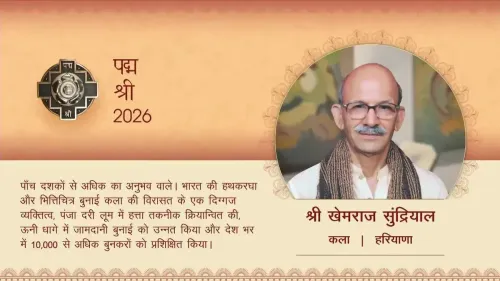
How Did Padma Shri Winner Khemaraj Sundriyal Weave Panipat's Global Legacy Over 60 Years?

Synopsis
Discover the inspiring journey of Khemaraj Sundriyal, a Padma Shri awardee who transformed Panipat into a global handloom hub. From humble beginnings to national acclaim, his story is a testament to dedication and innovation in Indian handicrafts.
Key Takeaways
Khemaraj Sundriyal is a Padma Shri awardee recognized for over 60 years of contributions to handloom.
He transformed traditional weaving techniques in Panipat .
His journey exemplifies the power of hard work and dedication .
He advocates for the preservation of traditional arts .
His story inspires youth to embrace craftsmanship.
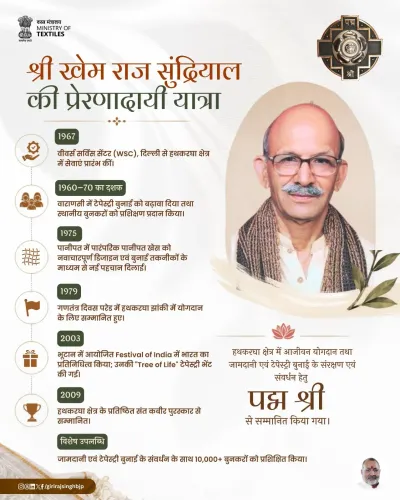
Panipat, Jan 25 (NationPress) In an emotional discussion following the announcement of the 2026 Padma Shri awards, master weaver Khemaraj Sundriyal revealed his extraordinary path from a modest farming family in Uttarakhand to becoming the unheralded force behind Panipat's emergence as an internationally acclaimed handloom center.
The esteemed accolade from the Government of India honors his 60 years of creativity, commitment, and impactful contributions to the realm of Indian handicrafts.
Khemaraj was born in Sumadi village, Uttarakhand, into a family lacking a weaving background, and faced numerous challenges early on.
"I had to trek six kilometers daily to attend my classes. There were mockeries and social ostracism because weaving was not viewed as a respectable profession for someone of my lineage," he reminisced.
"However, I dedicated my life to weaving. There is no distinction between Brahmin or Kshatriya; labor is the highest form of faith."
In 1966, after a governmental transfer from Varanasi, he arrived in Panipat and became part of the Weavers’ Service Centre, which was supported by Jawaharlal Nehru and Pupul Jayakar to assist migrants from Partition.
"This was a pivotal moment," he stated. "I experimented with traditional Khes weaving, transforming it into bedsheets, bed covers, and contemporary items, thus creating new markets."
His most groundbreaking achievement involved adapting Jamdani art—traditionally on cotton muslin—to wool shawls.
"People claimed it was unfeasible, yet I demonstrated that it could be exquisitely accomplished on wool," he clarified. This innovation won him national accolades and rejuvenated the industry. Khemaraj also recreated MF Hussain's artwork as lifelike woven tapestries.
"The intricacy was such that observers could hardly discern if it was painted or woven," he expressed with pride.
He pushed the evolution of tapestries and wall hangings, replicating famous artworks on looms with canvas-like accuracy. From basic to permanent dyeing, he initiated quality enhancements.
"At first, people were reluctant, but I organized training. Today, Panipat's dyeing processes are world-class," he remarked.
Reflecting on his award, Khemaraj conveyed his gratitude. "I applied last year and received the call this time. My family erupted with joy," he recounted.
His daughter-in-law commented, "This is a dream realized. The art that Papa (Father) embraced long ago is now acknowledged globally."
He lauded the current government's meritocratic approach, stating, "Now, accolades are awarded based on merit, not favors. It's commendable to recognize those who have remained unsung for years."
To the younger generation, his message is emphatic: "Hard work yields results. Embrace traditional art and handloom with commitment—this honor will inspire many."
Khemaraj Sundriyal's name has become intertwined with Panipat's identity. His legacy of innovation continues to weave pride into the cultural fabric of India.
Point of View
I believe Khemaraj Sundriyal's story epitomizes the spirit of perseverance and innovation. His dedication to preserving and enhancing traditional crafts is not just a personal achievement but a significant contribution to India's cultural heritage. We must always support narratives that celebrate such unsung heroes in our society.
NationPress
20 Sept 2026
Frequently Asked Questions
What is Khemaraj Sundriyal known for?
Khemaraj Sundriyal is renowned for his contributions to the handloom industry in Panipat, transforming traditional weaving techniques and earning the prestigious Padma Shri award.
What challenges did Khemaraj face in his journey?
He faced social stigma and financial hardships, having to walk long distances for education while pursuing a career in weaving, which was not considered respectable in his community.
How did Khemaraj innovate in weaving?
He adapted traditional techniques, such as Jamdani art on wool shawls, and modernized products like bedsheets and bed covers, opening new markets.
What message does Khemaraj have for the youth?
He encourages young people to embrace traditional arts and crafts with hard work and dedication, emphasizing that such efforts will lead to recognition and success.
What impact did Khemaraj's work have on Panipat?
His innovations and dedication significantly enhanced the quality of handloom products, contributing to Panipat's reputation as a world-class handloom hub.