Kishan Reddy at NIT Raipur: India's Education Leap
Synopsis
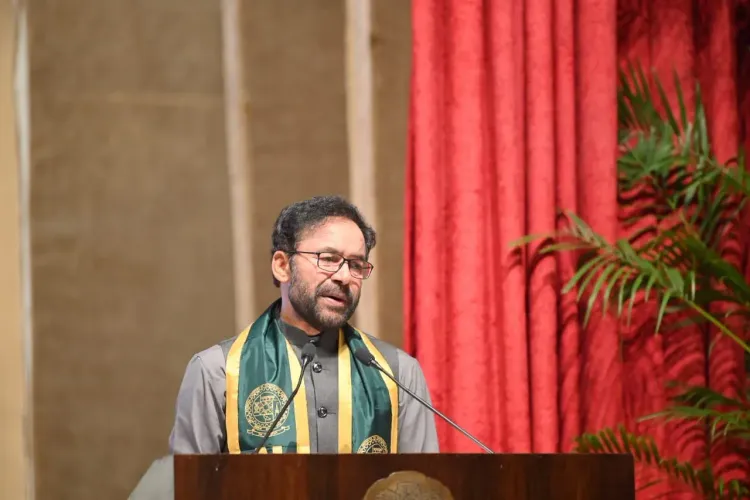
Union Minister G. Kishan Reddy attended NIT Raipur's 17th Convocation as Chief Guest, highlighting India's higher education expansion — from 700 to 1,100-plus universities — NEP 2020's shift from rote learning, and the ₹1 lakh crore Anusandhan Research Foundation driving indigenous innovation.
Key Takeaways
NIT Raipur conferred degrees on over 1,300 graduates including 91 PhD scholars at its 17th Convocation on November 3, 2026 .
The institution was founded in 1956 with just two branches — Metallurgical and Mining Engineering — and was upgraded to NIT status in 2005 .
Minister Reddy cited growth in Indian universities from 700 to over 1,100 under PM Narendra Modi , alongside new IITs, IIMs, IIITs and NITs.
India's Gross Enrolment Ratio has reportedly crossed 29% , signalling greater domestic access to higher education.
The ₹1 lakh crore Anusandhan National Research Foundation was highlighted as India's key funding mechanism for indigenous research and innovation.
52 Indian universities now feature in the QS World Rankings , according to the minister's address.
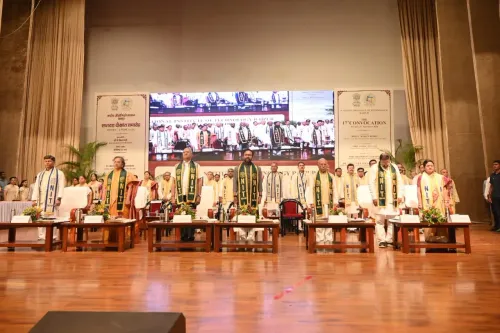
From two mining branches in 1956 to a convocation stage shared with over 1,300 graduating engineers — Union Coal and Mines Minister G. Kishan Reddy used the 17th Convocation Ceremony of NIT Raipur on Tuesday, November 3, 2026 to frame India's higher education transformation as nothing short of a generational revolution.
NIT Raipur's seven-decade arc — from mine to mainstream
NIT Raipur began life in 1956 as the Government College of Mining and Metallurgy, offering just two foundational branches — Metallurgical Engineering and Mining Engineering — disciplines that mirrored Chhattisgarh's resource-rich economy. It was upgraded to National Institute of Technology status in 2005, widening its academic canvas far beyond its mineral origins. Today it stands as one of the country's premier technical institutions, and its 17th convocation — conferring degrees on more than 1,300 scholars including 91 PhD graduates — marked a visible proof point of that transformation.
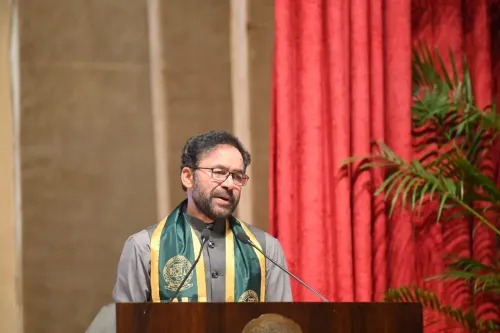
Reddy, speaking as Chief Guest, acknowledged the faculty whose sustained commitment built the institution, and the parents 'whose sacrifices laid the foundation for their children's success.' The tribute was deliberate. India's first-generation engineering families know exactly what that sentence costs.
The numbers behind the expansion pitch
Reddy placed NIT Raipur's story inside a larger national canvas. Under Prime Minister Narendra Modi, he said, Indian universities have grown from 700 to over 1,100, accompanied by new IITs, IIMs, IIITs, and NITs across the country. The country's Gross Enrolment Ratio has crossed 29%, he noted — a figure that signals world-class learning is now accessible domestically, reducing the historical pressure on Indian students to migrate abroad for quality education.
These figures were cited by the minister and have not been independently verified, but the directional trend — a significant expansion of higher education infrastructure post-2014 — is consistent with the government's stated policy record.
NEP 2020 and the case against rote learning
Reddy invoked the National Education Policy (NEP) 2020, approved by the Union Cabinet in July 2020, as the structural lever behind this shift. The policy replaced India's 1986 education framework and carries an explicit mandate for multidisciplinary education, hands-on skill development, and a deliberate break from the rote-learning culture that has long been the subject of criticism from industry and academia alike. For an audience of freshly minted engineers, the message was pointed: the system that trained you is already being rebuilt for the ones coming after.
From talent exporter to technology creator
The minister offered a statistic that reliably lands in any room full of Indian engineers: Indian-origin professionals lead 60% of top global companies and make up a third of Silicon Valley's technical workforce. The implicit question in that number is the one Reddy used to drive his argument — why should that talent be built here and harvested elsewhere?
His answer: the ₹1 lakh crore Anusandhan National Research Foundation, a government initiative designed to pump dedicated funding into research and innovation across Indian universities, and the arrival of 52 Indian universities in the QS World Rankings. India, Reddy argued, is no longer content to be a consumer of global technology. The country is 'stepping up to actively create it.'
For the 1,300-plus graduates walking off the NIT Raipur stage, that ambition is no longer an abstraction. It is a job description.
Point of View
QS rankings, and research funding reflects a pivot from access to excellence. Using an NIT convocation to amplify NEP 2020 and the Anusandhan Foundation signals that the policy is moving past the announcement phase into a story-of-outcomes phase. The 'Indian talent leads global firms, so why study abroad' argument is also a political hedge against brain-drain criticism, especially relevant in an era when overseas migration among graduates remains high. How quickly the Anusandhan Foundation disburses grants and how measurably QS rankings improve will determine whether the ambition survives scrutiny.
NationPress
3 Nov 2026
Frequently Asked Questions
What is the Anusandhan National Research Foundation?
The Anusandhan National Research Foundation is a ₹1 lakh crore government initiative designed to fund and promote research, innovation, and scientific development across Indian universities and institutions.
When was NIT Raipur founded and what was it originally?
NIT Raipur was founded in 1956 as the Government College of Mining and Metallurgy, with initial programmes in Metallurgical and Mining Engineering. It was upgraded to NIT status in 2005 .
What does NEP 2020 change about Indian education?
The National Education Policy 2020 , approved in July 2020 , replaces the 1986 policy and emphasises multidisciplinary education, hands-on skill development, and a reduction in rote learning across schools and universities.
How many universities does India have now compared to before?
Minister Reddy stated that under PM Narendra Modi , Indian universities have grown from 700 to over 1,100 , alongside the addition of new IITs, IIMs, IIITs, and NITs — though this figure is cited from the minister's speech and awaits independent verification.
What is India's Gross Enrolment Ratio in higher education?
According to Minister Reddy's address, India's Gross Enrolment Ratio (GER) in higher education has crossed 29% , indicating that a growing proportion of the eligible age group is now enrolled in tertiary education.