Kishan Reddy links NIT Raipur to India's critical mineral mission
Synopsis
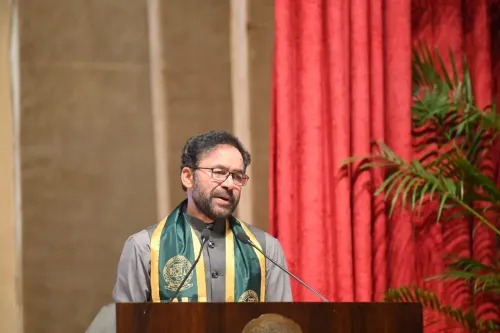
Union Coal and Mines Minister G. Kishan Reddy addressed NIT Raipur's convocation on November 3, 2026, positioning the institute as central to India's National Critical Mineral Mission and urging graduates to drive self-reliance in energy, mining, and sustainability under the Viksit Bharat 2047 vision.
Key Takeaways
Union Coal and Mines Minister G.
Kishan Reddy addressed NIT Raipur's convocation on November 3, 2026 .
He highlighted the institute's role in the National Critical Mineral Mission , covering sustainable mining, clean energy, and advanced materials.
Reddy invoked India's Vaccine Maitri programme — which supplied indigenous COVID-19 vaccines to more than 150 countries — as a model for domestic scientific self-reliance.
CSIR Director General Dr.
Kalaiselvi , Raipur MP Brijmohan Agrawal , and IIT Bhilai Director Dr.
Rajiv Prakash were among the dignitaries present.
Graduates were urged to treat challenges in energy, healthcare, sustainability, and agriculture as opportunities to build solutions under #ViksitBharat2047 .
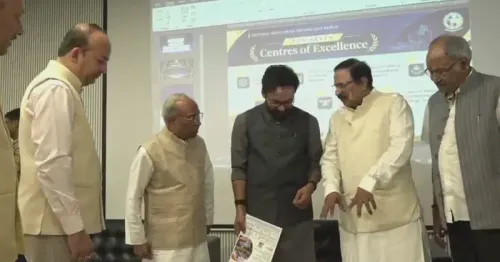
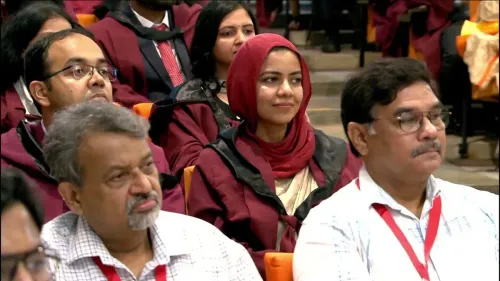
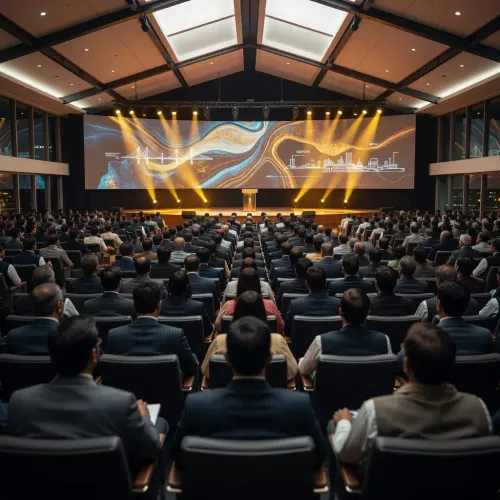
At NIT Raipur's convocation, Union Coal and Mines Minister G. Kishan Reddy on Tuesday, November 3 placed a premier technical institute squarely at the intersection of national security and net-zero ambition — telling graduates that their research in sustainable mining, clean energy, and advanced materials is not academic exercise but strategic necessity.
NIT Raipur's place at the heart of India's mineral economy
Chhattisgarh is the bedrock of India's coal and mineral geography, and NIT Raipur sits right inside that landscape. Reddy drew that geography deliberately, arguing the institute's work in mining engineering and materials science feeds directly into the National Critical Mineral Mission — the Central government's drive to accelerate exploration, sustainable extraction, and domestic processing of minerals essential for clean-energy technologies and defence applications.
The minister's framing was pointed: India cannot afford to depend on imported critical minerals for its green transition or its security supply chains. The graduates in front of him, he said, are the human capital that changes that equation.
The vaccine-Maitri analogy — and what it asks of engineers
Reddy reached for a resonant parallel. During the COVID-19 crisis, indigenous vaccine innovation — channelled through the Vaccine Maitri programme of 2020-21 — benefited more than 150 countries. He held that episode up as proof that complex, system-level challenges, when met with domestic scientific capacity, yield solutions that travel well beyond India's borders.
The ask to the graduating batch was direct: carry that same instinct into energy, healthcare, sustainability, and agriculture. View every hard problem as an opening for ground-breaking, self-reliant solutions — the spirit of Atmanirbhar Bharat made concrete in engineering careers.
Who shared the stage at Raipur
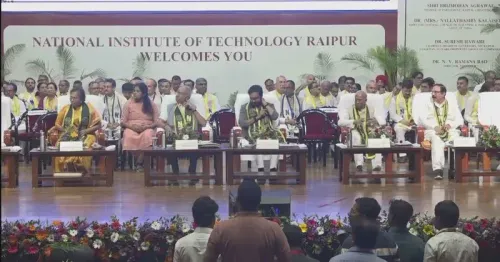
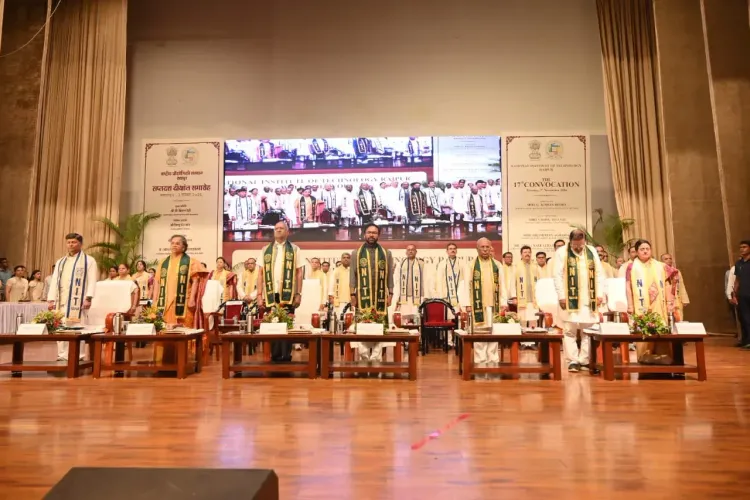
The convocation drew a notable assembly of science and policy leadership. Raipur MP Brijmohan Agrawal, Board of Governors Chairman Dr. Suresh Haware, NIT Raipur Director Dr. N. V. Ramana Rao, CSIR Director General Dr. N. Kalaiselvi, and IIT Bhilai Director Dr. Rajiv Prakash were all present — a gathering that underscored the convergence of parliamentary, institutional, and research authority around NIT Raipur's strategic role.
The presence of CSIR's top leadership is significant. As India's largest publicly funded R&D network, CSIR is a natural bridge between academic research at NIT Raipur and applied outcomes in critical-mineral processing and clean-energy materials.
Viksit Bharat 2047 — making the long arc visible to new graduates
Reddy closed with the government's signature long-horizon frame: #ViksitBharat2047, India's vision for a fully developed economy by the centenary of independence. For graduates entering the workforce in 2026, that target sits just 21 years away — a single professional generation. The minister's message was that the National Critical Mineral Mission, sustainable mining research, and net-zero commitments are not distant policy abstractions; they are the career terrain these engineers will actually navigate.
India's bet, visible across multiple policy signals, is that technical education aligned to strategic resource goals can compress the timeline to self-reliance — just as the pandemic compressed India's vaccine development cycle under pressure.
Point of View
Not merely degree-granting bodies. The Vaccine Maitri analogy is a carefully chosen rhetorical tool: it reframes scientific self-reliance as something India has already demonstrated under pressure, making the minerals and clean-energy challenge seem achievable rather than aspirational. The cross-institutional attendance — CSIR, IIT Bhilai, and a sitting MP — signals that the government is constructing a durable coalition around this agenda, likely ahead of new research MoUs and budgetary action on critical-mineral exploration.
NationPress
3 Nov 2026
Frequently Asked Questions
What is the National Critical Mineral Mission India?
The National Critical Mineral Mission is a Central government initiative to accelerate the exploration, sustainable mining, and domestic processing of minerals critical to clean-energy technologies and national security, reducing India's dependence on imports.
What did Kishan Reddy say at NIT Raipur convocation 2026?
Union Minister G. Kishan Reddy highlighted NIT Raipur's role in the National Critical Mineral Mission, drew a parallel with India's COVID-19 vaccine success in supplying more than 150 countries, and urged graduates to pursue self-reliant solutions in energy, healthcare, sustainability, and agriculture.
Who is Brijmohan Agrawal?
Brijmohan Agrawal is the Member of Parliament from the Raipur constituency in Chhattisgarh. He was among the dignitaries present at the NIT Raipur convocation on November 3, 2026.
What is Viksit Bharat 2047?
Viksit Bharat 2047 is India's long-horizon vision to become a fully developed economy by 2047, the centenary of independence. The government has linked technical education and missions like critical minerals research to this goal.
What is the role of CSIR in India's critical minerals research?
CSIR, the Council of Scientific and Industrial Research, is India's largest publicly funded R&D network. It serves as a bridge between academic institutions like NIT Raipur and applied outcomes in critical-mineral processing and clean-energy materials.