Kishan Reddy fires at Rahul Gandhi over flag row, Columbia speech
Synopsis
BJP minister G. Kishan Reddy accused Congress leader Rahul Gandhi of calling PM Modi a 'vote chor' abroad, staying silent on Khalistani abuse, allowing his car to roll over the national flag, and challenging PM Modi to a debate on anti-nationalism — all while accusing Gandhi of links with separatists and George Soros.
Key Takeaways
Kishan Reddy , Union Coal and Mines Minister and BJP Telangana president, posted a sharp attack on Rahul Gandhi on November 18, 2026 .
Reddy accused Gandhi of calling PM Modi a 'vote chor' domestically and describing India as an 'economic disaster' at Columbia University .
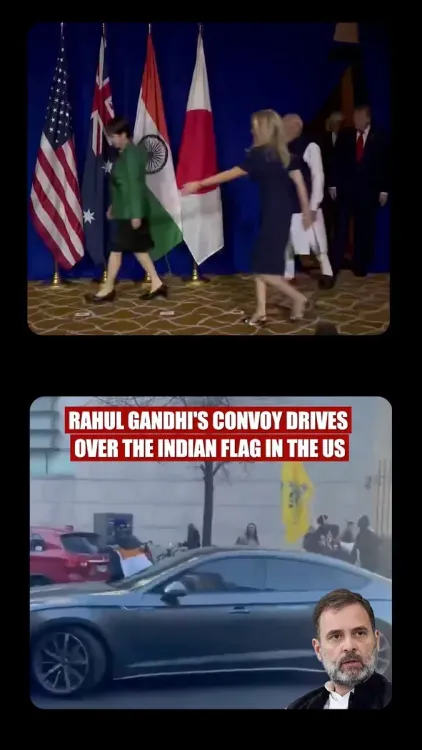
The minister alleged Gandhi stayed silent when Khalistani protesters abused India, and that his vehicle ran over the Tiranga without pause.
Reddy inverted Gandhi's 'Daro mat' slogan, calling the Congress leader a 'darpok' (coward) for not confronting anti-India forces.
BJP has since 2014 routinely linked Congress to Soros-funded groups and separatist movements ahead of elections.
No immediate Congress response to the specific incidents cited was available at the time of publication.
Union Coal and Mines Minister and BJP Telangana president G. Kishan Reddy launched a pointed political attack on Congress leader Rahul Gandhi on Wednesday, November 18, 2026, accusing him of staying silent while Khalistani protesters abused India and of allowing his vehicle to roll over the national flag — then daring Prime Minister Modi to a debate on who is 'anti-national.'
The 'vote chor' and Columbia address charges
Reddy's post catalogues a string of accusations: that Gandhi called Prime Minister Narendra Modi a 'vote chor' (vote thief) on Indian soil, described India as an 'economic disaster' during an address at Columbia University, and then — most viscerally — allowed his car to run over the Tiranga (the Indian tricolour) while walking away from a confrontation with what Reddy describes as 'Khalistani goons' without a word of rebuke. 'Not even the shame to pick it up,' the minister writes.
The sequence is framed not just as a political disagreement but as a loyalty test. Reddy argues that a leader who calls out the Prime Minister on foreign soil, tolerates separatist abuse of the national flag, and maintains what he characterises as links with George Soros — the philanthropist whose Open Society Foundations BJP has repeatedly accused of funding groups critical of the Indian government — cannot credibly challenge others to prove their nationalism.
The 'darpok' counter and the debate challenge
The sharpest line in the post is a rhetorical reversal of Gandhi's own slogan. Gandhi has campaigned extensively using the phrase 'Daro mat' — 'Don't be afraid' — positioning himself as someone willing to speak truth to power. Reddy turns it back: 'So who is the darpok (coward) now, Rahul ji?' The implication is that Gandhi summons courage for press conferences and university podiums abroad, but retreats into silence when faced with anti-India protesters on the street.
The challenge to debate 'who is anti-national' escalates a rhetorical war that has been a fixture of BJP-Congress exchanges since 2014, when BJP leaders began systematically framing opposition foreign-venue criticism and diaspora protest incidents as nationalism questions. That pattern, researchers note, typically intensifies in the run-up to elections.
Why the flag moment is the emotional core
Of all the charges, the flag incident carries the most emotional charge. The Tiranga occupies near-sacred status in Indian political culture — a symbol invoked by all parties and all ideological traditions. If Gandhi's convoy did run over a fallen tricolour without pause, even his own supporters would find the optics difficult to defend. That is precisely why Reddy places it at the centre of his argument rather than the policy disagreements, which carry less immediate visceral weight with a broad electorate.
The Khalistan angle adds a security dimension: the separatist movement, sustained largely by an overseas diaspora, has long been a flashpoint between the Indian government and diaspora communities in the United Kingdom, Canada, and the United States. BJP leaders have consistently accused Congress of soft-pedalling the movement's provocations. Reddy's framing — 'getting into bed with them and Soros' — fuses the separatist and foreign-funding accusations into a single charge of foreign-aligned opposition.
Congress has not issued an immediate response to the specific incidents cited. The ball is now in their court — and in an election season, silence carries its own political cost.
Point of View
A flag-desecration image, a separatist encounter, and a foreign-funding allegation into one unified charge of disloyalty. The rhetorical inversion of Gandhi's own 'Daro mat' slogan is particularly calculated — it weaponises the Congress leader's brand identity against himself. With the broader BJP-Congress war on nationalism having deepened since 2014, this kind of attack is designed less to persuade swing voters than to energise base sentiment and force Congress onto the defensive. The unresolved question is whether Congress can rebut the flag and Khalistan incidents on factual grounds, or whether the optics have already done their damage.
NationPress
18 Nov 2026
Frequently Asked Questions
What did G. Kishan Reddy say about Rahul Gandhi?
Kishan Reddy accused Rahul Gandhi of calling PM Modi a 'vote chor' in India, describing India as an 'economic disaster' at Columbia University, staying silent when Khalistani protesters abused India, and allowing his car to roll over the Tiranga — then daring PM Modi to debate 'who is anti-national.'
What is the Tiranga incident involving Rahul Gandhi?
BJP minister Kishan Reddy alleged that Rahul Gandhi's vehicle rolled over the Indian national flag lying on the road during an encounter with Khalistani protesters, and that Gandhi walked away without picking it up or condemning the abuse. The incident's specific details have not been independently verified.
What did Rahul Gandhi say at Columbia University?
According to Kishan Reddy's post, Gandhi described India as an 'economic disaster' during a Columbia University address. The specific statement cannot be independently verified as it postdates available research data.
What is the BJP-Soros accusation about?
BJP leaders have repeatedly alleged since 2014 that George Soros's Open Society Foundations fund organisations critical of the Indian government. Reddy's post extended that accusation to Rahul Gandhi, alleging an alignment between Congress, Soros, and anti-India forces.
What does 'darpok' mean and why did Kishan Reddy use it?
'Darpok' means coward in Hindi. Reddy used it to invert Rahul Gandhi's own 'Daro mat' (Don't be afraid) campaign slogan, arguing Gandhi shows courage only on foreign stages while retreating into silence when confronted by anti-India protesters.