Kishan Reddy Accuses Congress, Left of Exploiting Delhi Student Protest
Synopsis
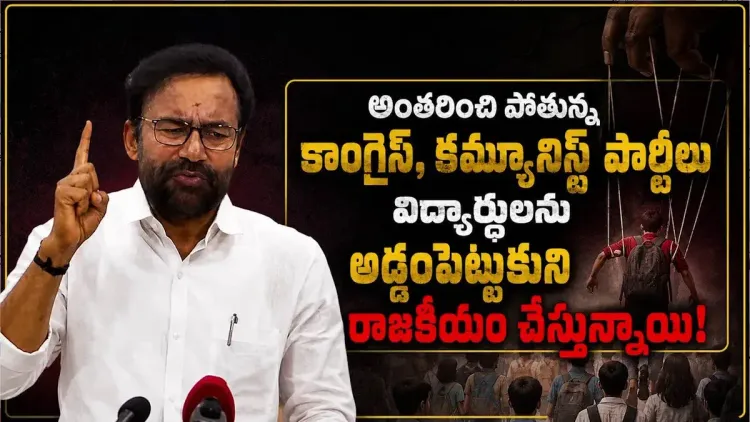
Union Minister G. Kishan Reddy has accused Congress and Communist parties of exploiting a student agitation at Jantar Mantar in New Delhi, alleging that electorally weakened opposition groups are using youth protests as a shield for political survival.
Key Takeaways
Kishan Reddy , Union Coal and Mines Minister and BJP Telangana president, posted the accusation on 23 July 2026 .
He alleged that Congress and Communist parties are using the Jantar Mantar student protest as political cover for their own survival.
He described these parties as 'disappearing from the country,' pointing to their declining national electoral footprint.
The charge mirrors BJP's earlier accusations during the 2019-2020 CAA-NRC agitations , when similar claims of opposition infiltration were made.
The statement carries added weight in Telangana , where Reddy leads state BJP and Congress currently holds government.
Responses from Congress and CPI-M leadership are awaited, as are details of the student movement's specific demands.
Union Coal and Mines Minister and BJP Telangana state president G. Kishan Reddy on Thursday, 23 July 2026, accused the Indian National Congress and Communist parties of using a student agitation at Jantar Mantar, New Delhi, as political cover for their own survival, alleging that parties with a dwindling national footprint were leveraging youth unrest for narrow electoral gain.
Context
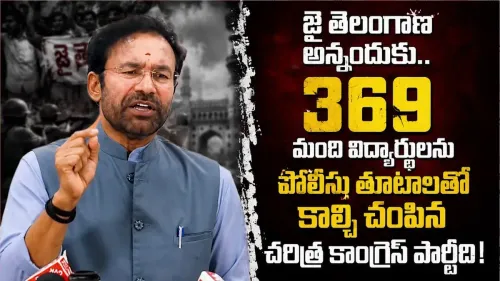
Posting in Telugu on X, Kishan Reddy wrote that Congress and Communist parties — described as 'disappearing from the country' (దేశంలో అంతరించిపోతున్న) — were doing politics for their own existence by using the student movement at Jantar Mantar as a shield. The charge frames the protest not as a legitimate grievance but as an instrument being wielded by opposition groups facing existential electoral pressure.
Jantar Mantar, the historic protest ground in central Delhi, has for decades served as the designated site for demonstrations seeking national attention. Student groups periodically converge there to press demands on education policy, employment, and civil rights issues.
Policy Backdrop
The accusation fits a well-established pattern in BJP political communication: ruling-party figures have repeatedly argued that Congress and Left formations, after successive electoral setbacks, attempt to reclaim relevance by aligning with or amplifying campus and youth demonstrations in the capital. Similar charges were levelled during the 2019-2020 CAA-NRC agitations, when the BJP accused opposition parties of infiltrating student-led protests.
Both the Communist Party of India (CPI) and the Communist Party of India (Marxist) (CPI-M) have seen their parliamentary strength decline sharply over the past decade, while Congress continues to rebuild after back-to-back general election losses. Critics of the BJP narrative, however, argue that opposition participation in protests is a legitimate democratic function, not exploitation.
Stakeholders and Impact
The immediate stakeholders are the student protesters at Jantar Mantar, whose specific demands remain unverified from available information, and the opposition parties — Congress and the Left — who are likely to push back against the characterisation. Kishan Reddy's statement, made in Telugu, also carries significance in Telangana, where he leads the state BJP unit and where Congress currently holds power, making the political contest between the two parties particularly sharp.
By framing the protest as a vehicle for 'parties disappearing from the country,' the minister signals that the BJP intends to contest the opposition's street-level mobilisation narrative ahead of any future electoral cycle in the state and nationally.
What's Next
Responses from senior Congress and CPI-M leaders are likely to follow, potentially sharpening the political debate around the student movement's legitimacy and the opposition's role in it. The duration and specific demands of the July 2026 Jantar Mantar agitation will determine whether this exchange remains a social-media skirmish or escalates into a broader political confrontation. Observers will also watch whether student groups themselves respond to being characterised as instruments of opposition politics.
Point of View
Reddy ensures the message lands in the state battleground as much as in the national discourse. The broader arc here is the BJP's sustained effort to deny Congress and the Left any moral ownership over youth and student politics, a space these parties once dominated.
NationPress
22 Oct 2026
Frequently Asked Questions
What did Kishan Reddy say about the Jantar Mantar student protest?
G. Kishan Reddy accused Congress and Communist parties of using the student agitation at Jantar Mantar as a political shield, alleging they are doing politics for their own survival as electorally declining parties.
Why is Jantar Mantar significant for protests in India?
Jantar Mantar in central New Delhi is a designated protest site with a long history of demonstrations. Activists, students, and civil society groups use it to draw national attention to their demands.
Which Communist parties did Kishan Reddy refer to?
Reddy referred broadly to Communist parties, which in the Indian context primarily means the Communist Party of India (CPI) and the Communist Party of India (Marxist) (CPI-M) , both of which have seen significant declines in parliamentary representation over the past decade.
Has BJP made similar accusations about opposition parties and student protests before?
Yes. During the 2019-2020 CAA-NRC agitations , BJP leaders similarly accused Congress and Left parties of infiltrating and politicising student-led protests for electoral benefit.
What is Kishan Reddy's political role beyond being a Union Minister?
G. Kishan Reddy serves as the BJP Telangana state president in addition to being Union Minister of Coal and Mines , making him a key figure in the party's political contest against the Congress government in Telangana.