KTR marks 4 years of BRS raising ST quota to 10%
Synopsis
On the fourth anniversary of the BRS government's order raising Scheduled Tribe reservations in Telangana from 6% to 10%, working president K. T. Rama Rao listed tribal welfare achievements — from Kumram Bheem district renaming and Banjara Hills cultural buildings to 100 new Gurukul schools and podu land titles — while implicitly challenging the successor Congress government.
Key Takeaways
Four-year anniversary: BRS working president KTR marked four years since the KCR government issued orders raising ST reservations in Telangana from 6% to 10% .
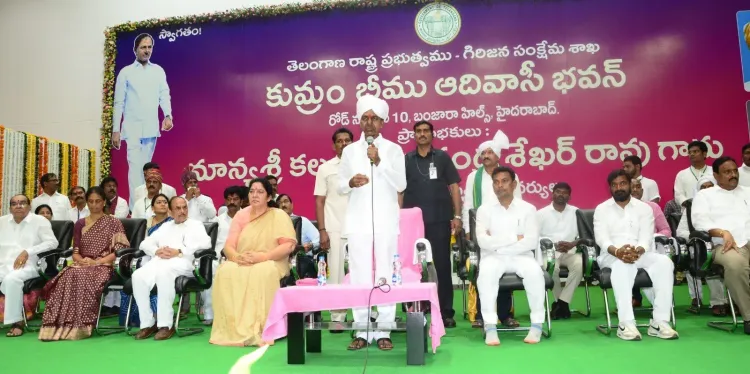
Cultural recognition: The BRS government renamed Asifabad district to Kumuram Bheem Asifabad and built the Sevalal Banjara Bhavan and Kumram Bheem Adivasi Bhavan in Banjara Hills, Hyderabad .
Land rights: Title deeds were distributed for podu lands , addressing one of the most contested issues for Telangana's tribal farming communities.
Education push: KTR cited approximately 100 new ST Gurukul residential schools , expanded ashram colleges, university tribal hostels, and the Ambedkar Overseas Scholarship.
Entrepreneurship scheme: The CMSTEI scheme was highlighted as an effort to develop tribal youth into entrepreneurs, beyond conventional welfare delivery.
Opposition framing: The post arrives nearly three years after BRS lost power in November 2023 , serving as both a legacy claim and a pressure point on the incumbent Congress government.
Four years after the K. Chandrashekar Rao-led government issued orders hiking Scheduled Tribe reservations from 6% to 10% in Telangana, BRS working president K. T. Rama Rao used the anniversary on Wednesday, September 30, 2026 to mount a sweeping defence of his party's tribal welfare record — and, implicitly, to draw a contrast with the Congress government that replaced BRS in 2023.
The reservation hike and what it meant on paper
Posting in Telugu, KTR framed the anniversary as proof that BRS governed on 'firm action, not empty words' — ఉత్త మాటలు కాదు… గట్టి చేతలతో ('not mere words… but with decisive deeds'). The centrepiece of his list was the government order expanding the ST quota, a move that, if fully implemented, would have significantly widened access to government jobs and educational seats for tribal communities across the state. The constitutional and legal journey of that hike — reservation expansions routinely face judicial scrutiny in India — remains a live question the current administration will need to answer.
Kumram Bheem, Banjara Hills, and the politics of symbolic recognition
Beyond the quota numbers, KTR catalogued a string of cultural and infrastructural gestures. The BRS government renamed Asifabad district to Kumuram Bheem Asifabad, honouring the legendary Gondi tribal leader who led an armed resistance against the Nizam's rule. In Banjara Hills, Hyderabad — one of the city's most prominent addresses — it constructed both the Sevalal Banjara Bhavan and the Kumram Bheem Adivasi Bhavan, giving tribal communities a physical foothold at the heart of the state capital. A memorial grove, smriti vanam, was also developed at Jodighat, a site associated with Kumram Bheem's legacy.
The government also distributed land title deeds — pattalu — for podu lands, the forest-fringe cultivation plots that generations of tribal families have farmed without formal ownership. Podu land rights have been among the most contested and emotionally charged issues for Telangana's tribal belt.
Gurukuls, scholarships, and the push to build tribal entrepreneurs
KTR's post devoted equal space to education. He cited the establishment of approximately 100 new ST Gurukul residential schools, an expansion of ashram schools and colleges, and the construction of tribal hostels in universities. The Ambedkar Overseas Scholarship — extended to ST students — and the CMSTEI scheme (Chief Minister's Scheduled Tribe Entrepreneurship and Innovation scheme) were also highlighted as tools designed to push tribal youth from beneficiaries of welfare into creators of enterprise.
The retrospective comes nearly three years after BRS lost power in the November 2023 assembly elections. For a party rebuilding its identity in opposition, the tribal welfare ledger serves a dual purpose: it stakes a claim to a loyal vote bank and pressures the incumbent Congress government to either match or exceed those commitments.
Where the current government stands
Whether the 10% ST reservation has survived legal challenge or been operationalised in full under the present administration is a question that hangs over KTR's anniversary post. Reservation expansions above constitutional baselines have historically attracted court intervention, and any gap between the order and its on-ground effect would be the sharpest rebuttal to the BRS narrative. The tribal communities whose futures depend on these policies are watching both sides of that argument very carefully.
KTR closed his post with greetings to 'all tribal children' on this anniversary — a warm sign-off that underlines just how politically freighted the word 'welfare' has become in post-2023 Telangana.
Point of View
And the current government's silence or response on that question will determine how much political traction this anniversary actually generates. More broadly, the post reflects a wider pattern across Indian state politics where affirmative-action expansion has become a primary arena for competitive populism.
NationPress
30 Sept 2026
Frequently Asked Questions
Did BRS actually increase ST reservations to 10% in Telangana?
The BRS government under K. Chandrashekar Rao issued orders raising Scheduled Tribe reservations from 6% to 10% in Telangana. The full legal and operational implementation of that hike remains subject to judicial scrutiny, as reservation expansions in India frequently face court challenges.
Why is KTR talking about tribal welfare in 2026?
September 30, 2026 marks four years since the BRS government's order on the ST reservation hike. KTR is using the anniversary to highlight his party's tribal welfare record and draw a contrast with the Congress government that has been in power since November 2023.
What is the Kumram Bheem Asifabad district?
Kumuram Bheem Asifabad is a district in Telangana renamed by the BRS government to honour Kumram Bheem, a revered Gondi tribal leader who led resistance against the Nizam's rule in the early 20th century.
What are podu lands in Telangana?
Podu lands are forest-fringe plots that tribal communities in Telangana have traditionally cultivated, often without formal land titles. The BRS government's distribution of title deeds — 'pattalu' — for these lands was one of its stated tribal welfare measures.
What is the CMSTEI scheme KTR mentioned?
The CMSTEI (Chief Minister's Scheduled Tribe Entrepreneurship and Innovation) scheme was a BRS-era initiative aimed at developing tribal youth into entrepreneurs, going beyond conventional welfare by providing skills and support for business creation.