KTR Slams Arrests of Youth Activists at Jantar Mantar

Synopsis
BRS working president K. T. Rama Rao on October 14, 2026 condemned the trespassing cases and alleged five-day judicial custody of youth activists Saurav Dass and Ashutosh Ranka for waving Indian flags at Jantar Mantar, invoking the 1975 Emergency and calling dissent the cornerstone of democracy.
Key Takeaways
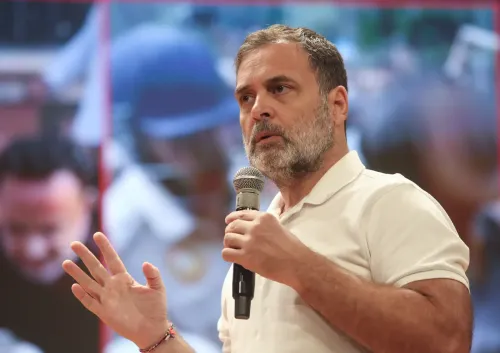
Rama Rao , BRS working president, posted a sharp condemnation on October 14, 2026 over the arrest of youth activists at Jantar Mantar , New Delhi.
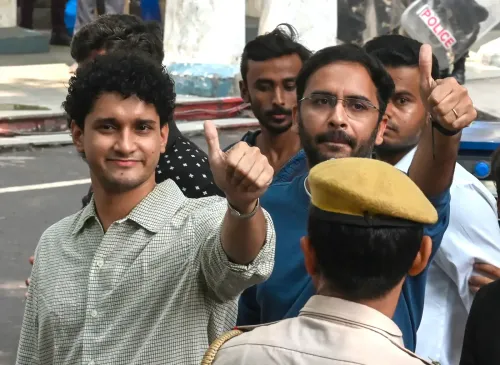
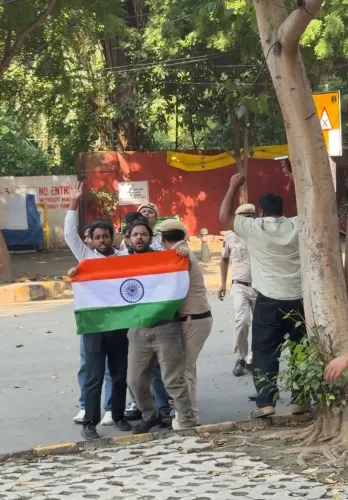
Trespassing cases were reportedly filed against activists Saurav Dass and Ashutosh Ranka for waving Indian flags at the protest site.
Rama Rao alleged the activists faced five-day judicial custody , calling it 'a new level of Emergency.' He invoked India's 1975 Emergency under Indira Gandhi — when civil liberties were suspended for 21 months — as a historical parallel.
Rama Rao argued India's freedom was itself won through protests and that 'dissent is the cornerstone of any democracy.' Jantar Mantar has historically served as New Delhi's primary venue for public demonstrations and civic petitions.
Five days of judicial custody for waving Indian flags at Jantar Mantar — that is the charge BRS working president K. T. Rama Rao has turned into a pointed political indictment of the ruling establishment, posting his sharp condemnation on Wednesday, October 14, 2026.
Trespassing Charges on Flag-Waving Students
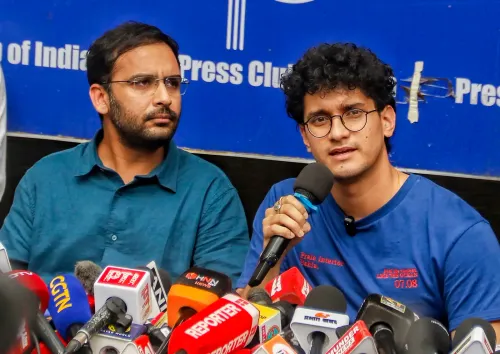
Rama Rao directed his criticism squarely at the trespassing cases filed against two young activists, @SauravDassss and @AshutoshRanka, who were reportedly demonstrating at Jantar Mantar, the historic site in New Delhi that has served as a focal point for public protest for decades. 'Slapping trespassing cases on Saurav Dass and Ashutosh Ranka is absolutely uncalled for,' he wrote, describing the alleged five-day judicial custody as 'a new level of Emergency.'
The invocation is deliberate and loaded. The 1975 Emergency — the 21-month period under Prime Minister Indira Gandhi when civil liberties were suspended, the press censored, and dissidents jailed by the thousands — remains the darkest chapter in post-independence Indian democratic history. To invoke it is to land the hardest available rhetorical punch in Indian political discourse.
Gen Z, Jantar Mantar, and the Legacy of Protest
Rama Rao's post frames the detained activists not as fringe agitators but as the conscience of the republic. 'If there is one group of people really fighting for this country's future, it is the youth, the Gen Z of this nation,' he wrote. The argument tracks a well-worn but still potent line: that India's founding was itself an act of mass civil disobedience, and that criminalising peaceful protest therefore inverts the nation's own origin story.
Jantar Mantar gives the episode particular symbolic weight. Built in the 18th century as an astronomical observatory, the New Delhi site evolved across the 20th and 21st centuries into the de facto square of democratic petition — where farmers, students, veterans, and citizens of every stripe have staked their grievances in plain sight of power. Arrests there, critics argue, carry an outsized symbolic charge precisely because of that history.
Opposition Rallies Around 'Dissent is Democracy'
The BRS leader's closing line — 'Dissent is the cornerstone of any democracy' — doubles as a rallying call that opposition parties have increasingly deployed when government action intersects with protest. The pattern is not new: references to the 1975 Emergency have surfaced repeatedly in opposition rhetoric during high-profile crackdowns on demonstrations, a rhetorical strategy designed to place any sitting government in the shadow of India's most cautionary democratic moment.
The specific charges, the precise circumstances of the custody, and the official government response to the Jantar Mantar demonstration remain subjects for the courts and authorities to clarify. What is already clear is that Rama Rao has chosen to make this a national conversation — and that the youth activists at the centre of it have, whatever happens next in court, already become symbols in a much larger argument about the boundaries of democratic expression in India.
The question now is whether other opposition leaders amplify the call, and whether the courts move quickly enough to defuse it before the symbolism hardens into something bigger.
Point of View
He converts a local custody dispute into a national referendum on democratic freedoms. The 'Gen Z' framing is strategically significant — it positions the BRS as the party of youth at a moment when multiple parties are competing for that demographic. Opposition parties have long used Emergency references as a pressure valve against the ruling establishment, but the tactic still commands mainstream resonance in Indian political culture. Whether the underlying facts fully sustain the comparison will matter less than whether the image — young Indians in custody for waving their own national flag — takes root in the public imagination.
NationPress
14 Oct 2026
Frequently Asked Questions
Why did KTR criticise the arrests at Jantar Mantar?
BRS working president K. T. Rama Rao condemned the trespassing cases and alleged five-day judicial custody imposed on youth activists Saurav Dass and Ashutosh Ranka, who were reportedly waving Indian flags at Jantar Mantar, calling the action an echo of the 1975 Emergency.
What happened to Saurav Dass and Ashutosh Ranka?
According to K. T. Rama Rao's post, trespassing cases were slapped on the two youth activists and they were placed in five-day judicial custody following their demonstration at Jantar Mantar in New Delhi. Independent verification of the specific charges and custody details was not available at the time of publication.
Why is Jantar Mantar significant for protests in India?
Jantar Mantar in New Delhi is a centuries-old astronomical site that evolved into India's most prominent designated protest venue, where citizens, farmers, students, and activists have historically gathered to air public grievances.
What is the 1975 Emergency that KTR referenced?
The 1975 Emergency was a 21-month period declared by Prime Minister Indira Gandhi during which civil liberties were suspended, the press was censored, and political opponents were jailed under the Maintenance of Internal Security Act — widely regarded as the gravest threat to Indian democracy in the post-independence era.
What is BRS and who is K. T. Rama Rao?
The Bharat Rashtra Samithi (BRS) is a political party based in Telangana. K. T. Rama Rao, known as KTR, is its working president and a former Minister for IT, Industries and Municipal Administration in the Government of Telangana.