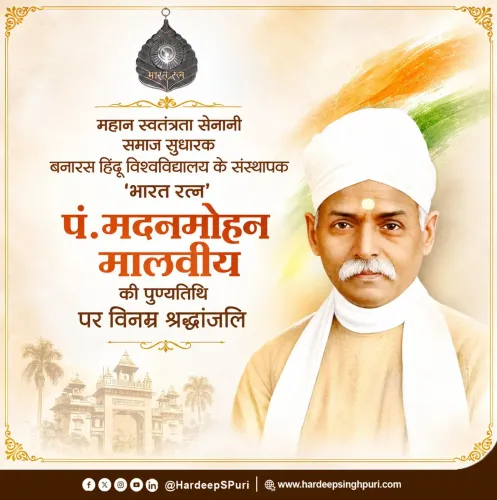
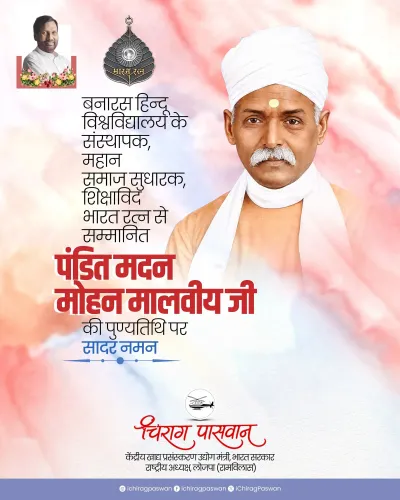
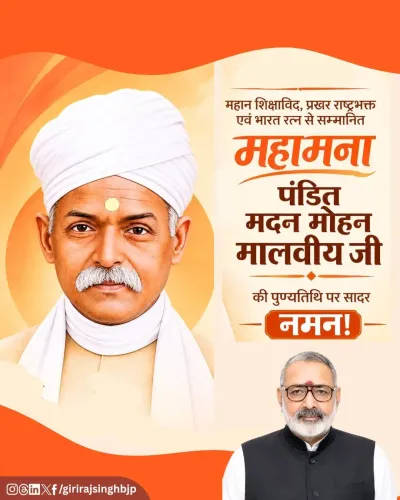
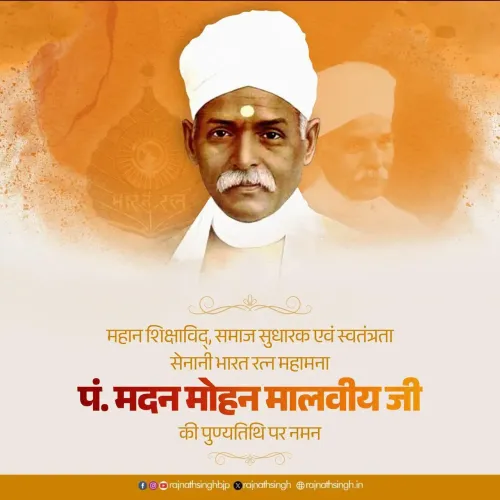
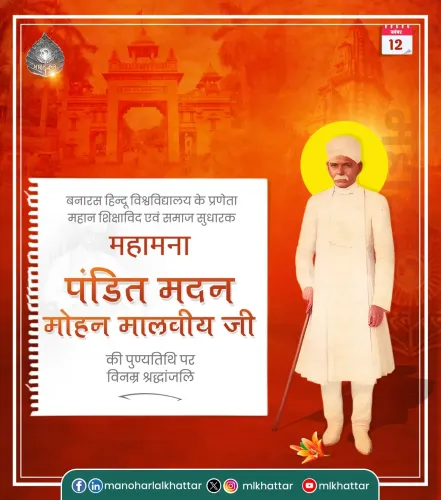
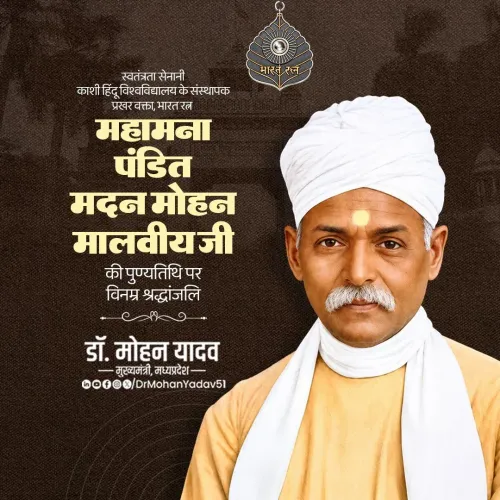
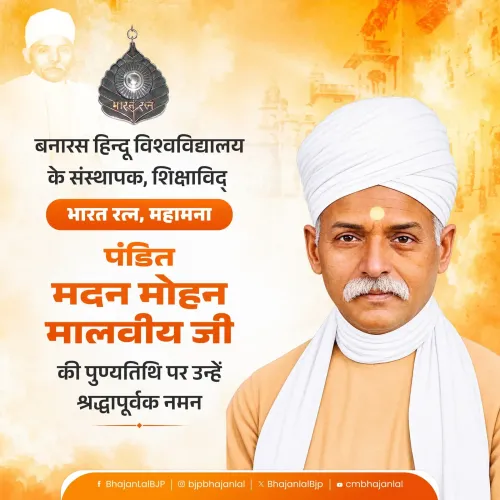
Lalan Singh pays tribute to BHU founder Madan Mohan Malaviya
Synopsis
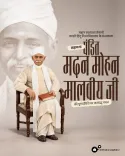
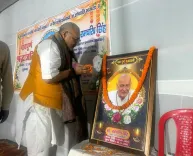
Union Minister Lalan Singh paid tribute to Pandit Madan Mohan Malaviya on his death anniversary on 12 November, honouring the founder of Banaras Hindu University and his enduring legacy in Indian education and nation-building.
Key Takeaways
Union Minister Rajiv Ranjan Singh (Lalan Singh) paid tribute to Pandit Madan Mohan Malaviya on his death anniversary, 12 November 2026 .
Malaviya, born in 1861 , was the founder of Banaras Hindu University (BHU) , established in 1916 in Varanasi.
Malaviya passed away on 12 November 1946 , weeks before Indian independence.
Lalan Singh hailed Malaviya's 'incomparable contribution to nation-building and education' as forever memorable.
BHU remains one of Asia's largest residential universities and a central institution under the Union Education Ministry.
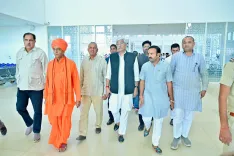
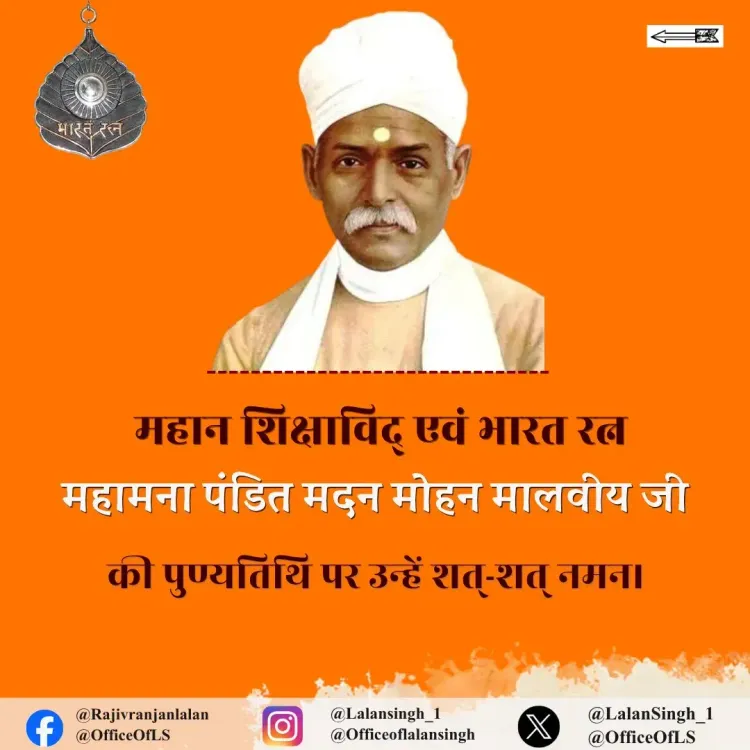
On the death anniversary of one of India's greatest educationists, Union Panchayati Raj and Fisheries Minister Rajiv Ranjan Singh — widely known as Lalan Singh — offered his homage to Pandit Madan Mohan Malaviya on 12 November 2026, remembering the visionary as an irreplaceable force in the making of modern India.
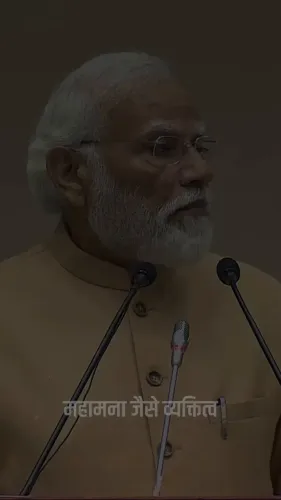
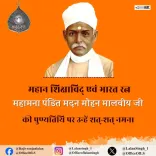
Posting on X in Hindi, the minister wrote: 'महान शिक्षाविद् एवं काशी हिंदू विश्वविद्यालय के संस्थापक महामना पंडित मदन मोहन मालवीय जी की पुण्यतिथि पर उन्हें विनम्र श्रद्धांजलि एवं शत्-शत् नमन।' — 'On the death anniversary of the great educationist and founder of Banaras Hindu University, Mahamana Pandit Madan Mohan Malaviya, I offer my humble tribute and salutations.' He added that Malaviya's 'incomparable contribution to nation-building and education will forever remain in our memory.'
The man who built a university for a nation in the making
Pandit Madan Mohan Malaviya, born in 1861 in Allahabad, wore many hats — lawyer, journalist, independence activist, Congress president — but history remembers him above all as the founder of Banaras Hindu University (BHU). Established in 1916 in Varanasi, BHU was Malaviya's answer to a civilisational question: could India have an institution that blended the rigour of modern science with the depth of Sanskrit learning and Hindu philosophy? The answer, still standing as one of Asia's largest residential universities, is an unambiguous yes. Malaviya spent years raising funds for BHU across the country — from maharajas to common citizens — driven by the conviction that education was the bedrock of self-rule. He passed away on 12 November 1946, just months before the independence he had worked a lifetime to bring about.A tradition of remembrance on the twelfth of November
Across the political spectrum, 12 November draws public tributes from Indian leaders to Malaviya — a pattern that reflects both his towering stature and the enduring association of education with national identity in Indian public life. For a senior leader of the Janata Dal (United) like Lalan Singh, whose party governs Bihar alongside the BJP-led National Democratic Alliance at the Centre, such acknowledgements also speak to a broader emphasis on constitutional figures who bridged caste, region, and religion through institution-building. BHU today is a central university under the Union Education Ministry, with its campus in Varanasi drawing students from across South Asia. Commemorative events on campus and ministerial statements like Lalan Singh's are a steady fixture each year on this date. Eighty years after his death, Malaviya's wager — that a free India needed educated citizens before anything else — still frames the debate around public universities and their purpose. That is the legacy Lalan Singh invoked this morning. It is not a small one.Point of View
Invoking Malaviya — a figure closely tied to Varanasi and the Hindi heartland — carries particular resonance in a state like Bihar where education access remains a live political issue. The annual rhythm of such tributes also signals that education and nation-building remain potent symbolic frames, even when no immediate policy announcement accompanies them. What gives Malaviya's legacy its durability is precisely its institutional concreteness: BHU is not an idea, it is a campus of thousands.
NationPress
12 Nov 2026
Frequently Asked Questions
Who was Pandit Madan Mohan Malaviya?
Pandit Madan Mohan Malaviya (1861–1946) was an Indian educationist, independence activist and the founder of Banaras Hindu University (BHU) in Varanasi, established in 1916 to blend modern learning with Indian cultural traditions.
When did Madan Mohan Malaviya die?
Madan Mohan Malaviya passed away on 12 November 1946, just months before India achieved independence in August 1947.
Why is Banaras Hindu University significant?
BHU, founded in 1916, is one of Asia's largest residential universities and was conceived by Malaviya as an institution that combined modern science with Sanskrit scholarship and Hindu philosophy, making it a cornerstone of Indian higher education.
Why do Indian ministers pay tribute to Malaviya on 12 November?
12 November marks the death anniversary of Pandit Madan Mohan Malaviya. It is a tradition across India's political spectrum to acknowledge his contributions to education and nation-building on this date, with commemorative events often held at BHU in Varanasi.