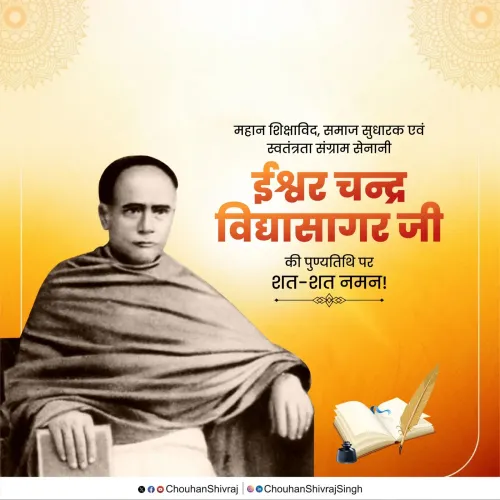
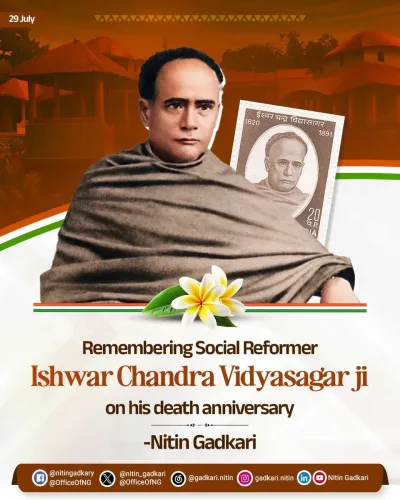
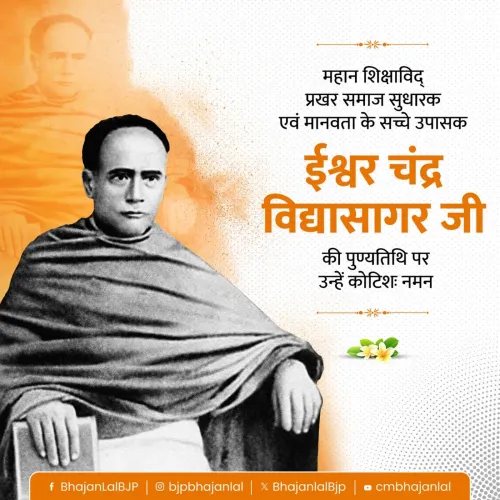
Lalan Singh pays tribute to Ishwar Chandra Vidyasagar on Jayanti

Synopsis
Union Panchayati Raj Minister Lalan Singh paid tribute to 19th-century reformer Ishwar Chandra Vidyasagar on his Jayanti, honouring his pioneering work in education, women's empowerment and social reform — particularly the landmark Hindu Widows' Remarriage Act of 1856.
Key Takeaways
Lalan Singh posted a tribute to Ishwar Chandra Vidyasagar on his birth anniversary, 26 September 2026 .
Vidyasagar, born in 1820 in Bengal, successfully campaigned for the Hindu Widows' Remarriage Act of 1856 .
He established multiple schools for girls and worked to make Bengali-script literacy more accessible.
The minister highlighted Vidyasagar's contributions in education, women's empowerment, and social reform as enduringly significant.
Vidyasagar Jayanti is observed annually on 26 September across India, particularly in West Bengal.
On the birth anniversary of one of India's greatest 19th-century reformers, Union Minister Rajiv Ranjan Singh (Lalan Singh) offered a respectful tribute to Ishwar Chandra Vidyasagar on Saturday, 26 September 2026, honouring a legacy that reshaped the social fabric of modern India.
Posting in Hindi, the senior Janata Dal (United) leader wrote: 'महान समाज सुधारक ईश्वर चंद्र विद्यासागर जी की जयंती पर उन्हें सादर नमन' — 'Respectful salutations to great social reformer Ishwar Chandra Vidyasagar on his birth anniversary. His contributions in the fields of education, women's empowerment and social reform will always be remembered.'
The reformer whose pen changed a nation's laws
Ishwar Chandra Vidyasagar, born in 1820 in Bengal, was not merely a scholar — he was a demolition crew aimed at the cruelties of his time. A master of Sanskrit and a tireless educator, he lobbied persistently until the colonial legislature passed the Hindu Widows' Remarriage Act of 1856, a landmark that gave widows — many of them children — the legal right to rebuild their lives. That single legislative win remains one of the most consequential social-reform victories of colonial India.
He did not stop there. Vidyasagar established scores of schools for girls at a time when female education was socially taboo, and he championed the simplification of the Bengali script, making literacy more accessible to ordinary people. His name — 'Vidyasagar', meaning 'ocean of knowledge' — was bestowed on him by the Sanskrit College, Calcutta, and it stuck because it fit.
Why political leaders keep returning to Vidyasagar
Across party lines, India's political class regularly invokes Vidyasagar on his Jayanti — and the impulse is not accidental. His three pillars of education, women's empowerment, and social reform map neatly onto the stated priorities of successive governments. For a Union minister who oversees Panchayati Raj — the grassroots layer of Indian democracy — the resonance with rural women's rights and local governance is particularly direct.
The tribute is ceremonial in form, but it points to something durable: nearly 170 years after the Widows' Remarriage Act, Vidyasagar's agenda remains unfinished business in pockets of the country, which is precisely why his anniversary still commands attention at the Cabinet level.
Point of View
The reference to Vidyasagar's grassroots educational work is not incidental. Yet such ceremonial tributes, however sincere, also highlight the gap between commemorating reformers and legislating the structural changes they once fought for.
NationPress
26 Sept 2026
Frequently Asked Questions
Who was Ishwar Chandra Vidyasagar?
Ishwar Chandra Vidyasagar was a 19th-century Bengali polymath, educator, and social reformer, born in 1820. He is best known for successfully campaigning for the Hindu Widows' Remarriage Act of 1856 and for founding schools for girls across Bengal.
When is Vidyasagar Jayanti celebrated?
Vidyasagar Jayanti is celebrated annually on 26 September, marking the birth anniversary of Ishwar Chandra Vidyasagar.
What did Lalan Singh say about Vidyasagar?
Union Minister Lalan Singh offered respectful salutations to Vidyasagar and stated that his contributions in education, women's empowerment, and social reform will always be remembered.
What was the Hindu Widows' Remarriage Act of 1856?
The Hindu Widows' Remarriage Act of 1856 was a colonial-era legislation that legalised the remarriage of Hindu widows in India, primarily campaigned for by Ishwar Chandra Vidyasagar, making it one of the most significant social-reform victories of 19th-century India.
Who is Lalan Singh and what ministry does he head?
Lalan Singh, formally known as Rajiv Ranjan Singh, is a senior Janata Dal (United) leader and the Union Minister of Panchayati Raj, Fisheries, Animal Husbandry and Dairying in the Indian Cabinet.