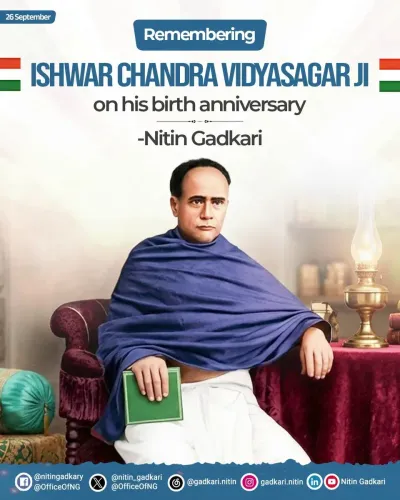
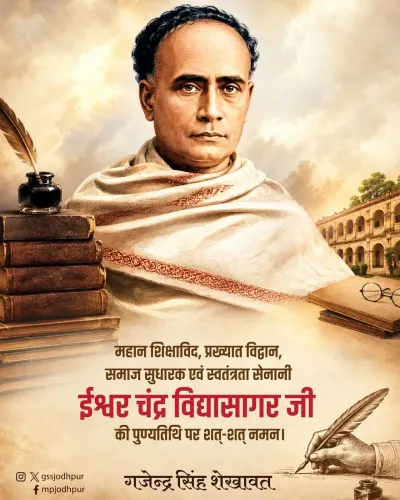
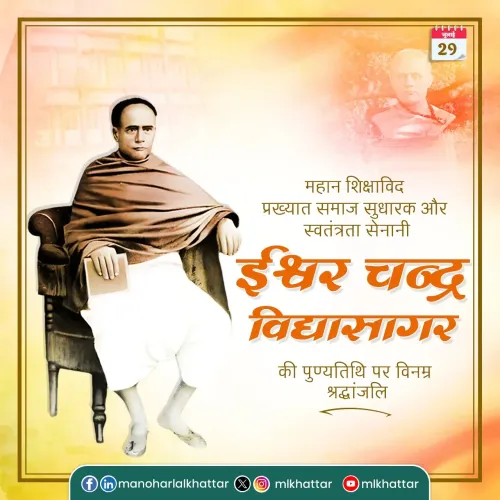
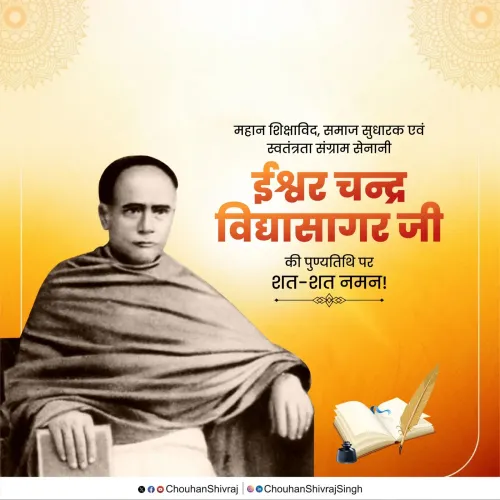
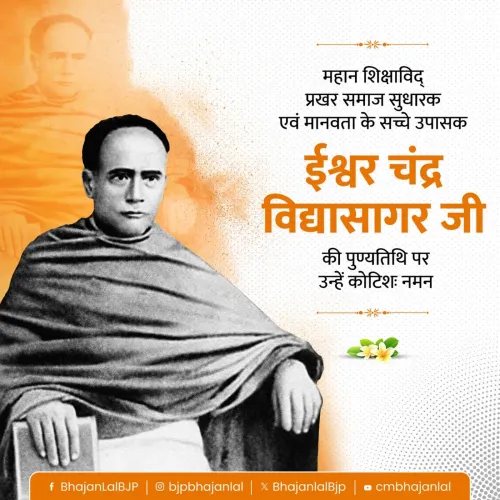
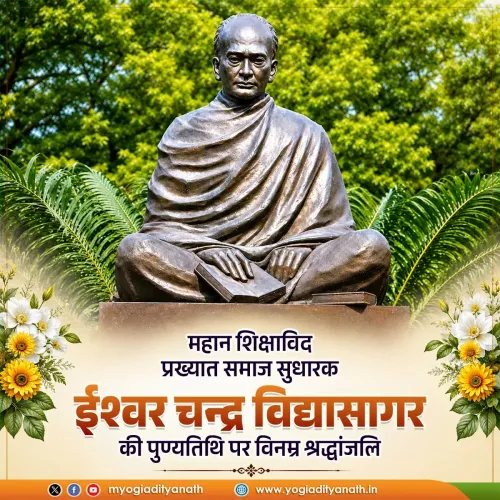
Gadkari Remembers Vidyasagar on Death Anniversary
Synopsis
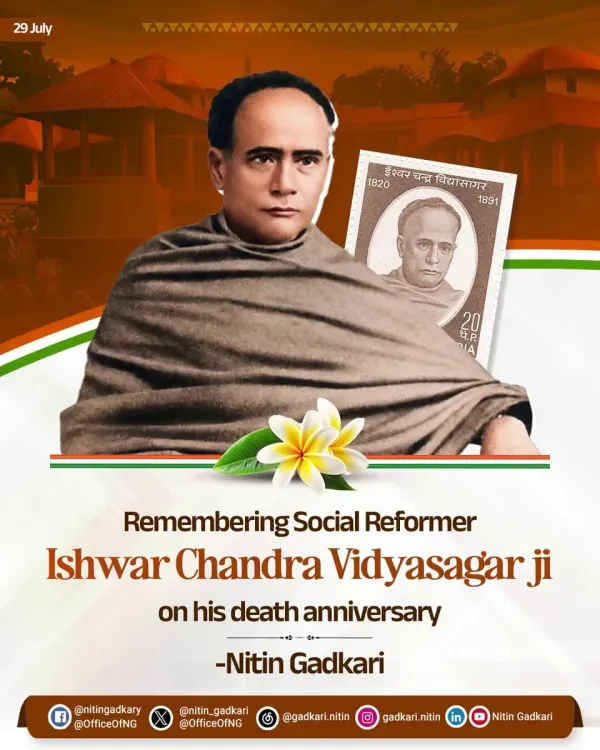
Union Minister Nitin Gadkari marked the death anniversary of Ishwar Chandra Vidyasagar on 29 July, honouring the Bengal Renaissance scholar whose campaigns for widow remarriage and female education transformed 19th-century India.
Key Takeaways
Nitin Gadkari posted a tribute to Ishwar Chandra Vidyasagar on his death anniversary, 29 July .
Vidyasagar (1820–1891) was a central figure of the Bengal Renaissance , known for championing widow remarriage and female education.
His advocacy helped bring about the Hindu Widows' Remarriage Act of 1856 , a landmark social reform law.
Gadkari described him as 'one of the pillars of Bengal Renaissance' and credited his 'major role towards women empowerment.' BJP leaders regularly mark the anniversaries of 19th-century reformers as part of a broader social-reform heritage narrative.
On the death anniversary of one of India's most consequential social reformers, Union Road Transport and Highways Minister Nitin Gadkari paid tribute to Ishwar Chandra Vidyasagar, honouring the 19th-century scholar who reshaped the social fabric of Bengal — and, in many ways, of modern India.
Gadkari described Vidyasagar as 'a distinguished social reformer and one of the pillars of Bengal Renaissance, who played a major role towards women empowerment' — a characterisation that captures the scale of a life spent fighting entrenched orthodoxy.
The man who moved mountains for widows
Ishwar Chandra Vidyasagar (1820–1891) was not merely a scholar — he was a disruptor. A towering figure of the Bengal Renaissance, he campaigned relentlessly for widow remarriage at a time when the practice was socially condemned and legally barred. His advocacy directly contributed to the passage of the Hindu Widows' Remarriage Act of 1856, one of the most significant social reform legislations of colonial India. He also championed female education, establishing schools for girls across Bengal when such institutions were virtually nonexistent.
Vidyasagar's legacy is not confined to legislation. He modernised the Bengali script, wrote foundational primers still in use, and used his own resources to fund reform causes — a rare combination of intellectual force and personal sacrifice that earned him the title Vidyasagar, meaning 'ocean of knowledge.'
BJP's reform-heritage narrative on annual display
BJP leaders have made a pattern of marking the birth and death anniversaries of 19th and early 20th-century social reformers on social media — a practice that weaves the party's political identity into India's long arc of social progress. Tributes to figures like Vidyasagar serve as a reminder that the push for women's rights and education has deep, pre-Independence roots — roots the party seeks to claim as part of a shared national heritage.
No policy announcement or legislative action is linked to today's commemoration. This is an annual observance, and 29 July marks the day Vidyasagar passed away in 1891.
More than a century after his death, Vidyasagar's battles — for a widow's right to remarry, for a girl's right to learn — remain live debates in parts of India. That a senior Union Minister pauses to name him is a small but telling signal of who the republic still considers worth remembering.
Point of View
Not merely a regional Bengali one. Vidyasagar is a particularly potent symbol: his campaigns for widow remarriage and female education predate the independence movement, allowing the party to anchor its women's empowerment messaging in deep historical roots. The tribute carries no immediate policy weight, but in the context of Bengal's politically contested identity, invoking Vidyasagar is never entirely without political resonance. It is a soft-power move as much as a memorial one.
NationPress
27 Oct 2026
Frequently Asked Questions
Who was Ishwar Chandra Vidyasagar?
Ishwar Chandra Vidyasagar (1820–1891) was a 19th-century Bengali scholar, educator, and social reformer central to the Bengal Renaissance. He is best known for his successful campaign for widow remarriage, which led to the Hindu Widows' Remarriage Act of 1856, and for promoting female education across Bengal.
When did Ishwar Chandra Vidyasagar die?
Ishwar Chandra Vidyasagar died on 29 July 1891 . His death anniversary is observed annually on this date.
What is the Bengal Renaissance?
The Bengal Renaissance was a cultural, intellectual, and social reform movement in Bengal during the 19th and early 20th centuries. It produced thinkers and reformers — including Vidyasagar and Raja Ram Mohan Roy — who challenged social orthodoxies around caste, gender, and education.
What did Nitin Gadkari say about Vidyasagar?
Gadkari described Vidyasagar as 'a distinguished social reformer and one of the pillars of Bengal Renaissance, who played a major role towards women empowerment,' paying tribute on his death anniversary via a post on X.
Why do BJP leaders pay tribute to Vidyasagar?
BJP leaders periodically mark the anniversaries of 19th-century social reformers to align the party's identity with India's long tradition of social reform. Vidyasagar's work on widow remarriage and female education makes him a significant figure in women's empowerment narratives.