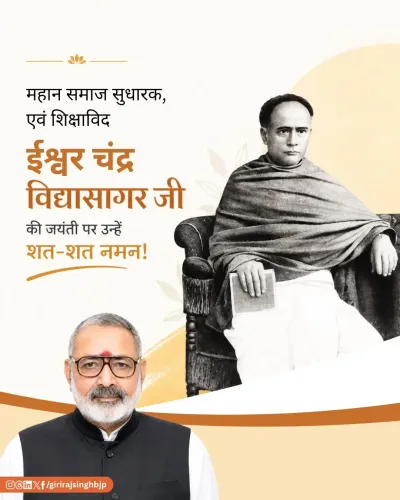
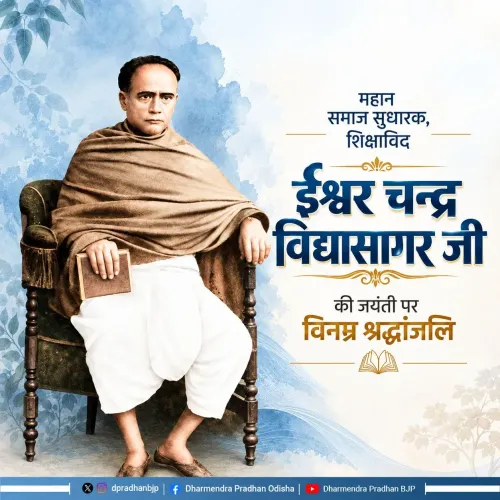
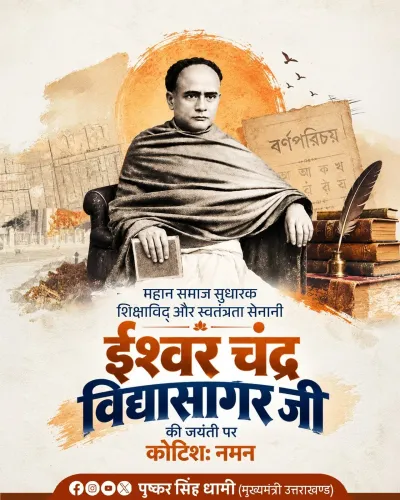
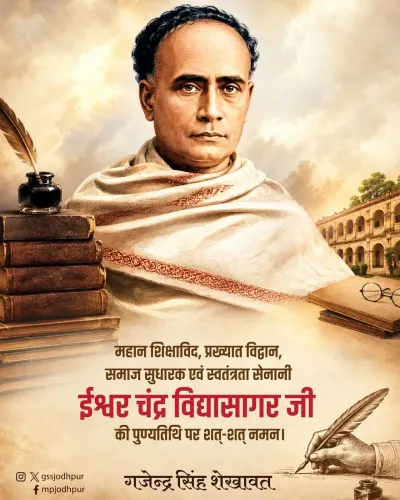
Gadkari remembers Ishwar Chandra Vidyasagar on birth anniversary
Synopsis
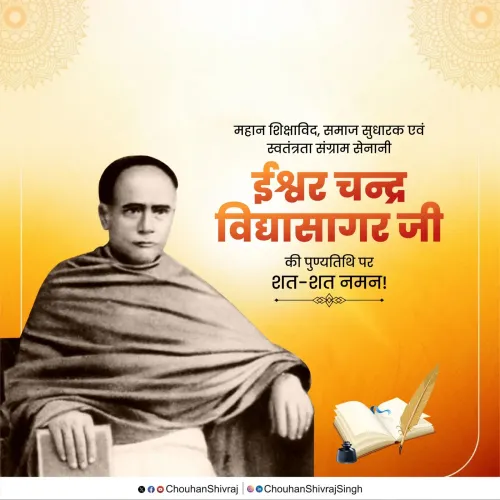
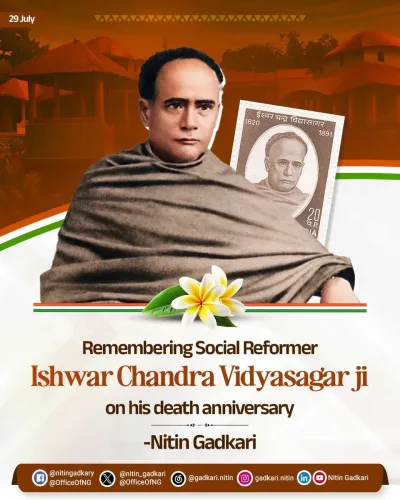
Union Minister Nitin Gadkari paid homage to 19th-century reformer Ishwar Chandra Vidyasagar on his birth anniversary, honouring the Bengali scholar's landmark campaigns for widow remarriage and girls' education.
Key Takeaways
Nitin Gadkari paid tribute to Ishwar Chandra Vidyasagar on his birth anniversary, 26 September 2026 .
Vidyasagar was a central figure of the Bengal Renaissance , the 19th-century intellectual awakening that shaped modern India.
His advocacy directly led to the Hindu Widows' Remarriage Act of 1856 , a landmark legal reform.
He championed girls' schooling and reformed Sanskrit College, Calcutta , broadening access to education.
The tribute carries no policy or legislative announcement — it is part of routine cultural commemoration by Union ministers.
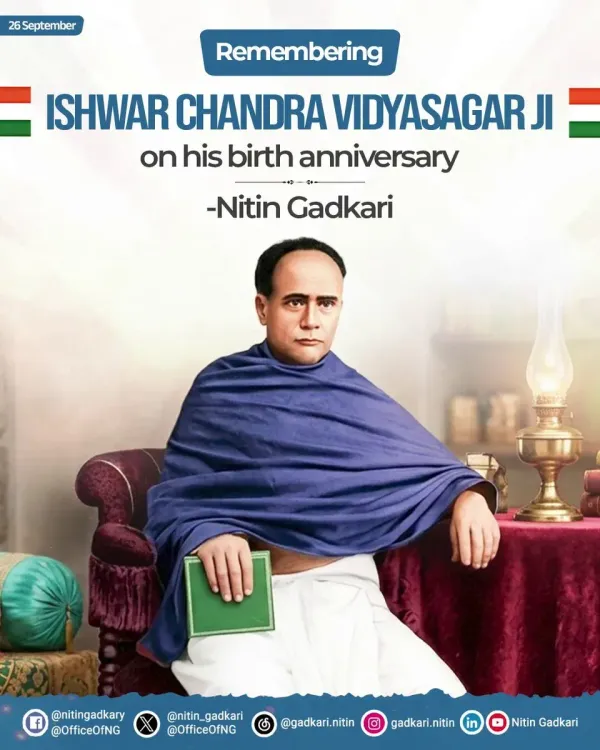
A reformer who rewrote the rules for millions of women in 19th-century India — Union Road Transport and Highways Minister Nitin Gadkari on Saturday, 26 September, paid tribute to Ishwar Chandra Vidyasagar on his birth anniversary, calling him 'a distinguished social reformer and one of the pillars of Bengal Renaissance.'
The man who moved a nation's conscience
Ishwar Chandra Vidyasagar — scholar, educator, and fierce humanist — stands as one of the most consequential figures of 19th-century India. Born in 1820 in Birsingha, Bengal, he rose from modest origins to become the principal of Sanskrit College, Calcutta, and systematically dismantled barriers that had kept women confined and uneducated for generations. His most celebrated campaign led directly to the Hindu Widows' Remarriage Act of 1856 — landmark legislation that, for the first time, gave Hindu widows the legal right to remarry. He championed girls' schooling at a time when female education was not merely uncommon but actively discouraged, and he reformed Sanskrit pedagogy to make learning more accessible to a broader student population.A Bengali intellectual giant at the heart of a national movement
Vidyasagar was not a lone voice — he was a fulcrum of the Bengal Renaissance, the 19th-century intellectual and cultural awakening that produced figures like Raja Ram Mohan Roy and Rabindranath Tagore and seeded the reform impulse that would eventually feed into the independence movement. His scholarship, his pen, and his relentless advocacy made him, in the words of contemporaries, a 'Daya-r Sagar' — an ocean of compassion. Union ministers routinely mark the birth anniversaries of pre-independence reformers on social media, situating their tributes within a broader cultural commemoration effort. Gadkari's post carries no policy announcement or legislative signal — it is a moment of national remembrance for a figure whose legacy cuts across party and regional lines. On a day India pauses to honour a man who made widowhood less of a life sentence and opened schoolroom doors for girls who had none, the tribute is a reminder that the architecture of modern Indian society rests on shoulders like Vidyasagar's.Point of View
Secular intellectual hero — carries a particular resonance in a state where the party has invested heavily in electoral credibility. The tribute signals no immediate policy direction but reinforces the government's posture of continuity with India's reform tradition. It also keeps Vidyasagar's legacy visible in a national conversation that can sometimes reduce 19th-century Bengal's intellectual giants to regional footnotes.
NationPress
26 Sept 2026
Frequently Asked Questions
Who was Ishwar Chandra Vidyasagar?
Ishwar Chandra Vidyasagar was a 19th-century Bengali scholar and social reformer, born in 1820, who championed widow remarriage, girls' education, and Sanskrit education reform. He is considered one of the key figures of the Bengal Renaissance.
What was Vidyasagar's role in the Bengal Renaissance?
Vidyasagar was a central pillar of the Bengal Renaissance — an intellectual and cultural awakening in 19th-century Bengal that produced reformers and thinkers who laid the groundwork for India's modern social fabric.
What law did Vidyasagar help pass?
Vidyasagar's persistent advocacy led to the Hindu Widows' Remarriage Act of 1856, which for the first time gave Hindu widows the legal right to remarry in British India.
Why did Nitin Gadkari pay tribute to Vidyasagar?
26 September is Ishwar Chandra Vidyasagar's birth anniversary. Gadkari posted a tribute on X honouring him as 'a distinguished social reformer and one of the pillars of Bengal Renaissance.'
Is Vidyasagar's birth anniversary a national event?
While not a gazetted national holiday, Vidyasagar's birth anniversary is widely observed across India, particularly in West Bengal, with tributes from political leaders, cultural institutions, and educational bodies.