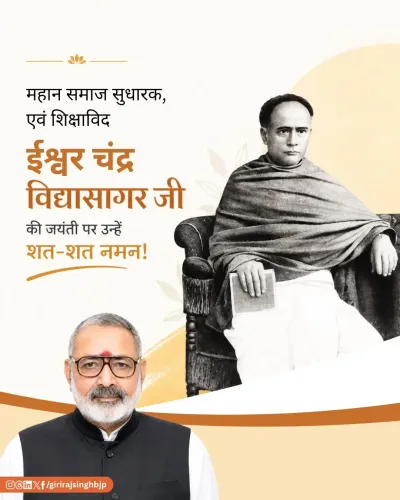
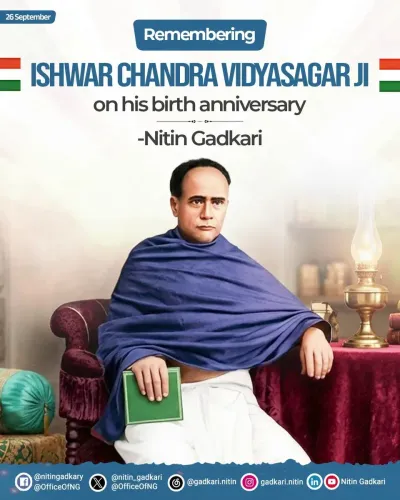
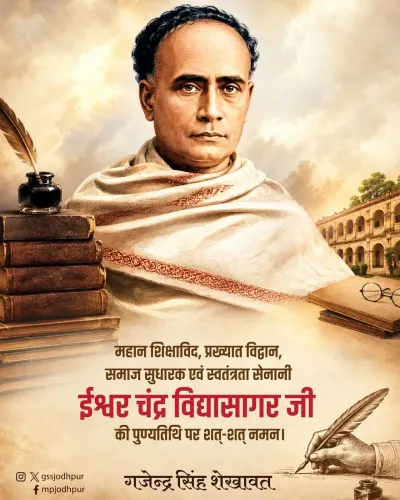
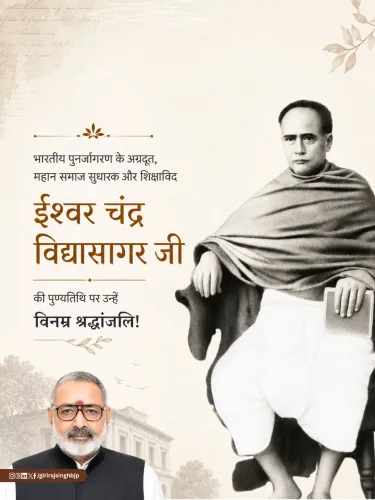
Shekhawat pays tribute to Ishwar Chandra Vidyasagar on jayanti
Synopsis
Union Culture Minister Gajendra Singh Shekhawat marked the birth anniversary of Ishwar Chandra Vidyasagar on 26 September 2026, honouring the 19th-century Bengali polymath who championed widow remarriage, women's education and the modernisation of Bengali prose.
Key Takeaways
Union Culture and Tourism Minister Gajendra Singh Shekhawat posted a tribute on X on 26 September 2026 marking Ishwar Chandra Vidyasagar's birth anniversary.
Vidyasagar (born 1820 ) was a Bengali polymath, social reformer, educationist, philosopher and freedom fighter central to the Bengal Renaissance .
His advocacy directly contributed to the passage of the Hindu Widows' Remarriage Act of 1856 , one of colonial India's landmark social reforms.
He served as principal of Sanskrit College, Kolkata , and is credited with modernising Bengali prose for mass readership.
The tribute aligns with the Ministry of Culture's mandate to commemorate reformers linked to India's social-reform and freedom-struggle heritage.
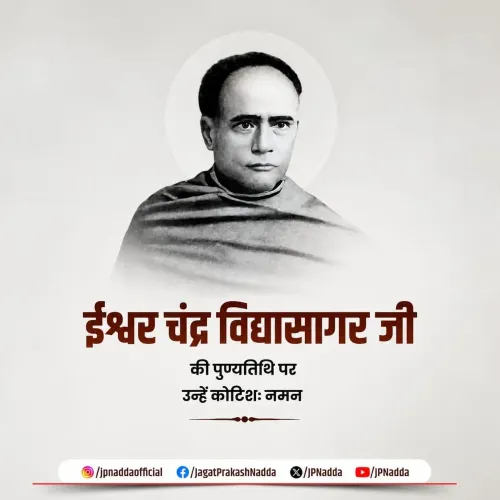
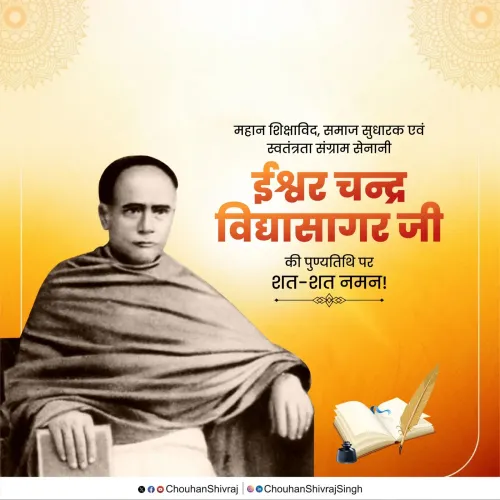
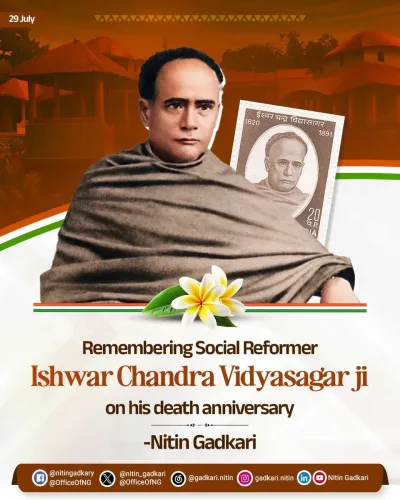
On the birth anniversary of one of India's most transformative 19th-century minds, Union Culture and Tourism Minister Gajendra Singh Shekhawat offered his respects to Ishwar Chandra Vidyasagar — the polymath who rewrote the social contract of colonial Bengal — on Saturday, 26 September 2026.
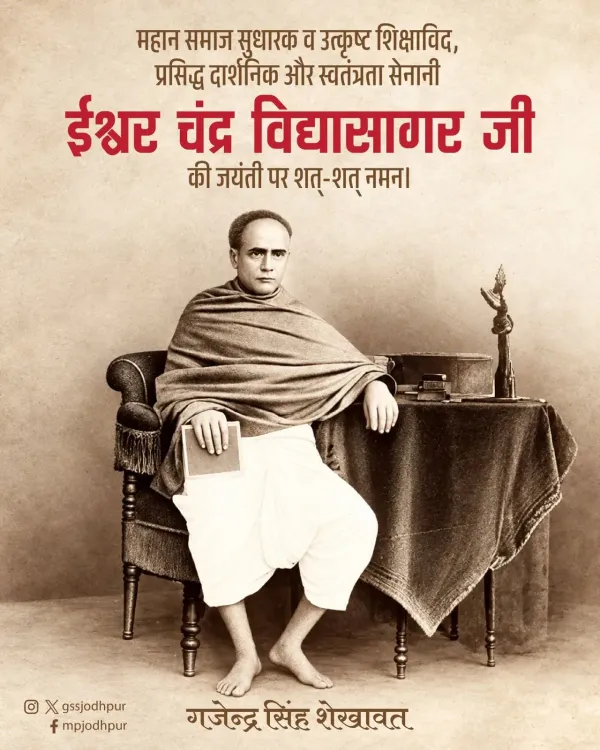
Posting in Hindi on X, Minister Shekhawat wrote: 'महान समाज सुधारक व उत्कृष्ट शिक्षाविद, प्रसिद्ध दार्शनिक और स्वतंत्रता सेनानी ईश्वर चंद्र विद्यासागर जी की जयंती पर शत्-शत् नमन' — 'A hundred salutations on the birth anniversary of the great social reformer, outstanding educationist, renowned philosopher and freedom fighter Ishwar Chandra Vidyasagar.'
The reformer who moved mountains for widows and girls
Ishwar Chandra Vidyasagar — born in 1820 in the Midnapore district of Bengal — was the architect of two of the most consequential social campaigns of the Bengal Renaissance: the legal recognition of widow remarriage and the expansion of women's education across rural Bengal. His relentless advocacy led directly to the Hindu Widows' Remarriage Act of 1856, a legislative landmark that broke a centuries-old taboo and offered millions of women a path out of enforced destitution.
He was simultaneously a literary force — credited with modernising and simplifying Bengali prose, making it accessible to common readers — and an institutional builder, serving as principal of Sanskrit College, Kolkata, where he fought to open the doors of Sanskrit learning to non-Brahmin students. The title 'Vidyasagar' — meaning 'ocean of knowledge' — was conferred on him by the college itself. He was no armchair philosopher. His battles were fought in courtrooms, classrooms and print shops.
Culture Ministry's mandate and the jayanti tradition
Commemorating 19th-century social reformers sits squarely within the Ministry of Culture's stated mandate to honour figures linked to India's reform movements and freedom struggle. Union ministers across portfolios regularly mark such jayantis on social media, keeping public memory of these figures alive in national discourse. Vidyasagar's legacy — straddling education, gender justice and literary modernisation — makes him a particularly resonant figure for a ministry that oversees both cultural heritage and the country's soft-power narrative.
For a nation still working through the long tail of social inequities that Vidyasagar spent his life fighting, the annual recall of his work is less ceremony and more standing reminder of unfinished business.
Point of View
But Vidyasagar's anniversary carries particular resonance for the Culture portfolio — his campaigns on widow remarriage and girls' education represent precisely the kind of 'social transformation through knowledge' the ministry frames as civilisational heritage. Shekhawat's tribute signals continuity in the BJP government's practice of claiming the reformist strand of 19th-century Bengal, a tradition it has used to broaden its cultural-nationalist narrative beyond purely Hindu-religious icons. The commemoration also keeps Vidyasagar — a figure sometimes reduced to a Bengali-regional icon — in the pan-Indian public imagination, which serves the Ministry of Culture's broader soft-power agenda.
NationPress
26 Sept 2026
Frequently Asked Questions
Who was Ishwar Chandra Vidyasagar?
Ishwar Chandra Vidyasagar (1820–1891) was a 19th-century Bengali polymath, social reformer, educationist and philosopher. He is best known for championing widow remarriage — which led to the Hindu Widows' Remarriage Act of 1856 — promoting women's education, and modernising Bengali prose. He was a central figure of the Bengal Renaissance.
Why is Vidyasagar's birthday celebrated?
Vidyasagar's birth anniversary is observed to honour his transformative contributions to Indian society, particularly his successful campaign for widow remarriage rights and his work to expand education for women and non-Brahmin students. His legacy is considered foundational to modern Indian social thought.
What did Gajendra Singh Shekhawat post about Vidyasagar?
On 26 September 2026, Union Culture and Tourism Minister Gajendra Singh Shekhawat posted a Hindi tribute on X describing Vidyasagar as a 'great social reformer, outstanding educationist, renowned philosopher and freedom fighter' and offering him 'a hundred salutations' on his birth anniversary.
What is the Hindu Widows' Remarriage Act of 1856?
The Hindu Widows' Remarriage Act of 1856 was a colonial-era Indian law that legalised the remarriage of Hindu widows, who had previously been barred from remarrying by social and religious custom. Ishwar Chandra Vidyasagar's sustained advocacy was the primary force behind its passage.
Why does the Ministry of Culture commemorate 19th-century reformers?
The Ministry of Culture holds a mandate to preserve and promote India's cultural and historical heritage, which includes figures from the country's social-reform and freedom-struggle movements. Commemorating reformers like Vidyasagar helps keep their contributions in national public memory and supports India's cultural soft-power narrative.