Visakhapatnam data centres won't hit city water supply, says Andhra IT Minister Lokesh

Synopsis
Andhra Pradesh IT Minister Nara Lokesh told the state assembly that Visakhapatnam's data centre hub — now at its 6.5 GW ceiling — will draw water from Polavaram's industrial quota, not the city's drinking supply. With Google already in and CPI, CPI-M, and citizens' groups pushing back hard, the government's credibility now rests on whether those pipeline commitments and 18-month water supply timelines actually hold.
Key Takeaways
Nara Lokesh defended Visakhapatnam data centres in the Andhra Pradesh Legislative Assembly on 19 August , calling opposition claims misinformation.
The full 6.5 GW data-centre allocation ceiling set by CM Chandrababu Naidu has been reached; data centres are coming up at Adavivaram-Mudasarlova , Tarluvada , and Rambilli .
At 6.5 GW capacity, the hub is estimated to require around 3 TMC of water annually; newer cooling tech is expected to cut this further.
Water will come from Polavaram project's industrial allocation via dedicated pipelines — not from Visakhapatnam's urban supply.
Gravity-based urban water supply from Polavaram is expected within 18 months .
CPI , CPI-M , and citizens' groups continue to oppose the projects over environmental and drinking-water concerns.
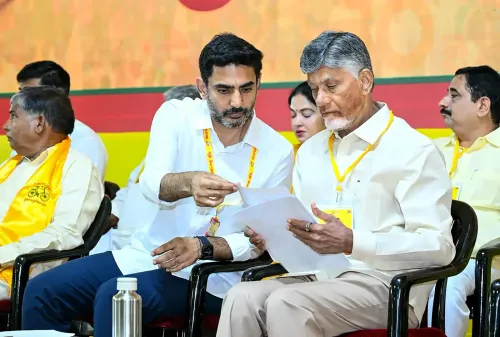
Andhra Pradesh IT Minister Nara Lokesh on Wednesday, 19 August defended the state government's plan to establish a data centre hub in Visakhapatnam, asserting that concerns over water and environmental impact were rooted in misinformation. Speaking on the floor of the State Legislative Assembly in Amaravati, Lokesh said the projects pose no threat to the city's drinking water supply and represent a critical investment in India's digital future.
What Lokesh Said in the Assembly
The minister was responding to a question raised by Jana Sena MLA Lokam Naga Madhavi. Lokesh said data centres are indispensable to an AI-driven digital economy and to India's data sovereignty, particularly given emerging geopolitical pressures. He noted that Google's decision to invest in Visakhapatnam had already triggered broader interest from other IT companies in the city.
On water usage, Lokesh said that once the proposed data-centre ecosystem reaches its targeted capacity of 6.5 GW, it is estimated to consume approximately 3 TMC of water annually based on current technology. He added that newer cooling technologies are expected to reduce that figure further over time.
Water Source and Infrastructure Plan
Lokesh clarified that water for the data centres would be drawn exclusively from the industrial allocation under the Polavaram project — not from the supply earmarked for Visakhapatnam's residents. He said the government is committed to meeting the city's urban water needs through Polavaram as well, with a gravity-based supply system expected to be operational within 18 months. Dedicated pipelines for data centres would be laid separately, he added.
To contextualise water consumption, Lokesh offered a pointed comparison: a 1 GW thermal power plant consumes nearly 10 times more water annually than a data centre of equivalent capacity. He questioned why public opposition over water usage had been directed specifically at data centres while thermal plants faced no similar scrutiny.
Capacity Cap and Environmental Commitment
Lokesh disclosed that Chief Minister N. Chandrababu Naidu had set a firm ceiling of 6.5 GW for data-centre allocations in the state, and confirmed that this target has now been fully met. He said the government would going forward prioritise companies demonstrating strong environmental responsibility. The data centres are coming up at Adavivaram-Mudasarlova, Tarluvada, and Rambilli areas in Visakhapatnam.
Opposition and Citizen Concerns
The minister's remarks come amid sustained pushback from multiple quarters. Citizens' groups in Visakhapatnam have opposed the data centre hub, citing fears of strain on water and power resources and broader environmental degradation. They have pointed to a Super El Niño-like weather pattern that has already stressed water availability across Andhra Pradesh as grounds for caution.
The Communist Party of India (CPI) and the Communist Party of India (Marxist) (CPI-M) have also opposed the projects, alleging adverse effects on the environment, drinking water sources, and public health. The government has not yet independently verified or addressed the specific claims raised by these groups beyond Lokesh's assembly statement.
What Comes Next
With the 6.5 GW allocation ceiling now reportedly reached, the immediate focus shifts to execution — dedicated pipeline infrastructure, Polavaram gravity-supply timelines, and the adoption of water-efficient cooling technologies. How the government manages transparency around industrial water drawdowns from Polavaram will likely determine whether public trust in the project can be rebuilt.
Point of View
And stacking industrial demand — even from a separate Polavaram quota — onto an already-strained basin is a cumulative risk, not a zero-sum one. The 18-month gravity-supply promise has been made before in various forms; what is missing is a binding, publicly audited timeline with penalties for slippage. More critically, the government has capped allocation at 6.5 GW but offered no independent environmental impact data to back Lokesh's misinformation claim. Dismissing CPI, CPI-M, and citizens' groups as misinformation vectors without publishing verified water-drawdown projections is a governance gap that could deepen, not defuse, the controversy.
NationPress
3 Oct 2026
Frequently Asked Questions
Will Visakhapatnam's data centres affect the city's drinking water supply?
According to IT Minister Nara Lokesh, the data centres will draw water exclusively from the industrial allocation of the Polavaram project through dedicated pipelines, separate from the supply earmarked for Visakhapatnam's residents. The government has committed to meeting the city's urban water needs via a gravity-based Polavaram supply within 18 months.
How much water will the Visakhapatnam data centre hub consume?
At the targeted 6.5 GW capacity, the data centre ecosystem is estimated to require around 3 TMC of water annually based on current technology, according to Minister Lokesh. He added that newer cooling technologies are expected to reduce this figure over time.
What is the total data centre capacity approved for Visakhapatnam?
Chief Minister N. Chandrababu Naidu had set a ceiling of 6.5 GW for data centre allocations in Andhra Pradesh, and Minister Lokesh confirmed in the assembly that this target has now been fully achieved.
Why are citizens' groups and left parties opposing the data centres?
Citizens' groups in Visakhapatnam have raised concerns about strain on water and power resources and environmental impact, also citing a Super El Niño-like weather pattern stressing the state's water availability. The CPI and CPI-M have alleged adverse effects on the environment, drinking water sources, and public health.
Where exactly are the data centres being built in Visakhapatnam?
The data centres are being developed in the Adavivaram-Mudasarlova, Tarluvada, and Rambilli areas of Visakhapatnam, according to information provided by the state government.