Maharashtra Cabinet Decision on Cooperation and Marketing Dept
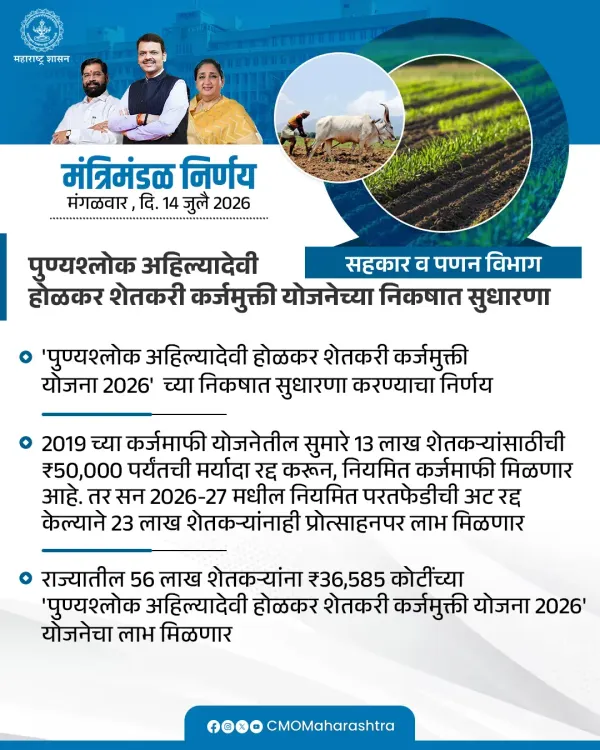
Synopsis
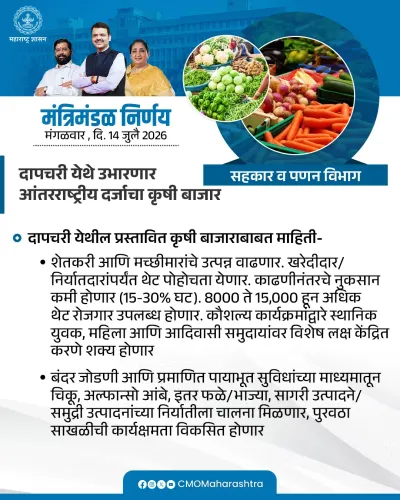
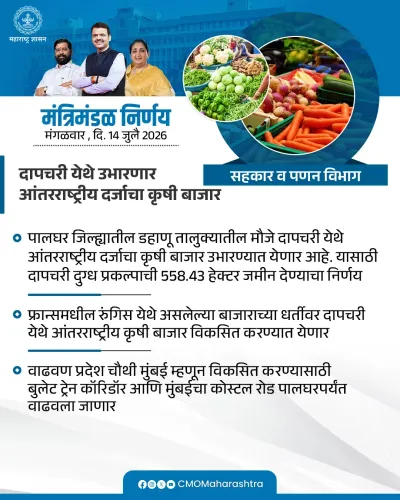
The Chief Minister's Office of Maharashtra announced a cabinet decision on the Cooperation and Marketing Department on 14 July 2026, with CM Devendra Fadnavis tagged in the official post, signalling a formal policy move affecting the state's vast cooperative and agricultural marketing network.
Key Takeaways
The CMO Maharashtra announced a cabinet decision on the Cooperation and Marketing Department on 14 July 2026 .
Chief Minister Devendra Fadnavis was directly tagged in the official communication, indicating his personal oversight of the decision.
The Cooperation and Marketing Department regulates cooperative societies, agricultural marketing, and fair price mechanisms across Maharashtra .
Maharashtra's cooperative sector spans sugar mills, dairy federations, rural credit societies, and agricultural produce marketing committees.
Detailed provisions of the cabinet decision are expected to be released via an official government notification or circular.
The decision may have downstream implications for farmers, cooperative society members, and agricultural marketers across the state.
The Chief Minister's Office of Maharashtra announced a cabinet decision pertaining to the Cooperation and Marketing Department on Tuesday, 14 July 2026, with the post tagging Chief Minister Devendra Fadnavis directly in the official communication.
Context
The post, shared by the official CMO Maharashtra handle, reads: 'मंत्रिमंडळ निर्णय : सहकार व पणन विभाग' ('Cabinet Decision: Cooperation and Marketing Department'). Such announcements are a standard channel through which the Maharashtra government communicates formal cabinet resolutions to the public. The tagging of Chief Minister Devendra Fadnavis signals that the decision was taken under his direct administrative purview.
Policy Backdrop
Maharashtra's cooperative sector is one of the largest and most complex in India, governed by the Maharashtra Cooperative Societies Act, 1960. The state's network spans agricultural credit, sugar cooperatives, dairy federations, and agricultural produce marketing committees. The Cooperation and Marketing Department is the nodal body responsible for regulating these societies, overseeing fair price mechanisms, and integrating rural producers with state marketing infrastructure.
During his earlier term from 2014 to 2019, CM Fadnavis had introduced measures to strengthen district central cooperative banks and marketing federations, establishing a policy continuity that his current administration appears to be building upon. Successive Maharashtra governments have used cabinet decisions to address governance gaps, financial viability concerns, and regulatory oversight within the cooperative ecosystem.
Stakeholders and Impact
The primary stakeholders in any decision touching the Cooperation and Marketing Department are the state's millions of farmers, cooperative society members, and agricultural marketers. Maharashtra hosts a significant share of India's sugar cooperative mills and rural credit societies, meaning even procedural or regulatory cabinet decisions can have wide-reaching consequences for rural livelihoods.
District central cooperative banks and state-level marketing federations are also directly affected by departmental policy shifts, particularly those related to financial restructuring, audit norms, or procurement mandates. Any change in oversight mechanisms can alter the credit flow and procurement efficiency that small and marginal farmers depend upon.
What's Next
The government is expected to release a detailed notification or official circular elaborating the specific provisions of this cabinet decision. Legislative follow-through, if required, could come during the upcoming monsoon or winter session of the Maharashtra legislature. Observers of the state's cooperative sector will watch for any accompanying budgetary allocations or amendments to existing regulatory frameworks that may accompany this announcement.
Point of View
An area the Chief Minister has prioritised across both his tenures. Maharashtra's cooperative network is politically and economically significant — sugar cooperatives in particular have historically been a key lever of rural influence in the state. A formal cabinet-level intervention signals that the government is addressing structural or regulatory concerns that could not be resolved at the departmental level alone. The specifics of the decision, once disclosed, will reveal whether this is a routine administrative measure or a more consequential policy shift in how the state manages its cooperative ecosystem.
NationPress
13 Oct 2026
Frequently Asked Questions
What is the Maharashtra cabinet decision on the Cooperation and Marketing Department?
The Chief Minister's Office of Maharashtra announced a cabinet decision related to the Cooperation and Marketing Department on 14 July 2026. The specific provisions are yet to be detailed in an official government notification.
What does the Cooperation and Marketing Department in Maharashtra do?
The Cooperation and Marketing Department regulates cooperative societies, oversees agricultural produce marketing committees, and manages fair price mechanisms across Maharashtra, playing a central role in rural credit and procurement.
How does this cabinet decision affect farmers in Maharashtra?
Any decision touching the Cooperation and Marketing Department can affect farmers through changes in cooperative credit access, procurement norms, or marketing infrastructure, given that millions of farmers are members of cooperative societies in the state.
What is Devendra Fadnavis's role in Maharashtra's cooperative sector?
As Chief Minister of Maharashtra, Devendra Fadnavis holds administrative oversight over the Cooperation and Marketing Department. During his earlier term from 2014 to 2019, his government introduced measures to strengthen district cooperative banks and marketing federations.
When will the full details of the Maharashtra cabinet decision be made public?
The government is expected to release a detailed official notification or circular. Legislative action, if needed, could follow in the upcoming monsoon or winter session of the Maharashtra legislature.