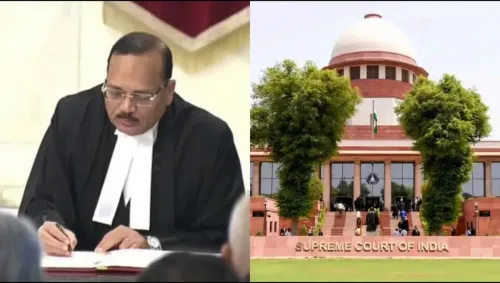
Mahua Moitra flags US judge's 'unusual' remark on $10 bn deal
Synopsis
TMC MP Mahua Moitra flagged a US judge's observation that a senior official's collaboration with defence lawyers — without consulting investigating agents — was 'unusual and concerning,' pointing to an unreported $10 billion deal at the heart of the case.
Key Takeaways
TMC MP Mahua Moitra posted on 11 August 2026 highlighting a US judicial observation on a high-value case.
A judge reportedly described a senior US official's collaboration with defence lawyers as 'unusual and concerning.' The official allegedly bypassed investigating agents when working with the defence side.
Moitra drew attention to what she said was a missing reference to a $10 billion deal in public reporting of the case.
The specific case details and identities of the parties remain unverified from available records.
Moitra has a documented pattern of using foreign legal proceedings to raise transparency questions in Indian political debate.
A judicial observation from a US courtroom landed in Indian political discourse on Tuesday, 11 August 2026, when TMC MP Mahua Moitra turned a pointed spotlight on what a judge reportedly called 'unusual and concerning' conduct — the collaboration of a senior US official with defence lawyers, bypassing the very agents investigating the case.
Moitra's post, laced with a sardonic 'Hahah,' zeroed in on what she framed as a glaring omission: no mention of a $10 billion deal at the centre of the controversy. The judge's quoted language — that the senior official's conduct was 'unusual and concerning' — carries weight precisely because such remarks from the bench are rare and deliberate. Judges do not reach for those words casually.
What the judge's language actually signals
In US legal proceedings, a judge flagging ex parte or unauthorised collaboration between a government official and defence counsel is a serious procedural red flag. It raises questions about the integrity of the investigation, the independence of prosecutorial decisions, and — in cases involving large commercial transactions — whether political or bureaucratic pressure shaped the legal strategy. The $10 billion figure Moitra references, if accurate, would place this among the most consequential deals under judicial scrutiny in recent memory.
The specific case and the identities of the senior official and the judge have not been independently confirmed from available records — the research on this post is limited, and the post date falls in 2026. What is verifiable is the pattern Moitra is invoking: Indian opposition legislators have increasingly used US legal and regulatory developments as a mirror to ask domestic questions about transparency in large defence and commercial contracts.
Moitra's track record of using foreign legal forums as leverage
This is not the first time the Krishnanagar MP has amplified a foreign judicial or regulatory proceeding to press a point at home. Her interventions — whether on financial wrongdoing, institutional independence, or executive overreach — have consistently used external credibility to sharpen domestic political arguments. The sardonic tone here is characteristic: the laugh is the argument. She is pointing at an absence — the deal not mentioned — as loudly as at the judge's words themselves.
The question she leaves hanging is the one that will follow this case through every subsequent filing: if a senior official was working with defence lawyers without informing investigating agents, who authorised that arrangement — and why did a $10 billion transaction stay off the record?
Point of View
The post is calibrated to seed that question in the public mind. The sardonic register signals confidence: she believes the facts, if they emerge, will do the work.
NationPress
11 Aug 2026
Frequently Asked Questions
What did the US judge say about the senior official in the $10 billion deal case?
According to Mahua Moitra's post, the judge described it as 'unusual and concerning' that a senior US official collaborated with defence lawyers without consulting the investigating agents on the case.
What is the $10 billion deal Mahua Moitra is referring to?
Moitra does not name the deal explicitly in her post. The specific transaction and the parties involved have not been independently verified from publicly available records as of the post date in 2026.
Why did Mahua Moitra post about a US court case?
Moitra highlighted the case to draw attention to what she framed as a transparency failure — a major deal going unmentioned alongside a judge's serious procedural concern about official conduct.
Is there an Indian connection to this US court case?
No Indian connection has been established or verified. Moitra's post does not assert one directly; she is pointing to the judicial observation and the omission of the deal from public discussion.
What happens next in the US court proceedings Moitra mentioned?
The key development to watch is any subsequent court filing or ruling that addresses the judge's concern about the senior official's collaboration with defence lawyers outside the investigating team's knowledge.