Jitan Ram Manjhi: Don't Narrow-Mind Population Growth Debate
Synopsis
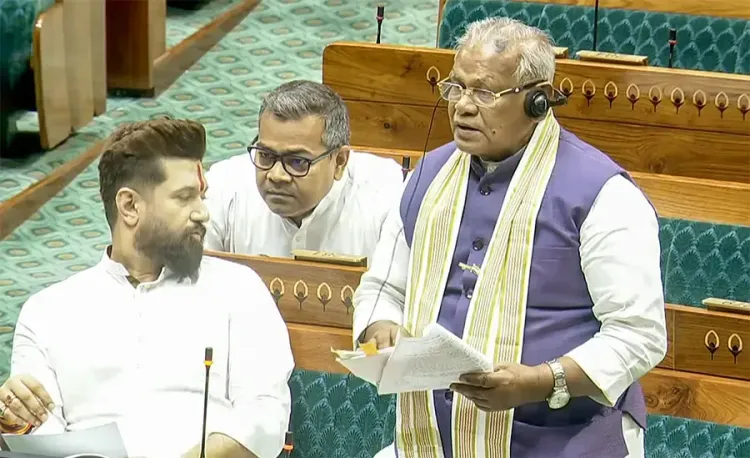
Union MSME Minister Jitan Ram Manjhi sparked a political firestorm in Gaya by defending population growth, saying every child is born with hands to work and a brain to think — a statement that echoes RSS pro-natalist ideology while adding a secular economic twist ahead of Bihar's election cycle.
Key Takeaways
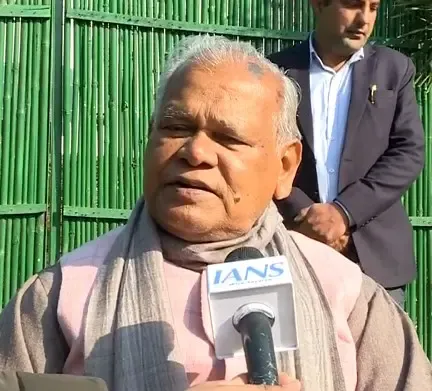
Union MSME Minister Jitan Ram Manjhi made pro-population remarks while addressing media in Gaya, Bihar on Saturday, April 25, 2025 .
His statement was a response to Bageshwar Baba's reported call in Nagpur for people to have four children and dedicate one to the RSS .
Manjhi argued that every child is born with "hands to work and a brain to think," framing population as a human resource, not a burden.
India's current population of approximately 140 crore was cited by Manjhi , who drew a parallel to ancient India's status as a 'Vishwa Guru' despite its large population.
The Union Minister clarified he was not advocating unchecked growth but called for investment in education, skill development, and entrepreneurship .
Political observers say the remarks could intensify population policy debates ahead of the Bihar elections , with the RSS long having promoted higher birth rates among Hindu communities.
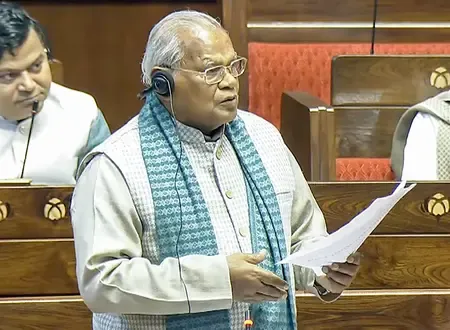
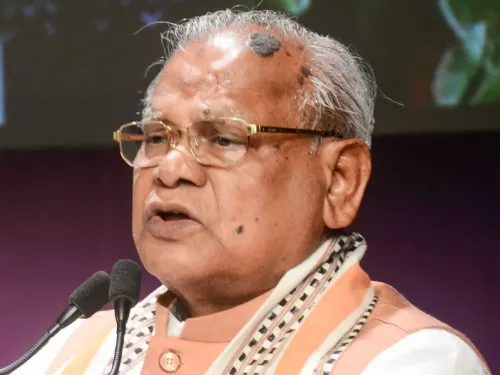
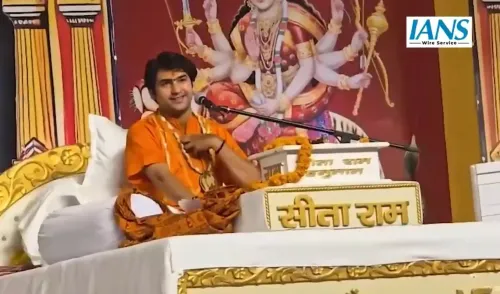
Patna, April 25: Union Minister for Micro, Small and Medium Enterprises (MSME) Jitan Ram Manjhi ignited a fresh political debate on Saturday when he urged society not to adopt a narrow-minded view on population growth, while speaking to the media in Gaya, Bihar. His remarks came in the backdrop of a controversial statement by Dhirendra Krishna Shastri, popularly known as Bageshwar Baba, who had reportedly asked people in Nagpur to have four children and dedicate one to the Rashtriya Swayamsevak Sangh (RSS).
What Manjhi Said in Gaya
Jitan Ram Manjhi acknowledged he was not fully aware of the exact context of Bageshwar Baba's statement but chose to articulate a broader philosophy on population. "One should not display a narrow mindset when it comes to increasing the population or having children," he stated firmly.
The Union MSME Minister elaborated further: "A person is not born merely with a mouth to feed, but also with hands to work and a brain to think. It is impossible to predict how great an individual a child may become. If employment opportunities are created and governance is carried out effectively, everyone can be supported."
His remarks reflect a perspective that frames population not as a burden but as a potential human resource — a position that aligns with pro-natalist currents gaining ground within certain sections of India's political landscape.
Historical Analogy and India's Population Context
Manjhi drew a historical parallel to underscore his point, noting that India's current population stands at approximately 140 crore. He pointed out that in ancient times, when India was regarded as a 'Vishwa Guru' (global teacher), the country also had a vast population — yet this was never seen as an obstacle to its civilisational greatness.
This framing is significant. It subtly challenges the dominant Malthusian narrative that has shaped India's family planning discourse since the 1970s, when forced sterilisation under the Emergency era left deep social scars, particularly among Dalit and marginalised communities.
Manjhi, himself a prominent Dalit leader and founder of the Hindustani Awam Morcha (HAM), has historically been sensitive to how population control policies disproportionately targeted lower-caste and minority groups.
Manjhi's Nuanced Clarification
The Union Minister was careful not to be seen as endorsing unchecked population growth. He clarified that if the population does increase, the state must respond with robust investment in education, skill development, and entrepreneurship. This positions his statement not as a call for unlimited births but as a demand for better governance and resource allocation.
This nuance is important in the context of Bihar, a state with one of India's highest fertility rates and significant challenges in employment generation, healthcare infrastructure, and educational outcomes. Critics may argue that advocating a relaxed attitude toward population growth without first addressing these structural deficits puts the cart before the horse.
Political Ripples: RSS, Bageshwar Baba, and the Bigger Picture
The trigger for Manjhi's remarks — Bageshwar Baba's reported statement in Nagpur — reflects a growing pro-natalist undercurrent within RSS-affiliated circles, which has long advocated for higher birth rates among Hindu communities as a demographic and civilisational imperative. This narrative has intensified in recent years, with several BJP-aligned leaders making similar calls.
Notably, the RSS has consistently promoted higher birth rates within the Hindu population, framing it as essential to preserving demographic balance in India. Manjhi's statement, while not explicitly communal, provides a secular economic justification that could lend broader political legitimacy to this position.
Observers in Bihar's political circles suggest the remarks could intensify debates around population policy ahead of the 2025 Bihar Assembly elections, where identity, caste arithmetic, and welfare politics will be decisive factors.
Impact Analysis and What Comes Next
The conversation around population policy in India is increasingly polarised. On one side are those who argue that a growing working-age population is a demographic dividend that, if harnessed through education and employment, can fuel economic growth. On the other are those who warn that without strong family planning, resource strain on healthcare, education, and infrastructure will deepen inequality.
Manjhi's statement is likely to draw reactions from opposition parties in Bihar, particularly those who have historically championed population control as a development imperative. The Rashtriya Janata Dal (RJD) and Congress may frame this as the ruling coalition abandoning evidence-based governance in favour of ideological positioning.
As Bihar prepares for its next electoral cycle and as national debates around a potential Uniform Civil Code and population policy legislation continue, Jitan Ram Manjhi's remarks are unlikely to be the last word — but they have firmly reopened a conversation that many thought had been settled.
Point of View
Economic vocabulary, while keeping his Dalit constituency in mind, given that population control policies have historically been weaponised against marginalised communities. What the mainstream narrative misses is that this debate isn't really about birth rates — it's about who gets to define India's demographic future and which communities bear the burden of 'control.' With Bihar elections approaching, expect this to become a flashpoint where caste, religion, and development politics collide in ways that no single soundbite can contain.
NationPress
16 Sept 2026
Frequently Asked Questions
What did Jitan Ram Manjhi say about population growth?
Union MSME Minister Jitan Ram Manjhi said society should not adopt a narrow-minded view on population growth, arguing that every person is born with hands to work and a brain to think. He clarified he was not advocating unchecked growth but stressed the need for education, skill development, and entrepreneurship if the population increases.
What did Bageshwar Baba say that triggered the population debate?
Dhirendra Krishna Shastri, known as Bageshwar Baba, reportedly urged people during a visit to Nagpur to have four children and dedicate one to the RSS. This statement sparked a nationwide controversy over population policy and religious demographics.
Why is the population debate significant for Bihar politics?
Bihar has one of India's highest fertility rates and faces significant challenges in employment and healthcare. With state elections approaching, population policy has become a flashpoint involving caste identity, development politics, and RSS ideology.
Does the RSS support higher birth rates among Hindus?
Yes, the RSS has consistently promoted higher birth rates within the Hindu community, framing it as essential to preserving demographic balance in India. Several BJP-aligned leaders have echoed similar pro-natalist positions in recent years.
What is Jitan Ram Manjhi's political background?
Jitan Ram Manjhi is a prominent Dalit leader and founder of the Hindustani Awam Morcha (HAM), currently serving as Union Minister for MSME in the BJP-led NDA government. He is a key political figure in Bihar with significant influence among Dalit and marginalised communities.