Why Can't a Marathi be the Mayor of Mumbai?
Synopsis
Maharashtra Chief Minister Devendra Fadnavis argues for a Marathi-Hindu Mayor in Mumbai, citing the success of diverse communities in other cities. He emphasizes the inseparable nature of Marathi and Hindu identities while discussing the BJP's campaign strategies and responses to opposition allegations.
Key Takeaways
Fadnavis advocates for a Marathi-Hindu Mayor.
Marathi and Hindu identities are intertwined.
BJP focuses on development in its campaign.
Opposition claims of minority appeasement are challenged.
Voter sentiment is crucial for upcoming BMC elections.
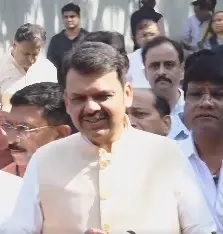
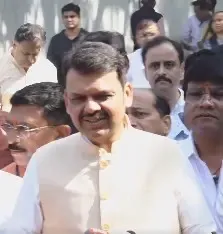
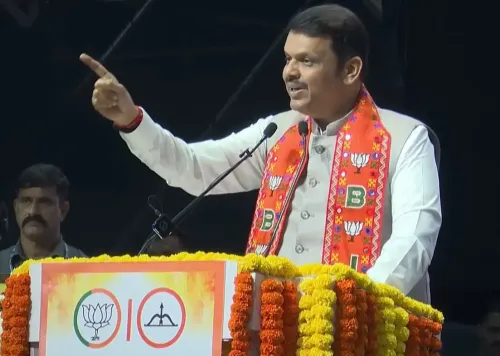
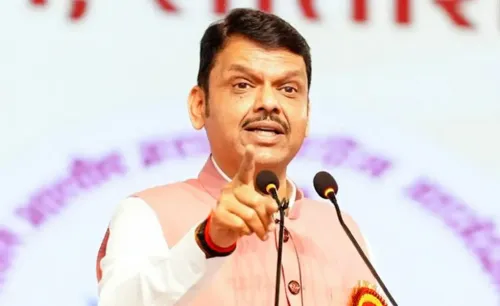
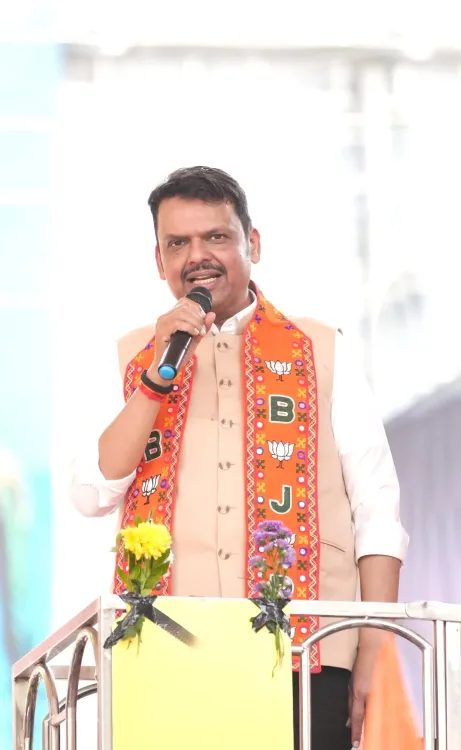
Mumbai, Jan 14 (NationPress) “If a Tamilian can serve as the Mayor of Chennai, a Gujarati in Ahmedabad, a Telugu in Hyderabad, and a Punjabi in Punjab, then why can’t a Marathi hold the mayoralty in Mumbai, Maharashtra?” questioned Maharashtra Chief Minister Devendra Fadnavis on Wednesday, firmly advocating for a Marathi-Hindu mayor in the forthcoming BMC elections.
He emphasized that Marathi and Hindu identities are intertwined and cannot be divided. As such, he predicted that after a successful election campaign, a Marathi-Hindu will assume the role of Mayor in Mumbai.
The elections for 29 municipal corporations in Maharashtra, including the BMC, are set for Thursday.
In an exclusive discussion with IANS, CM Fadnavis elaborated on various topics, including Uddhav Thackeray’s overt minority appeasement, Mamata Banerjee’s meddling in ED investigations, Annamalai’s controversial remarks, and the demolition of illegal religious structures, including madrasas. He also shared insights on a developing 'software' aimed at identifying and expelling illegal Bangladeshi migrants from the state to expedite the deportation process.
IANS: You have campaigned vigorously for the municipal elections, engaging with the public through rallies. How difficult is the civic body election for the BJP?
Devendra Fadnavis: The Bharatiya Janata Party (BJP) has approached the Maharashtra civic body elections with utmost seriousness, as evidenced by our thorough preparations. Our candidate selection process has been inclusive, encompassing individuals from diverse backgrounds, including vegetable vendors, PhD holders, teachers, researchers, doctors, and scientists.
Our campaign focused on the public interest, embodying the principle of “sabka saath, sabka vikas”. We held open public interviews and organized roadshows, emphasizing that growth and development surpass all electoral agendas, which is what the BJP will deliver when elected.
Region-specific issues took center stage in the BJP's campaign. Our leaders addressed localized problems and presented our plan to resolve them effectively and promptly.
As a result, the public feels a connection with the BJP. I confidently state that we will dominate the Brihanmumbai Municipal Corporation (BMC) elections and other municipal bodies across Maharashtra. Out of the 29 civic bodies, MahaYuti will emerge victorious in 26-27 of them, and you will witness Mayors from BJP, Shiv Sena, and NCP in these municipalities.
IANS: You mentioned that the BJP and its allies campaigned on developmental issues. However, the campaign has been overshadowed by narratives surrounding ‘hijab, khan-pathan’. Do you take responsibility for this?
Devendra Fadnavis: We merely responded to their allegations. We aimed to keep the civic elections focused on development and not allow emotional rhetoric to divert us.
Our primary agenda remains development. The parties that have governed the civic bodies for over two decades have little to show regarding progress.
The plethora of development projects we champion speaks volumes. From coastal roads to the Sea Link, Atal Setu, Navi Mumbai airport to extensive Metro rail and road networks, we centered our campaign around these initiatives.
Despite ruling for 25 years, they have nothing to promote and have resorted to misleading the public by shifting the focus from development to petty issues.
In fact, I proposed a reward for anyone who could present evidence of Uddhav Thackeray discussing development during his election rallies. I started with a prize of ₹1,000 and increased it to ₹7,000, but he couldn’t provide any.
Instead of prioritizing development, he pushed a divisive agenda by suggesting that Marathis and Muslims would together elect a Mumbai Mayor.
We contend that Marathi and Hindu identities are one and the same; they cannot be separated. Hindus will remain unified, and the next Mumbai Mayor will, without a doubt, be Marathi as it is inseparable from Hindu identity.
IANS: Why must the Mayor of Mumbai be a Marathi?
Devendra Fadnavis: Let me clarify why the Mayor of Mumbai should come from the Marathi community.
If a Tamil can become Mayor in Chennai, a Gujarati in Ahmedabad, a Telugu in Hyderabad, and a Punjabi in Punjab, then why can’t a Marathi be the Mayor of Mumbai?
IANS: Is the Shiv Sena deteriorating under Uddhav Thackeray? Is the alliance between the Thackeray brothers a fight for survival? Will Raj Thackeray emerge as the biggest loser in this alliance?
Devendra Fadnavis: Both brothers are losing their influence in the state and are desperately trying to reclaim their lost position. They believed that uniting would guarantee election success, but they failed to recognize that the Marathi populace is neither narrow-minded nor shortsighted. Marathis possess a long-term vision and are firmly aligned with us.
Despite their frantic attempts to recover their influence, they will achieve nothing. They claim to unite for the sake of Marathi pride, but I assert that this is merely a battle for their own existence and that of their party.
IANS: Will Raj Thackeray's involvement boost Uddhav’s political standing?
Devendra Fadnavis: There may be an initial psychological edge, but this will not significantly affect the electoral landscape. I believe Raj Thackeray and his party will be the biggest losers; while Uddhav might gain some advantage from the alliance, Raj has nothing to benefit from it.
IANS: Ajit Pawar is contesting separately from MahaYuti in several areas. There are also discussions about Supriya Sule potentially joining the cabinet. What are your thoughts?
Devendra Fadnavis: Ajit Pawar's NCP and BJP are competing against each other in Pimpri-Chinchwad. We had previously communicated that the BJP and its allies would contest elections against one another in certain civic bodies, as they are either ruling or in opposition.
We agreed to some friendly contests in these municipal elections, but at some point, Ajit Dada turned ‘unfriendly’, prompting us to take a stand.
He made some uncomfortable remarks against us, but we chose not to retaliate, believing that our work would speak for itself.
Regarding Supriya Sule, there are currently no proposals or discussions in this regard.
IANS: Nitesh Rane has spoken about expelling illegal Bangladeshi migrants from Maharashtra. Additionally, madrasas are facing scrutiny for suspected encroachments. If the BJP gains power independently, will illegal madrasas be demolished?
Devendra Fadnavis: In the past year, we have expelled an unprecedented number of illegal Bangladeshi nationals residing in Mumbai and other cities, with assistance from the Indian government.
This initiative will intensify in the coming weeks and months.
Bangladeshi nationals enter the country clandestinely via the Bengal border and subsequently infiltrate other states. They often possess fake documents from Bengal, making identification difficult. We are developing a mechanism for large-scale repatriation.
We are collaborating with IIT-Bombay to create a tool for identifying and isolating Bangladeshi nationals. The project is nearing completion, currently achieving 60% accuracy. Once we reach 100% accuracy in the next two to three months, we will ramp up our efforts and deport all illegal Bangladeshi individuals.
IANS: Will bulldozers be used to demolish madrasas?
Devendra Fadnavis: All illegal structures will be demolished, regardless of their nature.
IANS: Prithviraj Chavan recently asked whether former US President Donald Trump will abduct PM Modi, akin to Venezuelan President. What do you think?
Devendra Fadnavis: Prithviraj Chavan is an experienced politician who has held various positions, including Chief Minister and in the Prime Minister’s office. When a person of his stature makes such a thoughtless remark, it evokes pity.
Every politician faces frustration from repeated failures, but senior leaders must exercise restraint and guide their party appropriately.
Such reckless statements not only undermine one’s credibility but also embarrass the nation, providing adversaries with ammunition to discredit us. Pakistani media quickly capitalizes on such controversies to tarnish India’s image, which weakens our global standing.
Thus, no one should make such statements, even in moments of despair.
IANS: West Bengal CM Mamata Banerjee clashed with the ED during its probe into money laundering at a private office. Is there a hidden agenda behind this? What is your perspective?
Devendra Fadnavis: The Indian Constitution delineates the roles of institutions. Federal investigative agencies are empowered to conduct inquiries in any region, and state governments or Chief Ministers cannot interfere. If there are objections, they can approach the courts, but they cannot obstruct agencies from performing their duties.
This is a gross violation of the law, and such interference could lead to criminal liability under the Bharatiya Nyay Sanhita (BNS).
This is also constitutionally illegal, as such theatrics obstruct the functioning of a federal institution.
IANS: Does this indicate TMC’s anxiety? Is Mamata’s government apprehensive about the elections, given the BJP's strong performance in previous polls?
Devendra Fadnavis: Mamata Banerjee and her party are undoubtedly anxious and concerned. They fear the TMC’s prospects in the upcoming elections. The Bengal CM has remained silent on the persecution of Hindu minorities in Bangladesh. If she continues to provide refuge to Bangladeshis and relies on their support to win elections, she will inevitably face backlash from Bengal's residents.
IANS: K. Annamalai, a leading BJP campaigner in Maharashtra, stirred controversy with his comments, receiving harsh criticism from Raj Thackeray. What is your response?
Devendra Fadnavis: This is utterly misplaced. Annamalai referred to Mumbai as Bombay, but this was not intended to offend. Many cities, including Chennai, have had alternative names for decades. To accuse someone of disrespecting Mumbai merely for using the name Bombay is a frivolous claim.
Furthermore, Annamalai stated that Mumbai does not belong solely to Maharashtra, as it is an international metropolis with global implications. Twisting this is incorrect.
IANS: The BJP asserts that Uddhav Thackeray has forsaken Hindutva. What is your perspective? Additionally, how significant is Kejriwal’s influence in Maharashtra politics?
Devendra Fadnavis: Individuals accused in Mumbai bomb blasts participate in Uddhav Thackeray’s electoral events, Pakistani flags are displayed at his rallies, and his party members visit mosques to assure them that the loudspeakers removed will be reinstated if they regain power.
What does this indicate? We firmly adhere to Hindutva and align with all who respect India’s civilizational heritage, treating them as Hindus.
We cannot tolerate Uddhav’s associates’ subservience to minorities, particularly Muslims, while claiming to uphold Hindutva.
Uddhav Thackeray's party has utterly departed from its founder Balasaheb Thackeray’s principles and is openly engaging in minority appeasement, a stance vehemently opposed by the Sena patriarch.
This signifies a complete abandonment of Hindutva.
As for Arvind Kejriwal, he holds no relevance in Maharashtra politics. He and his party have been exposed, and he is without standing in these elections.
IANS: What are your thoughts on the 68 candidates who were elected unopposed ahead of the civic elections, given the Opposition's accusations of utilizing money and coercion?
Devendra Fadnavis: This situation arose because parties struggled to find contesting candidates in those areas. It is not only members of MahaYuti who have been elected unopposed; others have also been.
This reflects their failure to connect with the public and their inability to motivate candidates capable of posing a challenge.
IANS: Sanjay Raut criticized your recent Hindi address, claiming it belittled the Marathi language. What is your stance?
Devendra Fadnavis: The choice of language for communication is mine. Speaking Hindi, English, or any other language does not equate to disrespecting Marathi. Marathi is my native language, but all languages in our nation deserve respect.
They must clarify their own double standards regarding the Marathi language. They boast about Marathi pride, yet none of their children attended Marathi medium schools; they attended English schools. They should practice what they preach before lecturing others.
Point of View
Where cultural identity plays a crucial role in electoral strategies. As the BMC elections approach, the BJP's focus on development and community representation will be pivotal in shaping voter sentiment.
NationPress
26 Sept 2026
Frequently Asked Questions
What is the significance of Marathi identity in Mumbai politics?
Marathi identity holds substantial weight in Mumbai politics, as it represents the cultural heritage of a significant portion of the population, influencing electoral outcomes and governance.
How does Fadnavis view the opposition's narrative around minority appeasement?
Fadnavis believes the opposition's focus on minority appeasement distracts from key developmental issues and aims to steer the narrative back to progress and growth.
What are the major development projects highlighted by Fadnavis?
Fadnavis emphasizes several major projects, including coastal roads, the Sea Link, Atal Setu, and the Navi Mumbai airport, which are central to the BJP's campaign.
How is the BJP preparing for the BMC elections?
The BJP is vigorously preparing by selecting candidates from diverse backgrounds and focusing on development-oriented campaigning to resonate with the public.
What is the future of the Shiv Sena under Uddhav Thackeray?
The future of the Shiv Sena appears uncertain as internal struggles and public perception of minority appeasement could affect their electoral performance.