May 4 Assembly Results: A Survival Test for India's Left Parties
Synopsis
India's Left parties face a make-or-break moment as May 4 Assembly results loom. With exit polls predicting a Kerala regime change and West Bengal already a near-total washout, the Left's generational gamble — fielding 192 younger candidates in Bengal — may be its last credible bid for political relevance outside the margins.
Key Takeaways
May 4 Assembly results will be a defining moment for Left parties across India, who remain marginalised except in Kerala .
Exit polls have predicted a regime change in Thiruvananthapuram , threatening the Left's last major state government.
In West Bengal , the Left Front fielded 192 candidates across 294 seats , with several nominees from its youth wing aged below 45 years .
The Left Front drew a near-total blank in the 2021 West Bengal Assembly and won zero Lok Sabha seats in the state in 2019 .
The CPI(M) has set 75 years as the upper age limit for central committee membership, signalling a formal generational transition.
In Tripura , the BJP ended 25 years of uninterrupted Left rule in 2018 .
The May 4 Assembly election results will serve as a defining moment for India's Left parties, who remain politically marginalised across most of the country, with their last significant foothold being a coalition government in Kerala. Exit polls, however, have predicted a regime change in Thiruvananthapuram, potentially stripping the Left of its only major state stronghold.
Left's Gamble in West Bengal
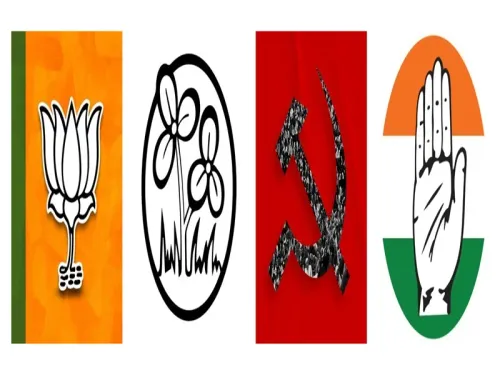
In West Bengal, the Left has attempted a calculated reinvention ahead of these polls. While the state's political narrative has been dominated by the All India Trinamool Congress (TMC) and the Bharatiya Janata Party (BJP), the Left Front fielded 192 candidates across all 294 Assembly seats, deliberately positioning younger faces as its electoral bet. Several nominees belong to the party's youth wing and are reportedly aged below 45 years.
How far these younger leaders can claw into turf largely divided between the TMC and BJP remains speculative. But the underlying reality — that this is a battle for organisational survival — is unmistakable. By 2021, the Left Front had drawn a near-total blank in the 294-seat West Bengal Assembly, a collapse that followed its failure to win a single Lok Sabha seat in the state in 2019.
Kerala: The Last Bastion Under Pressure
The Communist Party of India (Marxist)-led Left Democratic Front (LDF) in Kerala has remained more resilient than its counterparts elsewhere. The roots of the Left in Kerala trace back to the 1940s–50s, with its decisive breakthrough arriving in 1957, when a Communist-led coalition formed what is widely recognised as the world's first democratically elected Communist government.
The LDF re-emerged as a stable coalition in the 1980s, alternating power with the United Democratic Front (UDF) and winning six government formations between 1980 and 2021. The outgoing LDF government, led by Chief Minister Pinarayi Vijayan, has cited administrative successes but faces criticism over internal factionalism within the CPI(M), growing dependence on Vijayan's personal charisma, and mounting fiscal stress. Critics also point to Kerala's persistent youth unemployment despite its high human development indices as evidence that the Left's record on job creation and industrial growth has weakened.
The Rise and Fall in West Bengal
The CPI(M)-led Left Front once held an almost unshakeable grip over West Bengal's politics. It first came to power in 1977, in the post-Emergency period, winning 230 of 294 Assembly seats and securing around 54 per cent of the popular vote. Under Chief Minister Jyoti Basu, the coalition implemented landmark land reforms, strengthened local panchayats, and expanded a network of public sector units and cooperatives.
The decline, when it came, was as dramatic as the rise. Basu's successor, Buddhadeb Bhattacharjee, sought to attract industrial investment after aggressive trade unionism had driven away prospective investors and shuttered factories. However, inflexibility over industrial policy — most visibly in the violent land-acquisition conflicts at Singur and Nandigram — eroded the Left's rural base. Mamata Banerjee's TMC, positioning itself as both anti-Left and anti-Congress, won the 2011 Assembly elections, ending 34 years of uninterrupted Left rule in the state.
In Tripura, the BJP triumphed in 2018, ending an uninterrupted Left rule of nearly a quarter-century.
Generational Transition as a Strategic Bet
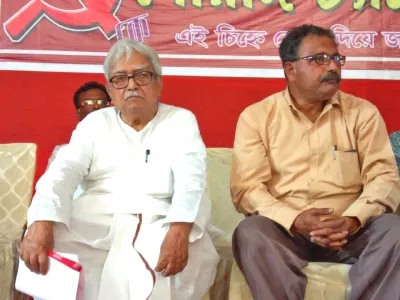
Across the country, the Left's organisational crisis has been compounded by an ageing leadership. For decades, key decision-making in the CPI(M) and allied parties remained concentrated in the hands of veterans who entered politics in the 1970s and 1980s. In recent years, the party at the all-India level has institutionalised an upper age limit of 75 years for central committee membership, triggering a wave of retirements among senior leaders.
In West Bengal, the Left Front has publicly committed to phasing out functionaries aged above 70 years and consciously inducting younger faces into state and district committees, as well as election tickets. This generational transition is not yet complete, but it reflects an explicit strategy: the Left hopes younger leaders can reconnect with first-time voters, adapt to social media politics, and project a less rigid image than the old guard associated with the regime's later years. Whether that bet pays off will begin to be known on May 4.
Point of View
Not cyclical — and fielding younger candidates in West Bengal, while symbolically important, does not address the deeper ideological vacuum. In Kerala, the LDF's longevity has rested more on Pinarayi Vijayan's personal authority than on a reinvigorated party programme, which makes any electoral setback there doubly dangerous. The party has repeatedly diagnosed its problem as one of communication and faces, when the real issue is the absence of a credible economic and social vision for 21st-century India. A generational refresh without ideological renewal risks producing a younger version of the same political irrelevance.
NationPress
19 Sept 2026
Frequently Asked Questions
Why are the May 4 Assembly results crucial for Left parties in India?
The May 4 results are critical because the Left remains politically relevant only in Kerala, and exit polls have predicted a regime change there. A loss in Kerala would leave the Left without any major state government, deepening its national marginalisation.
How did the Left perform in the 2021 West Bengal Assembly elections?
The Left Front drew a near-total blank in the 2021 West Bengal Assembly elections, winning no seats in the 294-seat House. This followed a similarly dismal 2019 Lok Sabha performance where it failed to win a single parliamentary seat in the state.
What strategy has the Left adopted in West Bengal for the current elections?
The Left Front fielded 192 candidates across all 294 seats in West Bengal, deliberately emphasising younger nominees from its youth wing aged below 45 years. The strategy aims to reconnect with first-time voters and project a less rigid image than the old guard.
When did the Left lose power in West Bengal and Tripura?
In West Bengal, the CPI(M)-led Left Front lost power in 2011 after 34 years of uninterrupted rule, when Mamata Banerjee's TMC won the Assembly elections. In Tripura, the BJP ended nearly 25 years of Left rule in 2018.
What internal reforms has the CPI(M) undertaken to address its leadership crisis?
The CPI(M) has institutionalised an upper age limit of 75 years for central committee membership, triggering widespread retirements of veteran leaders. In West Bengal, the Left Front has also committed to phasing out functionaries above 70 and inducting younger faces into party committees and election tickets.