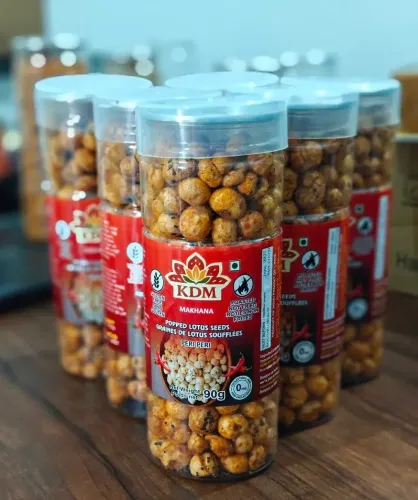
How is GI-tagged Mithila Makhana from Bihar's Purnia Making History with Its First Sea Export to Dubai?

Synopsis
This article explores the groundbreaking achievement of Bihar's Purnia as it exports GI-tagged Mithila Makhana to Dubai, showcasing the impact of Prime Minister Modi's initiatives on local economies and global markets.
Key Takeaways
Mithila Makhana has made its first sea export to Dubai.
This export aligns with the 'Vocal for Local' and 'Local to Global' initiatives.
Farmers’ incomes have significantly increased due to international trade.
The initiative is supported by APEDA and the Bihar government.
This achievement underscores the potential of rural products in global markets.
Purnia, Jan 22 (NationPress) Advancing Prime Minister Narendra Modi's vision of “Vocal for Local” and “Local to Global” to foster an ‘Aatmanirbhar Bharat’, the Geographical Indication (GI)-tagged Mithila Makhana (fox nut) from Bihar's Purnia has been successfully shipped to Dubai for the very first time via sea route.
This accomplishment serves as a testament to the fact that under Prime Minister Modi’s guidance, Bihar is now aligning with international standards of quality, packaging, traceability, and logistics.
The collaborative efforts of The Agricultural and Processed Food Products Export Development Authority (APEDA) and the Bihar government are turning the Prime Minister’s Agriculture Export Policy and the initiative to provide GI products with global exposure into a reality at the grassroots level.
The arrival of Mithila Makhana in Dubai marks not just an export achievement, but sends a powerful message that products cultivated in Bihar are now establishing their presence in international markets, simultaneously creating new job opportunities for local communities.
Manish Kushwaha, a Makhana exporter, remarked that Prime Minister Narendra Modi’s vision of “Local to Global” is indeed coming to fruition, stating, “If the Prime Minister had not introduced this scheme, it would have seemed meaningless for our village. We could only afford the machine after the scheme was implemented and the subsidy came in. I would say it is not just local to global but village to global.”
“Thanks to GI and APEDA, we have stalls that allow us to connect with foreign traders and conduct seamless business,” Kushwaha added.
“Previously in 2022, Makhana was priced at about Rs 600 to 800, but with international trade benefits, we are now earning Rs 30,000 to 35,000, which has not only doubled but tripled our farmers’ income.”
Shatrughan Kumar Sharma, a factory worker, stated: “I used to travel a long distance to Mumbai searching for job opportunities, which took a toll on my finances. Now, working in my hometown saves me time and money.”
Jaipreet Kumar, another factory worker, mentioned: “I have been working in the Makhana factory for the past two years. Previously, I earned between Rs 10,000 to 12,000 in Ghaziabad, but now I make around Rs 30,000 to 35,000 without the burden of travel costs, living close to my work.”
Point of View
This development signifies a pivotal moment for Bihar, reflecting how local products can achieve international acclaim through strategic government initiatives. The success of GI-tagged Mithila Makhana showcases the potential of rural economies to thrive in global markets, aligning with the national vision of self-reliance.
NationPress
19 Sept 2026
Frequently Asked Questions
What is Mithila Makhana?
Mithila Makhana, also known as fox nut, is a popular snack and health food from the Mithila region of Bihar, India, recognized for its nutritional value.
What does GI-tagged mean?
GI-tagged refers to Geographical Indication, which is a sign used on products that have a specific geographical origin and possess qualities or a reputation due to that origin.
How has the export impacted local farmers?
The export has significantly increased farmers' income, with prices soaring from Rs 600-800 to Rs 30,000-35,000, thus tripling their earnings.
What initiatives support this export?
The Agricultural and Processed Food Products Export Development Authority (APEDA) and the Bihar government are key players in facilitating this export under the Prime Minister's Agriculture Export Policy.
What are the benefits of exporting Mithila Makhana?
Exporting Mithila Makhana not only boosts the local economy but also creates job opportunities, enhancing the overall livelihood of the community.