How are modern tools influencing the growth of handicrafts?
Synopsis
At the forefront of India's economic transformation, the National Conference on Handlooms and Handicrafts 2025 in Bhubaneswar brought together experts to discuss the future of the handmade sector. Discover how modern tools and sustainability can redefine traditional craftsmanship.
Key Takeaways
Integration of modern tools with traditional craftsmanship is crucial for enhancing productivity.
Regular conferences will facilitate continuous dialogue between Central and State Governments.
Importance of inter-State collaboration for efficient supply chains in handicrafts.
Recognition of artisans and promoting sustainable practices are essential.
Goals align with the vision of Viksit Bharat 2047 .
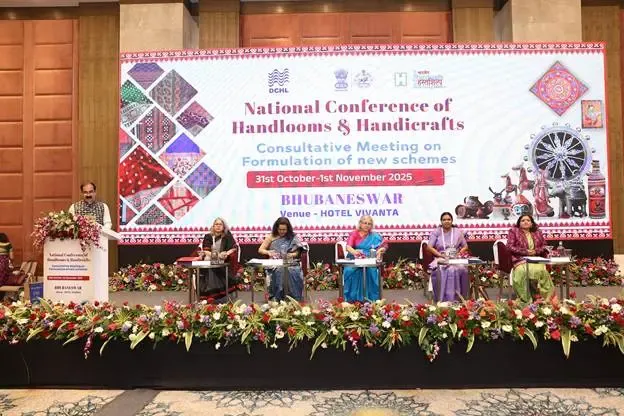
Bhubaneswar, Nov 1 (NationPress) At the National Conference on Handlooms and Handicrafts 2025, held in Bhubaneswar on Saturday, policymakers and industry experts collaborated to establish a cohesive vision for the advancement of India’s handloom and handicraft sectors.
Textiles Secretary Neelam Shami Rao highlighted the importance of merging traditional craftsmanship with modern technologies to boost productivity and minimize labor-intensive tasks.
She remarked, "It is vital to protect the ecosystem we are cultivating. Whether referred to as handloom or handicraft, it should not be regarded as merely a marginal part of our economy — it represents the premium product of tomorrow."
During the conference, the Union government reaffirmed its dedication to re-envisioning India's handmade sector as a crucial component of Viksit Bharat 2047.
Organised by the Offices of the Development Commissioner (Handlooms) and Development Commissioner (Handicrafts) under the Ministry of Textiles, this two-day event brought together senior officials from various States and Union Territories, alongside policymakers and industry specialists, as reported.
The discussions focused on two primary objectives: evaluating the current state of the handmade economy and crafting a blueprint for a forthcoming national initiative designed to encourage enhanced State involvement, integrated governance, and sustainable sectoral growth.
The second day of the conference was chaired by Textiles Secretary Rao, alongside Anu Garg, Additional Chief Secretary and Development Commissioner (Odisha), and Poonam Guha Tapas Kumar, Commissioner-cum-Secretary (Handlooms, Textiles & Handicrafts), Government of Odisha.
Rao encouraged institutions such as the National Institute of Fashion Technology (NIFT) and the Indian Institute of Handloom Technology (IIHT) to actively engage in predicting design and color trends ahead of market cycles.
Emphasizing the necessity of inter-State collaboration, she called for the smooth transfer of raw materials between States to ensure efficient supply chains in the handicrafts sector.
Rao stated that such conferences will be held biannually to maintain ongoing dialogue between the Central and State Governments, facilitate cross-learning of best practices, and assess the progress of initiatives in the handloom and handicraft fields.
She reaffirmed that sustained collaboration and regular evaluation are crucial for realizing the shared vision of a resilient, inclusive, and innovation-driven handmade economy aligned with the objectives of Viksit Bharat 2047.
Anu Garg underlined the cultural and ecological significance of handlooms, referencing Kotpad and Dongria Shawls as sustainable models.
She advocated for greater acknowledgment of artisans (including product name-tagging), youth-centric training in market research and product design, and unveiled plans for a Sustainability Cell and the promotion of eco-textiles like Katha Silk.
Point of View
It is evident that fostering collaboration between policymakers and artisans is essential for the growth of India’s handloom and handicraft industries. The commitment shown at the conference in Bhubaneswar to integrate modern technology with traditional practices reflects a promising path towards a sustainable and prosperous future for this vital sector.
NationPress
19 Sept 2026
Frequently Asked Questions
What was the main focus of the National Conference on Handlooms and Handicrafts?
The conference aimed to create a unified vision for the growth of India's handloom and handicraft industries, emphasizing the integration of modern tools with traditional craftsmanship.
How often will these conferences be held?
These conferences are planned to be held every six months to ensure ongoing dialogue and assessment of the initiatives in the handloom and handicraft sectors.
What role do institutions like NIFT and IIHT play?
Institutions such as NIFT and IIHT are encouraged to predict design and color trends to align with market needs and enhance the competitiveness of the handmade sector.