PM Modi Hails Indian Youth Driving Tech, Space and Semiconductor Growth
Synopsis
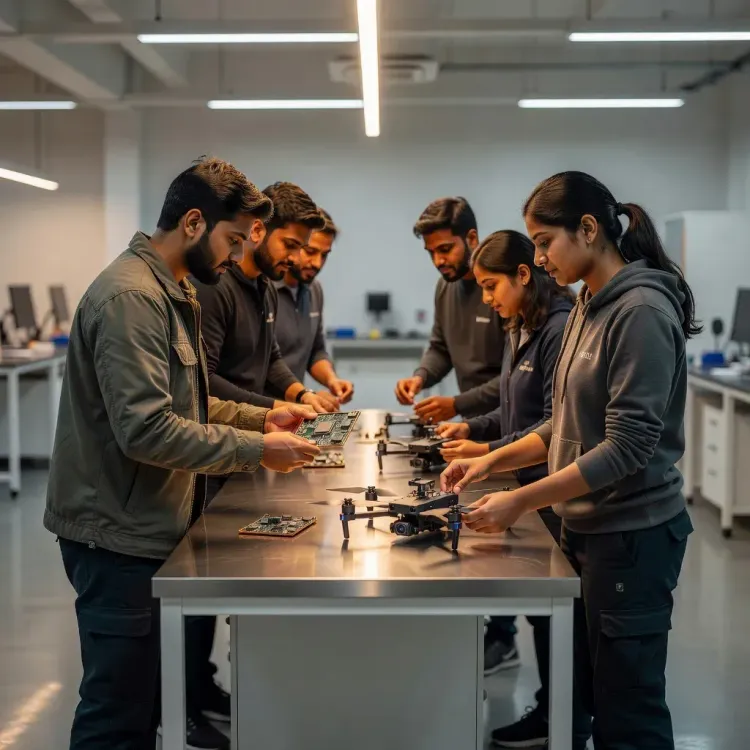
Prime Minister Narendra Modi on June 13, 2026, praised India's youth for shaping the nation's future through contributions to space, semiconductors, drones, and manufacturing — sectors at the heart of the government's Atmanirbhar Bharat self-reliance agenda.
Key Takeaways
PM Modi on June 13, 2026 , publicly praised Indian youth for contributions across space, semiconductors, drones, science, technology, and manufacturing.
The remarks align with the Atmanirbhar Bharat framework, which seeks domestic self-reliance in strategic industries.
The India Semiconductor Mission , approved in 2021 , provides financial incentives for chip fabrication and design within India.
A Production Linked Incentive scheme for drones and 2020 space sector reforms have enabled private-sector participation alongside ISRO .
Flagship schemes including Make in India , Skill India , and Startup India form the broader policy base supporting youth-led innovation.
Progress on semiconductor plants and private space launches are the key milestones to watch in the near term.
Prime Minister Narendra Modi on Saturday, June 13, 2026, praised India's young population for their growing contributions across critical sectors including science, technology, manufacturing, space, semiconductors, and drones, calling the trend 'heartening' and a signal of the nation's future trajectory.
Context
In his post, PM Modi wrote that 'India's youth are making their mark across various sectors, from science and technology to manufacturing, space, semiconductors and drones,' adding that it was 'heartening to see young Indians contributing to areas that will shape the future of our nation and the world.' The post, shared in English, reflects a sustained effort by the Prime Minister to publicly acknowledge and amplify the role of youth-led innovation in national development.
The acknowledgement comes as India positions itself as a global hub for next-generation industries, with young professionals and entrepreneurs increasingly visible in domains that were once the preserve of state-run enterprises or large legacy corporations.
Policy Backdrop
The Prime Minister's remarks align closely with a series of flagship government initiatives designed to build domestic capability in strategic technologies. The India Semiconductor Mission, approved in 2021, offers financial incentives to attract chip fabrication and design investment into the country, directly targeting the semiconductor gap that the post references.
The Production Linked Incentive scheme for drones, also introduced in 2021, has spurred a new generation of domestic drone manufacturers. Meanwhile, space sector reforms announced in 2020 opened the door to private participation in launch and satellite services, enabling young startups to operate alongside ISRO, India's premier space agency. Broader frameworks such as Make in India, launched in 2014, and Skill India, launched in 2015, have together sought to equip millions of young people with industry-relevant capabilities. The Startup India initiative, introduced in 2016, further extended institutional support to young entrepreneurs in technology and innovation.
Collectively, these programmes form the scaffolding of the Atmanirbhar Bharat — or 'self-reliant India' — framework, which seeks to reduce dependence on imports in sectors considered strategically vital, from defence electronics to space launch vehicles.
Stakeholders and Impact
The sectors named by the Prime Minister — space, semiconductors, and drones — share a common thread: they are dual-use industries with both civilian and defence applications, and all are undergoing rapid globalisation of supply chains. India's demographic advantage, with a median age well below that of major competitors, makes youth-led participation in these industries a structural asset rather than merely an aspirational talking point.
Young innovators, technology startups, and domestic defence manufacturers stand to benefit most directly from the policy ecosystem the government has built. For the broader economy, success in semiconductor fabrication and private-sector space launches would represent a qualitative shift in India's industrial profile, moving it up the value chain in global technology supply networks.
What's Next
The immediate indicators to watch include the progress of semiconductor fabrication plants approved under the India Semiconductor Mission and the outcomes of private-sector space launches expected in the coming fiscal year. PM Modi's public recognition of youth contributions in these fields is likely to reinforce government messaging ahead of further policy announcements or investment milestones in the technology sector. The trajectory will depend significantly on how quickly approved projects translate into operational capacity and employment for the young workforce the Prime Minister has spotlighted.
Point of View
Reinforcing the Atmanirbhar Bharat narrative ahead of potential milestone announcements in semiconductors and space. By naming specific high-stakes sectors — chips, drones, space — rather than offering generic praise, the messaging signals that the government views youth participation as a deliverable of policy, not merely a cultural aspiration. This framing also serves a political function: it positions the BJP-led administration as the enabler of a generational technological leap, a claim that will be tested against the operational timelines of approved fabrication plants and private launch programmes. The broader arc points toward India attempting to convert its demographic dividend into hard industrial capacity in domains where global supply-chain realignment is creating genuine entry points.
NationPress
13 Sept 2026
Frequently Asked Questions
What did PM Modi say about India's youth on June 13 2026?
PM Modi said India's youth are 'making their mark across various sectors, from science and technology to manufacturing, space, semiconductors and drones,' calling it 'heartening' to see young Indians shaping the nation's future.
What is the India Semiconductor Mission?
The India Semiconductor Mission is a government programme approved in 2021 that offers financial incentives to attract semiconductor fabrication and design investment into India, aiming to build domestic chip manufacturing capability.
How is the government supporting youth in technology sectors?
The government has launched several schemes including Skill India (2015), Startup India (2016), Make in India (2014), drone PLI schemes, and space sector reforms (2020) to equip and enable young Indians in strategic technology industries.
What is Atmanirbhar Bharat and how does it relate to youth in tech?
Atmanirbhar Bharat , meaning 'self-reliant India,' is a government framework aimed at reducing import dependence in strategic sectors. Youth-led innovation in space, semiconductors, and drones is central to achieving this self-reliance goal.
What sectors did PM Modi highlight for India's youth contributions?
PM Modi specifically highlighted science, technology, manufacturing, space, semiconductors, and drones as sectors where Indian youth are making significant contributions.