PM Modi Holds Joint Press Meet with Japan's PM Takaichi
Synopsis
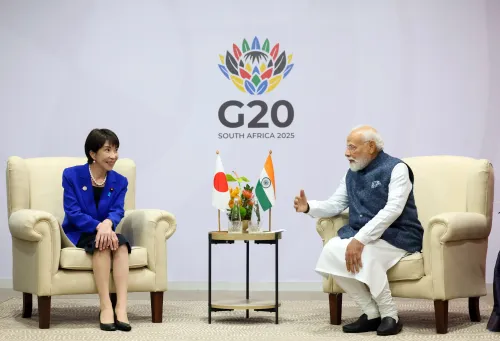
Prime Minister Narendra Modi addressed a joint press conference with Japanese PM Sanae Takaichi on 2 July 2026, reinforcing the India-Japan Special Strategic and Global Partnership. The meeting reflects deepening bilateral ties spanning defence, technology, infrastructure, and Indo-Pacific security cooperation under the Quad framework.
Key Takeaways
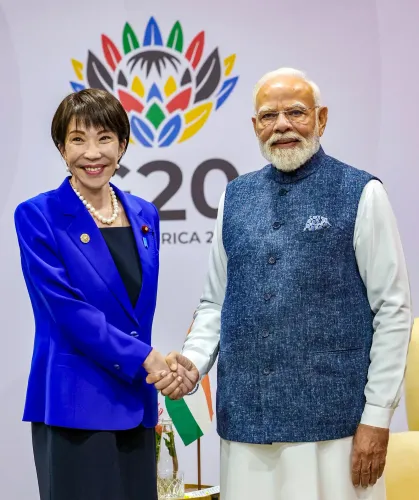
PM Narendra Modi shared his remarks from a joint press conference with Japanese PM Sanae Takaichi on 2 July 2026 .
India and Japan share a Special Strategic and Global Partnership , the highest bilateral tier India accords, upgraded in 2014 .
Annual India-Japan prime ministerial summits have been held regularly since 2006 .
Both nations are members of the Quad , alongside the United States and Australia, focused on Indo-Pacific stability.
Key cooperation areas include the Mumbai-Ahmedabad High Speed Rail , joint defence production, and critical minerals supply chains.
Follow-up announcements on defence technology transfers and joint production are expected after the meeting.
Prime Minister Narendra Modi addressed a joint press conference alongside Japanese Prime Minister Sanae Takaichi on Thursday, 2 July 2026, sharing his remarks from the bilateral meeting in a post on X. The press meet marks a significant moment in the ongoing India-Japan Special Strategic and Global Partnership.
Context
Modi shared his remarks from the joint press meet, tagging @takaichi_sanae directly — signalling the personal diplomatic rapport both leaders are projecting publicly. Joint press conferences between Indian and Japanese prime ministers typically follow structured bilateral talks covering trade, defence, and technology cooperation.
Sanae Takaichi is a senior leader of Japan's Liberal Democratic Party (LDP) who has held portfolios including Internal Affairs and Communications. She has been a consistent advocate for stronger security policies and deeper engagement with like-minded democracies in the Indo-Pacific.
Policy Backdrop
India and Japan established their Strategic and Global Partnership in December 2006, which was upgraded to a Special Strategic and Global Partnership in 2014 — the highest tier of bilateral relationship India accords to any country. Annual prime ministerial summits have since become a cornerstone of this architecture.
The relationship has expanded well beyond its initial economic foundation. Flagship infrastructure projects such as the Mumbai-Ahmedabad High Speed Rail corridor sit alongside growing cooperation in joint defence production, maritime security, and critical minerals supply chains. Both nations are also members of the Quad — the informal grouping with the United States and Australia — which has become a key vehicle for Indo-Pacific stability and supply-chain resilience.
Stakeholders and Impact
Defence industries and technology companies on both sides stand to gain the most from deepened bilateral ties. India's ambition to localise defence manufacturing under its 'Make in India' push aligns with Japan's own push to expand defence exports following its revised security policies in recent years.
Businesses in semiconductors, green energy, and infrastructure are closely watching outcomes from such high-level engagements for signals on investment frameworks, technology transfer agreements, and joint venture opportunities. Diplomatic observers in New Delhi and Tokyo are also tracking how the bilateral relationship evolves within the broader Quad framework.
What's Next
Follow-up announcements on defence technology transfers or joint production frameworks are expected to emerge in the days following the press meet. The annual India-Japan summit cycle and the next Quad leaders' summit will be the next major milestones on the bilateral calendar.
The tone and substance of Modi's remarks, once fully detailed, are likely to set the agenda for working-level engagements across defence, trade, and technology corridors in the months ahead.
Point of View
A pattern consistent with his social-media-led foreign policy communication. The meeting fits into a broader arc in which India is consolidating ties with Quad partners to manage regional influence dynamics in the Indo-Pacific. Outcomes on defence technology and critical minerals will determine whether this summit advances the relationship materially or remains primarily symbolic.
NationPress
30 Sept 2026
Frequently Asked Questions
Who is Sanae Takaichi and why is she meeting PM Modi?
Sanae Takaichi is a senior politician of Japan's Liberal Democratic Party who serves as Prime Minister of Japan. She met PM Modi on 2 July 2026 for bilateral talks as part of the long-standing annual India-Japan summit tradition, covering defence, technology, and Indo-Pacific cooperation.
What is the India-Japan Special Strategic and Global Partnership?
It is the highest tier of bilateral relationship India extends to any country, established in 2014 as an upgrade from the Strategic and Global Partnership formed in 2006. It covers defence, infrastructure, trade, and people-to-people ties.
What is the Quad and how does India-Japan fit into it?
The Quad is an informal grouping of India, Japan, the United States, and Australia focused on Indo-Pacific stability, maritime security, and supply-chain resilience. India and Japan are two of its four core members and their bilateral relationship is central to the grouping's cohesion.
What are the key areas of India-Japan cooperation in 2026?
Key areas include the Mumbai-Ahmedabad High Speed Rail corridor, joint defence production, critical minerals supply chains, semiconductor cooperation, maritime security, and green energy investment.
What could come out of the Modi-Takaichi meeting?
Analysts expect follow-up announcements on defence technology transfers, joint production frameworks, and investment agreements, with further milestones expected at the next Quad leaders' summit and the annual India-Japan summit cycle.