Mahua Moitra Awaits SC Verdict on Bihar SIR Plea
Synopsis
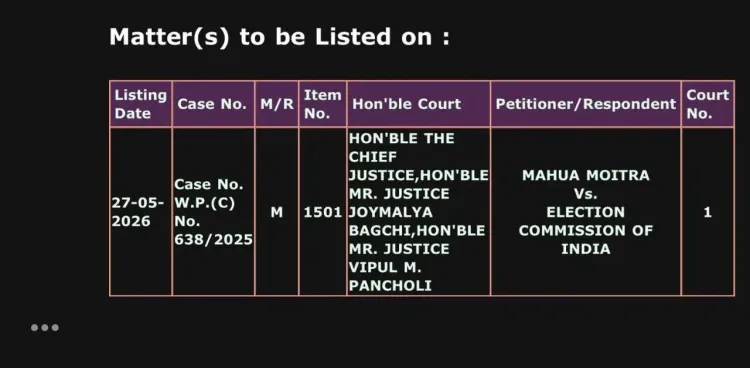
TMC MP Mahua Moitra announced that the Supreme Court will pronounce its judgement on May 27, 2026, on her petition challenging Bihar's Special Intensive Revision of electoral rolls — a case that could shape judicial oversight of the Election Commission's voter-list revision process.
Key Takeaways
TMC MP Mahua Moitra announced on May 26, 2026 , that the Supreme Court is set to rule on her Bihar SIR plea the next day.
The case concerns the Special Intensive Revision (SIR) of electoral rolls in Bihar , conducted by the Election Commission of India .
SIR exercises are carried out under the Representation of the People Act, 1950 and involve large-scale verification and revision of voter lists.
Opposition parties have raised concerns that intensive revisions can lead to exclusion of legitimate voters, particularly from marginalised communities.
A Supreme Court ruling could set a precedent for judicial oversight of electoral roll revisions across Indian states.
Bihar voters and political parties are the primary stakeholders in the outcome of this judgement.
TMC MP Mahua Moitra announced on Tuesday, May 26, 2026, that the Supreme Court of India is set to pronounce its judgement the following day on her petition challenging the Bihar Special Intensive Revision (SIR) of electoral rolls — a legal challenge that has put the spotlight on the Election Commission of India's voter-list revision process in the state.
Context
Moitra posted on X that the apex court's ruling on her plea in the Bihar SIR matter was due on Wednesday, May 27, 2026. The post, brief and direct, signals that a significant judicial moment in an ongoing electoral dispute is imminent. The Krishnanagar MP has been among the more active opposition voices raising legal and parliamentary challenges on governance and electoral integrity issues.
Policy Backdrop
The Special Intensive Revision (SIR) is a mechanism under the Representation of the People Act, 1950, by which the Election Commission of India undertakes large-scale enumeration and revision of electoral rolls in a state — typically ahead of assembly or general elections. Such exercises involve door-to-door verification, addition of new voters, and deletion of names deemed ineligible or untraceable.
Opposition parties have historically raised concerns that intensive revisions, if conducted without adequate safeguards, can result in the exclusion of legitimate voters — particularly among migrant workers, marginalised communities, and those with incomplete documentation. Legal challenges to SIR exercises have periodically come before the Supreme Court, testing the boundaries of the Election Commission's statutory powers against the court's oversight role in protecting the franchise.
Stakeholders and Impact
Bihar, one of India's most populous states, has a large and complex electorate. Any judicial direction regarding its electoral roll revision process carries direct implications for millions of voters. Political parties across the spectrum — particularly those with a strong base among communities vulnerable to voter-list deletions — have a stake in how the court rules.
The Election Commission of India will also be watching closely: a Supreme Court ruling could either affirm the Commission's statutory authority to conduct SIR exercises as it sees fit, or impose procedural conditions and oversight requirements that shape how future revisions are carried out across states.
What's Next
All eyes will be on the Supreme Court bench on May 27, 2026, when the pronouncement is expected. Depending on the ruling, the court may issue directions to the Election Commission on the conduct of the Bihar SIR, stay specific aspects of the revision, or dismiss the plea. Any consequential order could set a precedent for how similar challenges to electoral roll revisions in other states are handled going forward.
Point of View
While a dismissal would reinforce the Commission's discretionary powers. Either way, the judgement arrives at a politically sensitive moment for Bihar, a state whose electoral arithmetic has national consequences.
NationPress
10 Oct 2026
Frequently Asked Questions
What is the Bihar SIR matter in the Supreme Court?
The Bihar SIR matter refers to a petition filed by TMC MP Mahua Moitra in the Supreme Court challenging the Special Intensive Revision of electoral rolls conducted by the Election Commission of India in Bihar. The case concerns whether the revision process adequately protects the voting rights of all eligible citizens.
What is a Special Intensive Revision (SIR) of electoral rolls?
A Special Intensive Revision (SIR) is a large-scale exercise under the Representation of the People Act, 1950, in which the Election Commission of India conducts door-to-door verification to update voter lists in a state — adding new eligible voters and removing ineligible or untraceable names.
When will the Supreme Court pronounce its verdict on Mahua Moitra's Bihar SIR plea?
According to Mahua Moitra's post on X on May 26, 2026, the Supreme Court was scheduled to pronounce its judgement on her Bihar SIR plea on May 27, 2026.
Why do opposition parties challenge electoral roll revisions?
Opposition parties argue that intensive electoral roll revisions, if not conducted with adequate safeguards, can result in the deletion of legitimate voters — particularly migrant workers, the poor, and marginalised communities who may lack complete documentation or stable addresses.
What could the Supreme Court's ruling mean for Bihar voters?
Depending on the verdict, the Supreme Court could either affirm the Election Commission's authority to conduct the Bihar SIR as planned, or issue directions imposing procedural conditions on the revision. A ruling could directly affect whether millions of Bihar voters remain on or are restored to the electoral rolls.