Mahua Moitra slams SC Bihar SIR ruling, cites 27 lakh Bengal voters

Synopsis
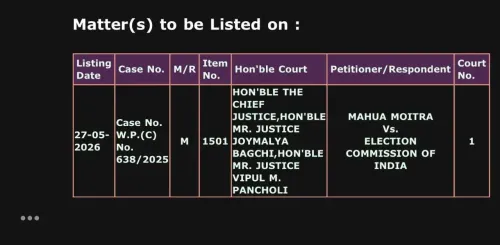
TMC MP Mahua Moitra condemned the Supreme Court's Bihar SIR decision on May 27, 2026, arguing it endorses the ECI's hurried voter-list revision practices that allegedly left 27 lakh valid West Bengal voters unable to vote, with their status still unresolved.
Key Takeaways
TMC MP Mahua Moitra publicly criticised the Supreme Court's May 27, 2026 ruling on the Bihar Special Intensive Revision (SIR) of electoral rolls.
She described the ECI's SIR methodology as 'illogical, hurried and discriminatory,' and said the court ruling amounts to endorsing it.
Moitra cited the earlier West Bengal SIR exercise, claiming 27 lakh valid voters were left unable to vote and their fate remains unresolved.
The Supreme Court's Bihar decision is expected to set a precedent that could affect pending legal challenges from West Bengal on the same issue.
Moitra invoked the principle that 'justice must be done and must also be seen to be done,' signalling the TMC's intent to continue pressing the matter legally and politically.
TMC MP Mahua Moitra on Wednesday, May 27, 2026, sharply criticised the Supreme Court of India's decision on the Bihar Special Intensive Revision (SIR) of electoral rolls, calling it a stamp of approval on what she described as 'illogical, hurried and discriminatory practices' by the Election Commission of India (ECI). She drew a direct link to an earlier SIR exercise in West Bengal, alleging that 27 lakh valid voters were left unable to cast their votes and their status remains unresolved.
Context
Moitra posted on X that the Supreme Court's Bihar SIR ruling 'puts a stamp of approval on ECI's illogical, hurried and discriminatory practices.' She added that 'justice must be done and must also be seen to be done,' invoking a foundational principle of natural justice to argue that procedural legitimacy is as important as the outcome itself.
The post directly connects the Bihar court decision to the Bengal SIR, framing the apex court's ruling as setting a precedent that could further entrench what the opposition characterises as flawed voter-list revision methodology.
Policy Backdrop
The Election Commission of India periodically conducts Special Summary and Intensive Revisions of electoral rolls in states ahead of assembly or general elections. These exercises are designed to remove duplicate or ineligible entries and add new eligible voters, but they have repeatedly drawn legal challenges, particularly from opposition parties alleging selective or hurried deletions.
In West Bengal, Moitra and other Trinamool Congress (TMC) leaders have claimed that the SIR process resulted in the names of 27 lakh legitimate voters being struck off or left in limbo, leaving them disenfranchised. The ECI maintains that such revisions are a necessary exercise to keep rolls accurate and free of ineligible entries.
Supreme Court rulings on ECI-driven voter-list revisions frequently set cross-state precedents. Opposition parties have argued that a court sanction of the Bihar SIR methodology effectively legitimises the same approach applied in West Bengal and potentially other states.
Stakeholders and Impact
The most immediate group affected is the estimated 27 lakh voters in West Bengal whose names were reportedly removed or remain unverified following the SIR exercise. For them, the Supreme Court's Bihar decision could narrow the legal avenues available to challenge their exclusion from electoral rolls.
Opposition parties, particularly the TMC, have a direct political stake in ensuring these voters — concentrated in constituencies such as Krishnanagar — are restored to the rolls before any future election. The ECI, on the other hand, faces pressure to demonstrate that its revision process is both legally sound and procedurally fair.
Broader civil society groups focused on electoral integrity and voter rights are also watching the case, as the outcome shapes the standard of judicial scrutiny applied to mass voter-list revisions across India.
What's Next
Attention now turns to whether the Supreme Court will issue follow-up directions on implementation for affected Bihar voters and whether linked petitions from West Bengal — concerning the fate of the 27 lakh names — will be taken up for fresh hearing in light of the Bihar ruling.
If the court's Bihar reasoning is applied uniformly, it could either close the door on West Bengal challenges or, if the facts are distinguished, leave room for a separate legal remedy. Moitra's public statement signals that the TMC intends to keep the issue alive both in court and in the political arena ahead of the next electoral cycle.
Point of View
As opposition parties have spent months building a narrative around mass voter disenfranchisement ahead of the next electoral cycle. Moitra's swift public response signals that the TMC intends to use the ruling as a rallying point, framing every future ECI revision exercise through the lens of the alleged 27 lakh deletions in West Bengal. The invocation of natural justice — that justice must also be 'seen to be done' — is a deliberate rhetorical move to shift the debate from legality to legitimacy. If linked West Bengal petitions are heard and distinguished from Bihar on facts, the opposition retains a live legal front; if not, the political argument becomes their primary instrument.
NationPress
11 Oct 2026
Frequently Asked Questions
What is the Bihar SIR Supreme Court decision Mahua Moitra is referring to?
The Bihar SIR refers to the Supreme Court's ruling on the Election Commission of India's Special Intensive Revision of electoral rolls in Bihar. Moitra stated on May 27, 2026, that this ruling endorses ECI practices she considers flawed, though the full operative details of the order are subject to official court records.
How many voters in West Bengal were affected by the SIR exercise?
TMC MP Mahua Moitra has claimed that 27 lakh valid voters in West Bengal were unable to vote following the SIR exercise there, and that their status remains unresolved. The ECI has maintained that such revisions are intended to keep electoral rolls accurate.
What is a Special Intensive Revision (SIR) of electoral rolls?
A Special Intensive Revision is a process conducted by the Election Commission of India to update voter lists, typically before state assembly or general elections. It involves adding new eligible voters and removing duplicate or ineligible entries, and has been legally challenged in several states.
Why does the Bihar SIR ruling matter for West Bengal voters?
Supreme Court decisions on ECI voter-list revision processes often set precedents applied across states. If the Bihar ruling validates the SIR methodology, it could narrow the legal options available to West Bengal voters and opposition parties challenging similar deletions in that state.
What action is Mahua Moitra demanding?
Moitra has not specified a single procedural demand in this post, but has called for justice to be 'done and seen to be done,' signalling that the TMC will continue to pursue both legal remedies and political pressure to restore the 27 lakh affected West Bengal voters to the electoral rolls.