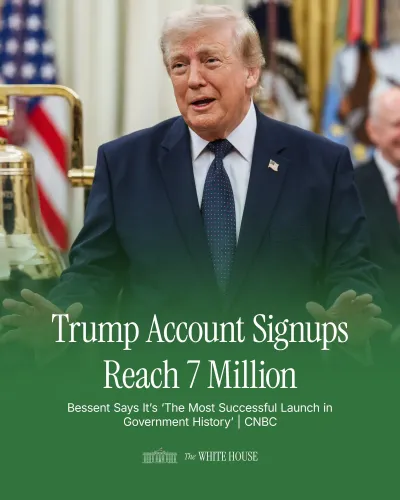
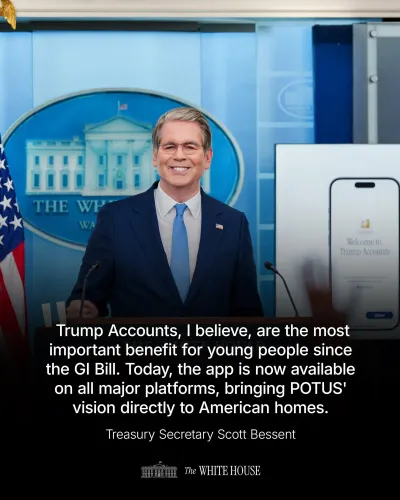
White House Promotes 'Trump Accounts' Savings Push for Youth

Synopsis
The White House on 14 July 2026 promoted 'Trump Accounts,' a savings initiative for young Americans, directing the public to TRUMPACCOUNTS.GOV. The move continues a long-standing U.S. policy tradition of using tax-advantaged vehicles to build generational wealth, framed squarely around the American Dream narrative central to the Trump administration's economic messaging.
Key Takeaways
The White House on 14 July 2026 promoted a new savings initiative called 'Trump Accounts' via an official post on X.
The post directed the public to the dedicated government domain TRUMPACCOUNTS.GOV .
The initiative is framed as 'investing in the next generation's American Dream,' targeting young Americans and families .
The policy lineage includes the Tax Cuts and Jobs Act of 2017 , which expanded 529 education savings accounts and created Opportunity Zones .
Formal programme details — including contribution limits, tax treatment, and eligibility — are pending Congressional or Treasury guidance .
The existence of a dedicated .GOV domain signals the initiative has received formal federal government infrastructure.
The White House, the official communications account of the Executive Office of the President of the United States, on Monday, 14 July 2026, promoted a new savings initiative under the banner of 'Trump Accounts,' directing the public to TRUMPACCOUNTS.GOV and framing the programme as an investment in 'the next generation's American Dream.'
Context
The post, shared by the White House on X, reads: 'Investing in the next generation's American Dream. http://TRUMPACCOUNTS.GOV.' The message is brief but pointed, linking a dedicated government web address to a savings-oriented initiative aimed at younger Americans. The framing of the 'American Dream' — a recurring rhetorical anchor in Trump-era economic messaging — signals a generational wealth-building angle rather than a short-term relief measure.
Policy Backdrop
The broader policy lineage of such initiatives traces back to the Tax Cuts and Jobs Act of 2017, which expanded 529 education savings accounts and created Opportunity Zones to incentivise long-term investment in underserved communities. U.S. administrations across party lines have periodically promoted tax-advantaged savings vehicles — from individual retirement accounts to college savings plans — as tools for economic mobility and generational wealth creation.
The Trump administration's second term has continued to frame economic policy around expanding opportunity, deregulation, and reducing the tax burden on families. A dedicated domain such as TRUMPACCOUNTS.GOV suggests the initiative has received formal government infrastructure, indicating it is at minimum an active federal communications effort, if not a fully legislated programme.
Stakeholders and Impact
The primary beneficiaries, as implied by the White House post, are American families and young Americans seeking pathways to financial security. Tax-advantaged savings programmes of this nature typically benefit middle-income households most directly, offering compounding investment returns sheltered from federal taxation over time.
If the initiative involves new legislation or Treasury guidance, financial institutions, employers, and state governments would also be key stakeholders in implementation. Congressional action or executive orders would determine the scope, contribution limits, and eligibility criteria of any formal 'Trump Accounts' programme.
What's Next
Observers will watch for Congressional hearings or formal Treasury Department guidance outlining the structure, tax treatment, and rollout timeline of the programme. Subsequent White House economic reports are expected to provide further detail. The launch of a dedicated government domain suggests an announcement or legislative push may be imminent, with the messaging cycle likely to intensify ahead of any formal bill introduction or executive action.
For India, which tracks U.S. economic policy closely given bilateral trade and investment ties, the evolution of American savings incentives can influence discussions around comparable instruments such as the National Pension System and Sukanya Samriddhi Yojana — underscoring how generational wealth frameworks travel across policy ecosystems.
Point of View
Much as the first term used 'Opportunity Zones' to anchor investment incentives. Whether the programme delivers substantive new savings benefits or primarily repackages existing vehicles will determine its lasting policy significance.
NationPress
11 Oct 2026
Frequently Asked Questions
What are Trump Accounts?
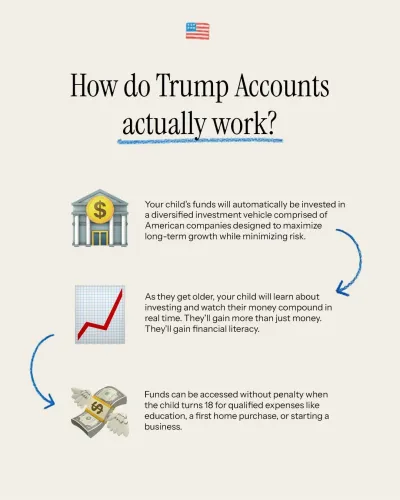
'Trump Accounts' is a savings initiative promoted by the White House in July 2026 , directed at young Americans and framed around building generational wealth and the American Dream. The official programme details are available at TRUMPACCOUNTS.GOV , though full legislative or regulatory specifics had not been publicly confirmed at the time of the announcement.
What is the TRUMPACCOUNTS.GOV website?
TRUMPACCOUNTS.GOV is a dedicated U.S. government domain set up to host information about the Trump Accounts savings initiative. The existence of a .GOV address indicates it is an official federal government communication platform.
How does Trump Accounts relate to existing U.S. savings schemes?
The initiative follows a long U.S. policy tradition of tax-advantaged savings vehicles. The Tax Cuts and Jobs Act of 2017 previously expanded 529 education savings accounts and created Opportunity Zones . Trump Accounts appears to be a new or rebranded vehicle in this lineage, though precise details await Treasury or Congressional confirmation.
Who benefits from Trump Accounts?
The White House has framed the programme as targeting the next generation of Americans — primarily young people and families seeking long-term financial security. Tax-advantaged savings programmes of this type typically benefit middle-income households most directly through compounding, tax-sheltered returns.
What happens next with Trump Accounts?
Observers are watching for formal Treasury Department guidance or Congressional hearings that would define contribution limits, eligibility, and tax treatment. Subsequent White House economic reports are expected to provide a detailed rollout timeline.