MP CM Mohan Yadav Calls Ministers to Join Shastra Puja on Vijayadashami
Synopsis
Chief Minister Dr. Mohan Yadav has called Madhya Pradesh's ministers to join Shastra Puja ceremonies statewide on Vijayadashami 2026, framing the festival as a celebration of dharma's victory and the honour of valour — turning a religious tradition into a co-ordinated act of official participation.
Key Takeaways
Mohan Yadav issued a formal call on October 20, 2026 for all state ministers to participate in Shastra Puja on Vijayadashami.
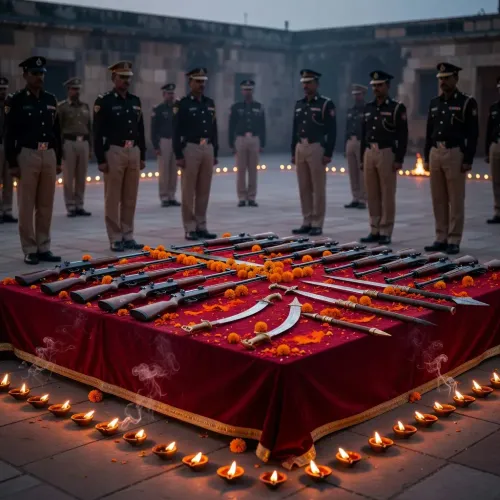
The Chief Minister's Office of Madhya Pradesh described Vijayadashami as 'a festival of the victory of righteousness and the honour of valour.' Shastra Puja — the ceremonial worship of arms — is an ancient tradition now observed publicly by several state governments, particularly in BJP-ruled states.
Mohan Yadav has served as Chief Minister of Madhya Pradesh since December 2023 , representing the BJP.
Ministers are expected to attend events in their respective districts, extending the observance across all of Madhya Pradesh .
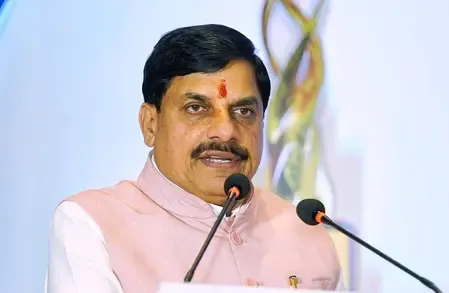
On Vijayadashami 2026, the festival that marks the triumph of dharma (righteousness) over adharma (evil), Madhya Pradesh is turning the celebration into a state-wide show of official participation — with Chief Minister Dr. Mohan Yadav personally calling on his council of ministers to join the ancient Shastra Puja tradition across the state.
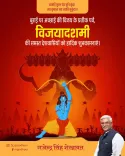
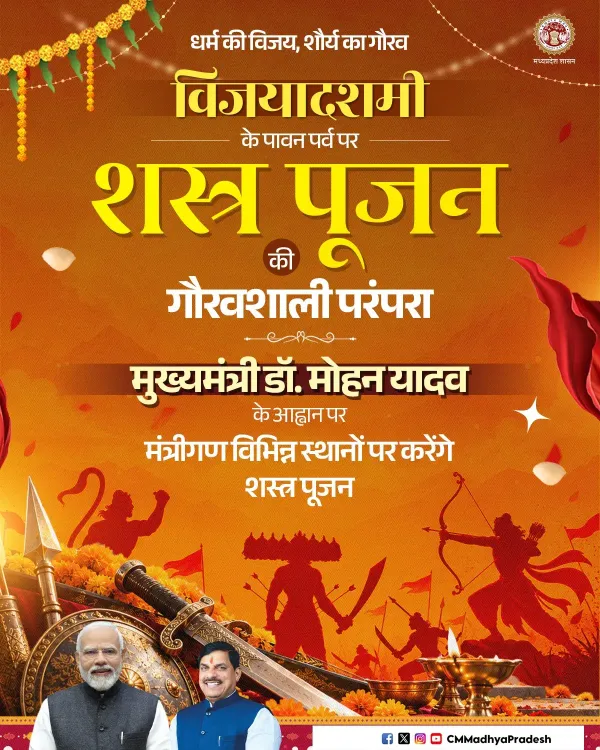
The Chief Minister's Office of Madhya Pradesh announced on Tuesday, October 20 that ministers across the state will participate in Shastra Puja — the ceremonial worship of arms — at the call of CM Dr. Mohan Yadav. The post described Vijayadashami as 'dharm ki vijay aur shaurya ke samman ka parv' — 'a festival of the victory of righteousness and the honour of valour.'
What Shastra Puja means on Vijayadashami
Vijayadashami, also widely known as Dussehra, falls on the tenth day of the Navratri cycle and is one of Hinduism's most resonant festivals. Beyond the iconic burning of Ravana's effigy in public grounds, the day carries a parallel tradition: Shastra Puja, the ritualistic honouring of weapons and tools as symbols of protective power and valour. The practice draws on ancient customs once observed by warrior clans and royal courts, now kept alive in households, armed forces units, and — increasingly — by elected governments.
In Madhya Pradesh, a state with deep roots in Hindu cultural observance, the participation of cabinet ministers in Shastra Puja signals an explicit alignment between state authority and religious tradition — a pattern that has become a defining feature of governance in several BJP-ruled states.
A statewide call, not just a symbolic gesture
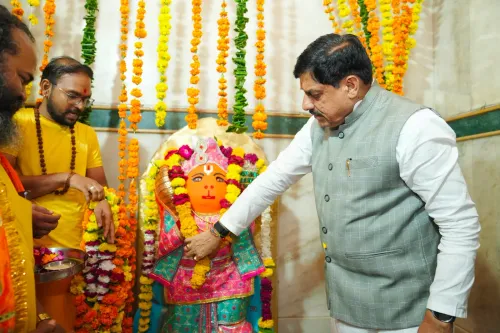
Dr. Mohan Yadav, who took charge as Chief Minister in December 2023, has consistently positioned public participation in festivals as a governance statement, not just a cultural courtesy. His aahwaan — or formal call — to ministers to attend Shastra Puja events in their respective districts turns a religious observance into a co-ordinated statewide exercise. District-level gatherings, where ministers preside alongside community leaders and religious figures, amplify the reach of the observance far beyond the state capital.
The broader pattern is well established: state governments across India routinely mark major festivals with official participation, but the degree of co-ordination — a chief minister issuing a formal summons to his full cabinet — underlines the political as much as the spiritual significance of the day.
Vijayadashami as both festival and statement
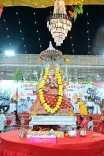
Across India, Vijayadashami 2026 is being observed with processions, Ramlila finales, and the burning of Ravana effigies. In Madhya Pradesh, the state government's emphasis on Shastra Puja frames the day through a specific lens: the honour of valour and the duty of those in power to publicly uphold it. Whether measured in metres of marigold garland or in the political optics of a full cabinet visible in temple courtyards across the state, the message from Bhopal is deliberate and unified.
As ministers fan out across Madhya Pradesh's 55 districts today, the festival becomes both devotion and demonstration — of faith, of cultural continuity, and of where this government chooses to be seen.
Point of View
Still consolidating authority after taking charge in late 2023, a full-cabinet show of Vijayadashami observance reinforces his image as a culturally rooted leader. The move sits within a deliberate pattern: official endorsement of Hindu public ritual blurs the line between governance and religious expression, drawing both admiration from the party's core constituency and scrutiny from those who see it as a conflation of state and religion. The district-level spread ensures visibility not just in Bhopal but at the grassroots — where electoral narratives are actually built.
NationPress
20 Oct 2026
Frequently Asked Questions
What is Shastra Puja and why is it done on Vijayadashami?
Shastra Puja is the ceremonial worship of weapons and tools performed on Vijayadashami, rooted in ancient traditions of warrior clans and royal courts who honoured their arms on the day marking the victory of dharma. It is now observed by households, armed forces units, and governments as a symbol of valour and protective power.
Why did CM Mohan Yadav call ministers for Shastra Puja in Madhya Pradesh?
CM Dr. Mohan Yadav issued a formal call for all state ministers to participate in Shastra Puja ceremonies across Madhya Pradesh on Vijayadashami 2026, framing it as a participation in the 'glorious tradition' that honours dharma and valour — a move that also carries significant political and cultural signalling.
Is Vijayadashami a public holiday in Madhya Pradesh?
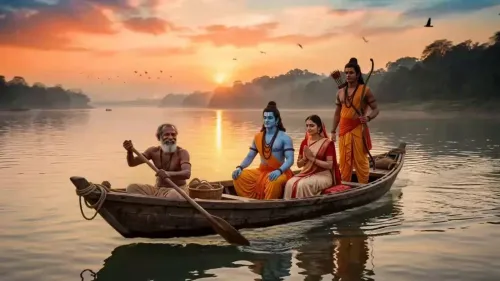
Yes, Vijayadashami (also called Dussehra) is a gazetted public holiday across India, including Madhya Pradesh, marking the tenth day of Navratri and the victory of Lord Rama over Ravana in Hindu tradition.
When did Mohan Yadav become Chief Minister of Madhya Pradesh?
Dr. Mohan Yadav became Chief Minister of Madhya Pradesh in December 2023, representing the Bharatiya Janata Party (BJP).
Do other BJP-ruled states also hold official Shastra Puja events?
Yes, official participation in Shastra Puja on Vijayadashami has become a visible pattern across BJP-ruled states in India, where elected representatives join public ceremonies as a statement of cultural and religious identity.