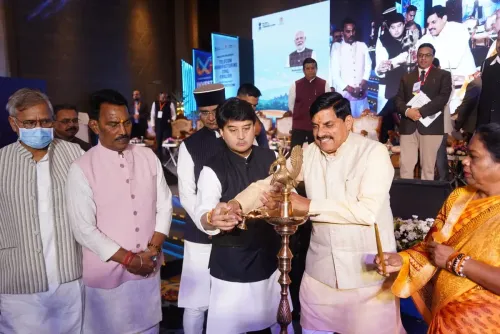
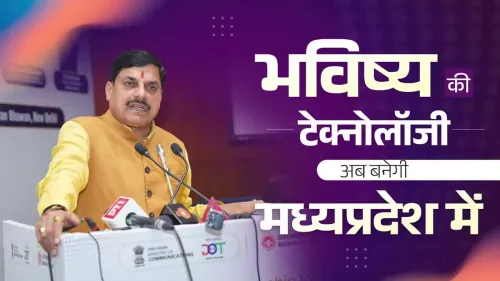
MP CM Mohan Yadav: Gwalior Tech Zone Phase 2 Gets 450 Hectares
Synopsis
Madhya Pradesh CM Mohan Yadav announced the allocation of approximately 450 hectares for Phase 2 of the Gwalior Telecom and Electronics Manufacturing Zone on 19 November 2026, months after a July MoU, calling it a model of 'maximum results in minimum time.'
Key Takeaways
The Chief Minister's Office of Madhya Pradesh announced on 19 November 2026 that ~450 hectares of land have been allocated for the second phase of the Gwalior Telecom and Electronics Manufacturing Zone .
Mohan Yadav stated that the first phase of the zone is nearing completion, triggering the Phase 2 land decision.
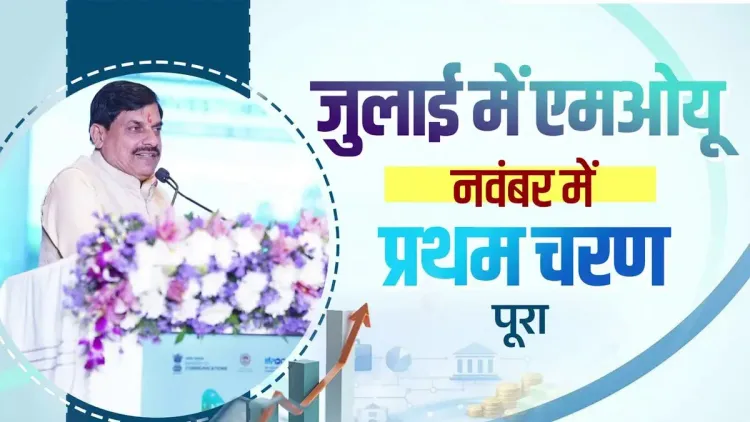
A MoU for the Gwalior zone was signed in July 2026 ; Phase 2 land allocation followed within four months.
The Department of Telecommunications (DoT) is tagged as a central partner, signalling national policy backing for the project.
The move is part of India's broader push under the PLI scheme (launched 2020) to build domestic electronics and telecom manufacturing capacity.
Specific investor names, job-creation numbers, and investment commitments have not yet been disclosed.
From a signed agreement in July to land allotted for a second phase by November — Madhya Pradesh is moving at a pace its government calls 'maximum results in minimum time.' The Chief Minister's Office of Madhya Pradesh announced on Thursday, 19 November 2026 that roughly 450 hectares of land have been allocated for the second phase of the Gwalior Telecom and Electronics Manufacturing Zone, even as the first phase nears completion.
From July MoU to November land allocation — the Gwalior timeline
Chief Minister Dr. Mohan Yadav framed the announcement as proof of the 'double-engine government' — the alignment between his state administration and the Narendra Modi-led central government — delivering visible results. 'A MoU was signed for the Gwalior Telecom and Electronics Manufacturing Zone in July, and with the first phase nearing completion in November, a decision has also been taken to allocate approximately 450 hectares of land for the second phase,' the CM posted on X, tagging the Department of Telecommunications (@DoT_India).
The zone is designed as a dedicated cluster for telecom and electronics manufacturers — companies that make everything from mobile components to network hardware. The involvement of the Department of Telecommunications signals central-government backing for the project, a critical ingredient for attracting large-scale investment in a sector that tends to follow policy certainty.
India's electronics race and where Gwalior fits
The Gwalior zone is part of a broader national drive. Since the Production Linked Incentive (PLI) scheme for electronics was launched in 2020, states across India have raced to offer manufacturing clusters that can plug into central incentives and reduce the country's dependence on imported components. Uttar Pradesh, Tamil Nadu, and others have moved aggressively; Madhya Pradesh is now staking a claim with Gwalior's strategic location in north-central India and its connectivity to major markets.
The sheer scale of the second-phase allocation — ~450 hectares — suggests the state is planning for a substantial industrial footprint, not a pilot. For context, 450 hectares is roughly equivalent to 630 standard football fields. That is land earmarked for factories, logistics corridors, worker facilities, and ancillary infrastructure.
What the DoT tag means for investors watching this space
Tagging @DoT_India in a state government's announcement is not incidental. It is a public signal that the central ministry is a partner in the project — which matters enormously to multinational or domestic electronics manufacturers evaluating whether to commit capital. The telecom sector in particular requires spectrum-adjacent policy alignment that only the central government can provide.
The names of companies that have signed up for units, and the eventual job-creation and investment figures from the zone, will be the real test of whether Gwalior's manufacturing ambition translates into shop-floor reality. The land is allocated. The clock is running.
Point of View
Fast-tracked industrial milestones to validate the argument that alignment with the central BJP government accelerates delivery. By moving from MoU to Phase 2 land allocation in under five months, Madhya Pradesh is competing directly with more established manufacturing states like Tamil Nadu and Uttar Pradesh for the same pool of electronics investors. The DoT partnership tag is strategically important: it signals to global and domestic OEMs that this is not a state-only venture but one with central spectrum and telecom-policy backing. The real verdict, however, will come when tenant companies and job numbers are announced — until then, the land allocation is a credible but incomplete proof point.
NationPress
19 Nov 2026
Frequently Asked Questions
What is the Gwalior Telecom and Electronics Manufacturing Zone?
It is a dedicated industrial cluster in Gwalior, Madhya Pradesh designed to attract telecom and electronics manufacturers, backed jointly by the state government and the Department of Telecommunications .
How much land has been allocated for Phase 2 of the Gwalior zone?
Approximately 450 hectares of land has been allocated for the second phase, as announced by CM Mohan Yadav on 19 November 2026 .
When was the MoU for the Gwalior zone signed?
The MoU for the Gwalior Telecom and Electronics Manufacturing Zone was signed in July 2026 , according to CM Mohan Yadav's official statement.
What is the double-engine government model CM Mohan Yadav refers to?
The 'double-engine government' refers to the political alignment between the BJP-led Madhya Pradesh state government and the BJP-led central government under PM Narendra Modi, which the party argues speeds up policy implementation and fund flow.
How does the Gwalior zone connect to India's PLI scheme for electronics?
India's Production Linked Incentive (PLI) scheme for electronics , launched in 2020 , incentivises states to build manufacturing clusters. The Gwalior zone is Madhya Pradesh's bid to attract investors under this national framework.