MP CMO Flags State's Coal Rank and 73% Copper Ore Reserves
Synopsis
The Chief Minister's Office of Madhya Pradesh has highlighted the state's fourth-place national ranking in coal production and its claim to 73% of India's copper ore reserves — a dual pitch positioning MP as a critical destination for mineral-sector investment.
Key Takeaways
The Chief Minister's Office of Madhya Pradesh posted on 3 August 2026 citing two headline mineral statistics.
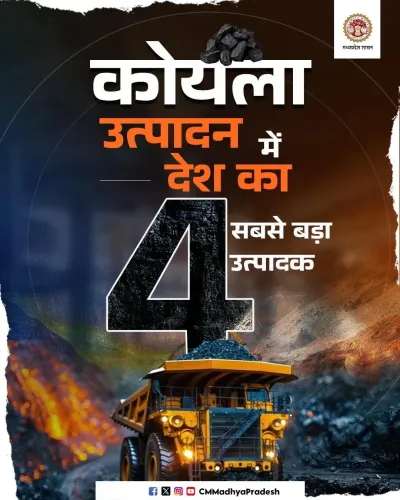
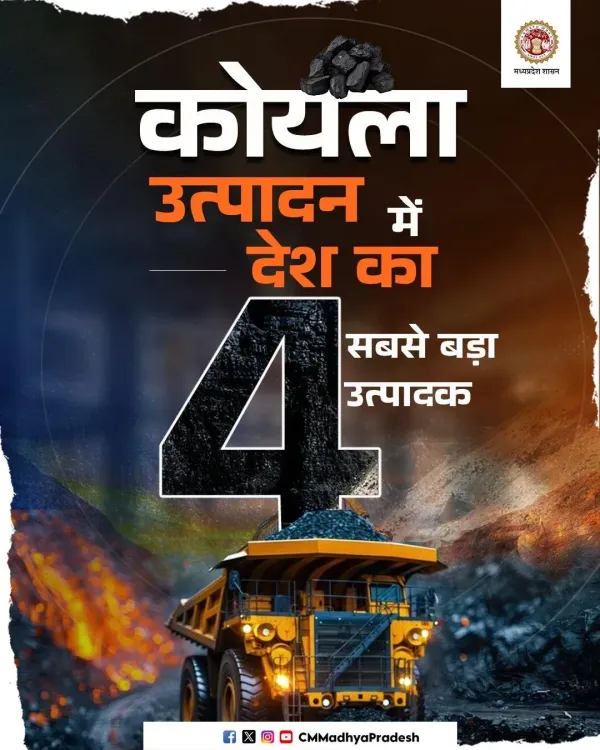
Madhya Pradesh claims to be the fourth-largest coal-producing state in India.
The state asserts it holds 73% of India's total copper ore reserves , making it the dominant custodian of the metal nationally.
The post aligns with a pattern of states publicising mineral rankings to attract investment under the central MMDR Act framework.
Copper's strategic importance is rising globally due to demand from electric vehicles, renewable energy infrastructure, and power grids .
The next concrete indicators will be fresh mineral block auctions and the annual mineral statistics release by the Indian Bureau of Mines .
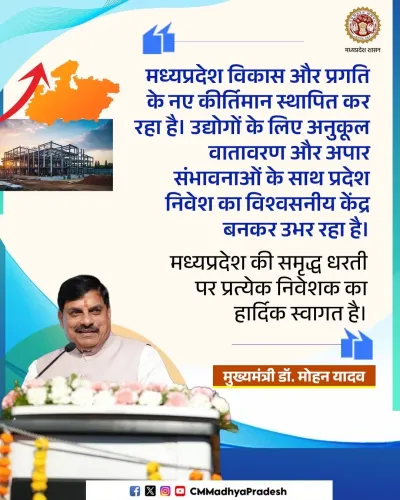
Madhya Pradesh is staking its claim as one of India's premier mineral powerhouses — and the numbers the state is putting forward are hard to ignore. The Chief Minister's Office of Madhya Pradesh posted on Monday, 3 August 2026, highlighting two headline figures: the state ranks fourth in coal production nationally and holds a commanding 73% share of India's copper ore reserves.
The Mineral Credentials MP Wants Investors to See
The post, shared in Hindi, leads with two data points that together paint a picture of a state sitting atop some of India's most strategically significant subsoil wealth. Coal and copper sit at opposite ends of the energy-transition debate — one the fuel of the old economy, the other a critical input for electric vehicles, power cables, and renewable infrastructure. Madhya Pradesh, the post implies, has a foot in both worlds.
The coal ranking places MP behind only a small cluster of eastern and central states that have historically dominated India's pit production. The copper reserve figure — 73% of the national total — is the sharper claim: it positions the state not merely as a significant player but as the dominant custodian of a metal whose global demand is rising sharply with the green-energy transition.
Why States Broadcast Their Mineral Rankings
Posts like this one are a recognisable genre in Indian state politics. Governments routinely publish mineral production rankings and reserve-share data to signal investment potential to mining companies and mineral-based industries. Madhya Pradesh's mineral sector operates within the framework of the central Mines and Minerals (Development and Regulation) Act, which governs prospecting licences and mining leases — meaning the state must compete for investor attention within a nationally regulated system.
Flagging reserve dominance is, in effect, a pitch: the state is telling industrial players that the ore is here, the policy window exists, and the opportunity is real. The Indian Bureau of Mines publishes annual mineral statistics that states draw on for such rankings, and any fresh mineral block auctions from the Madhya Pradesh mining department will be the next concrete test of whether these numbers translate into investment on the ground.
Copper's Rising Strategic Weight
The copper figure deserves its own moment. India is a net importer of refined copper, and domestic ore production has lagged behind the country's industrial appetite for decades. A state holding nearly three-quarters of the nation's copper ore reserves is sitting on an asset whose strategic value is only climbing — every solar panel array, every EV charging station, every grid upgrade adds to the demand curve. Whether Madhya Pradesh can convert that geological inheritance into active, large-scale extraction is the question the mining sector will be watching.
The state's coal fields, concentrated in districts such as Singrauli, Shahdol, and Chhindwara, have long been central to India's thermal power supply chain. A fourth-place national ranking in production reflects decades of extraction activity — and ongoing relevance even as the country navigates its energy transition commitments.
Mineral wealth on paper is one thing. Auction calendars, environmental clearances, and infrastructure connectivity are where rankings become revenue — and that is precisely where the state's next moves will matter most.
Point of View
The state is attempting to reframe itself from a legacy coal economy to a future-critical mineral hub. The move fits a broader pattern of BJP-governed states competing aggressively for mineral-sector FDI ahead of the next round of MMDR-driven block auctions. Whether the reserve figures translate into active extraction will depend on clearance timelines and infrastructure — the gap between geological wealth and industrial output that has historically defined MP's mining story.
NationPress
17 Sept 2026
Frequently Asked Questions
Which state has the largest copper ore reserves in India?
Madhya Pradesh claims to hold approximately 73% of India's copper ore reserves, making it the dominant state for this mineral. Rajasthan and Jharkhand also have notable copper deposits, but MP's share is cited as the largest.
What is Madhya Pradesh's rank in coal production in India?
According to the Chief Minister's Office of Madhya Pradesh, the state ranks fourth in coal production nationally. Major coal-producing districts include Singrauli, Shahdol, and Chhindwara.
Why is copper ore important for India's economy?
Copper is a critical input for electric vehicles, renewable energy infrastructure, power cables, and electronics. As India scales up its green-energy transition, domestic copper ore reserves have growing strategic and industrial significance.
What law governs mining in Madhya Pradesh?
Mining in Madhya Pradesh, as across India, is governed by the central Mines and Minerals (Development and Regulation) Act (MMDR Act). The state issues licences and conducts mineral block auctions within this framework.
Which body publishes official mineral production rankings for Indian states?
The Indian Bureau of Mines (IBM), under the Union Ministry of Mines, publishes annual mineral statistics that form the basis for state-level production rankings and reserve-share data.