MP CM Office Marks 12 Years With Pilgrim Facility Push

Synopsis
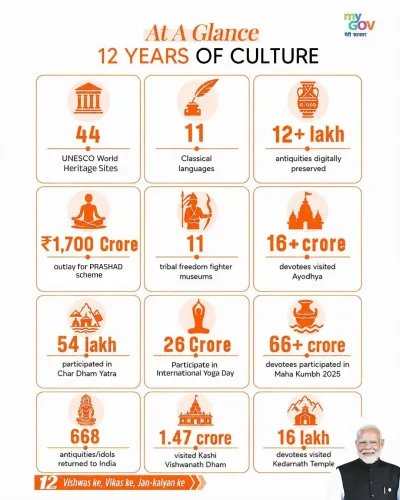
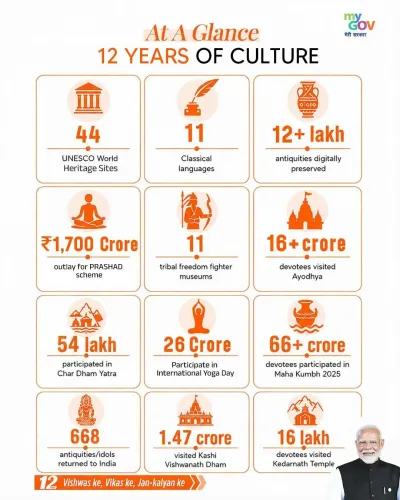
The Chief Minister's Office of Madhya Pradesh marked its 12-year governance milestone on 18 June 2026 by announcing expanded modern amenities at pilgrimage sites, framing easier spiritual travel as a key development achievement under the hashtag #12YearsOfVikasBhiVirasatBhi.
Key Takeaways
The Chief Minister's Office of Madhya Pradesh posted on 18 June 2026 highlighting improved pilgrim facilities at religious sites.
The announcement is part of a 12-year governance milestone campaign under #12YearsOfVikasBhiVirasatBhi and #12YearsOfSeva .
Madhya Pradesh hosts two of India's twelve Jyotirlinga shrines — Mahakaleshwar in Ujjain and Omkareshwar on the Narmada river .
The central government's PRASAD scheme , launched in 2014-15 , supports modern amenities and connectivity at pilgrimage destinations nationwide.
Pilgrims, religious tourists, and local economies around sacred sites are the primary beneficiaries of these infrastructure upgrades.
The Chief Minister's Office of Madhya Pradesh announced on Thursday, 18 June 2026 that spiritual travel across the state has been made more accessible, highlighting the expansion of modern amenities at pilgrimage sites as part of its 12-year governance milestone.
Context
The post, shared under the hashtags #12YearsOfVikasBhiVirasatBhi and #12YearsOfSeva (meaning 'twelve years of development as well as heritage' and 'twelve years of service'), frames infrastructure upgrades at religious destinations as a defining achievement of the current dispensation. The announcement states that aatmik yatra sugam hui — 'spiritual journeys have been made easier' — through the spread of modern facilities at teerthsthalon, or pilgrimage centres.
Policy Backdrop
Madhya Pradesh is home to two of India's twelve Jyotirlinga shrines: the Mahakaleshwar temple in Ujjain and the Omkareshwar temple on an island in the Narmada river. Both sites draw millions of pilgrims annually and have been focal points for state-level infrastructure investment over successive government terms.
At the national level, the PRASAD scheme — launched by the Ministry of Tourism in 2014-15 — was designed to provide modern amenities and improved connectivity at identified pilgrimage destinations across India. Madhya Pradesh has integrated such central programmes into its broader tourism and heritage policy framework, seeking to balance contemporary pilgrim conveniences with the preservation of sacred heritage.
Stakeholders and Impact
The primary beneficiaries of improved pilgrim infrastructure are the millions of religious tourists and devotees who visit Ujjain, Omkareshwar, and other sacred sites in Madhya Pradesh each year. Better facilities — including sanitation, connectivity, rest areas, and approach roads — directly affect the quality and safety of pilgrimage experiences, particularly during large congregations such as the Simhastha Kumbh Mela held at Ujjain.
Local economies around pilgrimage centres also stand to gain, as improved access typically drives higher footfall among domestic and international religious tourists, supporting livelihoods in hospitality, transport, and the informal sector.
What's Next
The 12-year milestone framing suggests the state government intends to use this communications cycle to document and publicise infrastructure achievements ahead of future electoral and policy cycles. Observers will watch for detailed project completion reports from Ujjain and Omkareshwar, as well as any fresh allocations for pilgrimage infrastructure in the next Madhya Pradesh state tourism budget. The degree to which announced facilities have translated into on-ground improvements will be the measure of the campaign's credibility among pilgrims and civil society.
Point of View
Positioning heritage conservation and development as complementary — not competing — goals, a narrative that resonates strongly in a state with deep religious tourism infrastructure. By anchoring the announcement to pilgrimage infrastructure, the Madhya Pradesh government signals that faith-based tourism remains a cornerstone of its governance identity. This aligns with a broader national pattern of state governments investing in Jyotirlinga and Char Dham corridors as both development priorities and political capital. The campaign's durability will ultimately depend on verifiable on-ground outcomes at Ujjain and Omkareshwar, where pilgrim volumes make infrastructure gaps highly visible.
NationPress
17 Sept 2026
Frequently Asked Questions
What pilgrimage sites has Madhya Pradesh upgraded?
Madhya Pradesh has focused infrastructure upgrades on major pilgrimage centres including Ujjain , home to the Mahakaleshwar Jyotirlinga , and Omkareshwar , home to another of the twelve Jyotirlingas on the Narmada river .
What is the PRASAD scheme and does it apply to Madhya Pradesh?
The PRASAD scheme is a central government programme launched in 2014-15 by the Ministry of Tourism to provide modern amenities at pilgrimage destinations. Madhya Pradesh has integrated this scheme into its state tourism policy.
What does #12YearsOfVikasBhiVirasatBhi mean?
The hashtag translates from Hindi as '12 years of development as well as heritage,' reflecting the Madhya Pradesh government's framing of its governance record as balancing modern infrastructure with cultural and religious preservation.
How many Jyotirlinga temples are in Madhya Pradesh?
Madhya Pradesh hosts two of India's twelve Jyotirlinga shrines — Mahakaleshwar in Ujjain and Omkareshwar on an island in the Narmada river .
Who benefits from better pilgrimage infrastructure in Madhya Pradesh?
The primary beneficiaries are pilgrims and religious tourists visiting sacred sites, along with local economies in towns like Ujjain and Omkareshwar that depend on hospitality, transport, and trade linked to temple footfall.