Surat cyber fraud: Mumbai businessman arrested for lending firm's bank account

Synopsis
A Mumbai businessman received just ₹12,000 in commission for lending his firm's bank account — but investigators found over ₹1.36 crore had flowed through it since 2021. The arrest by Surat's Cyber Crime Cell exposes the 'money mule' pipeline linking local account holders to overseas fraudsters, in a case that began with a dating app and a fake e-commerce website.
Key Takeaways
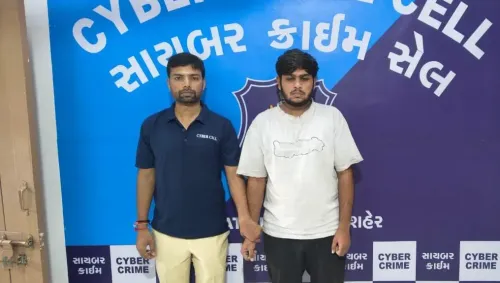
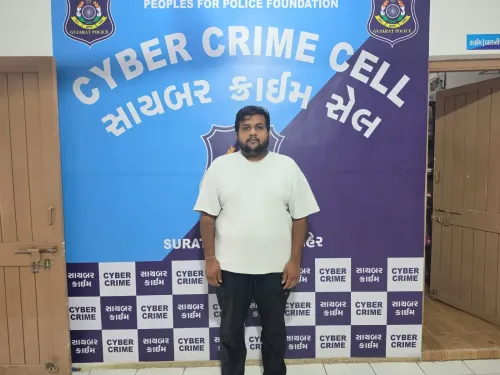
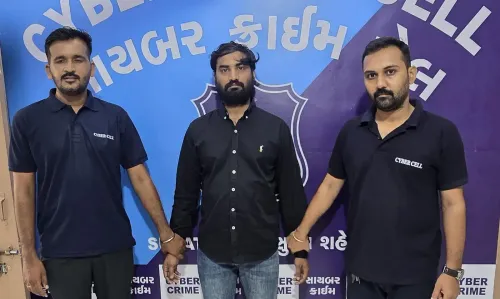
Imran Khilchi , a 46-year-old businessman from Grant Road, Mumbai , was arrested by the Surat City Cyber Crime Cell on 7 October 2026 .
He allegedly provided his firm's current account to an absconding accused based in Dubai , receiving a commission of ₹12,000 .
A complainant was cheated of ₹5,88,909 after being lured via a dating app and a fake e-commerce website.
Investigators found ₹1,36,05,550 transacted through the firm's account between 9 April 2021 and 24 September 2026 .
The case was registered under the Bharatiya Nyaya Sanhita, 2023 and Section 66D of the IT Amendment Act, 2008 .
Police have warned citizens against lending bank accounts for commissions, noting that account holders face legal liability for fraud transactions.
The Surat City Cyber Crime Cell has arrested a 46-year-old Mumbai-based businessman for allegedly providing his company's bank account to an absconding accused, enabling a cyber fraud in which a complainant was cheated of ₹5,88,909 through a fake e-commerce scheme. The arrest was made on 7 October 2026, following a technical investigation by a team led by Police Inspector A.M. Mori.
How the Fraud Was Executed
According to the Surat Cyber Crime Branch, the primary accused — who remains at large — contacted the complainant through a dating app and shared a link to a fraudulent website. The complainant was instructed to create a user ID on the platform and was told that conducting e-commerce transactions through it would yield substantial returns.
Believing the promise of attractive profits, the complainant transferred a cumulative amount of ₹5,88,909 across multiple bank accounts as part of the purported business. The funds were never returned, prompting the victim to file a formal complaint at the Cyber Crime Police Station.
The Case Against the Arrested Accused
Police identified the arrested individual as Imran Khilchi, a businessman residing in the Grant Road area of Mumbai. He allegedly provided the current account of his firm to an absconding accused reportedly based in Dubai, and received a commission of ₹12,000 in return.
Investigators found that a staggering ₹1,36,05,550 was transacted through the firm's current account between 9 April 2021 and 24 September 2026 — a detail that broadens the scope of the probe well beyond the initial complaint.
Legal Sections Invoked
A case was registered under Sections 318(4), 336(2), 338, 336(3), 340(2), 61(2) and 3(5) of the Bharatiya Nyaya Sanhita, 2023, as well as Section 66D of the Information Technology Amendment Act, 2008 — which specifically addresses cheating by impersonation using computer resources.
Police Warning to the Public
The Surat Cyber Crime Cell used the occasion to issue a public advisory, cautioning citizens against lending their bank accounts to others in exchange for commissions or any other inducement. Authorities warned that such accounts can be misused for large-scale cyber fraud, and that account holders risk criminal prosecution for all transactions routed through them.
This case follows a broader national pattern of 'money mule' networks — where individuals knowingly or unknowingly provide bank accounts to fraudsters — which has emerged as a key enabler of online financial crime in India. With the absconding accused reportedly in Dubai, investigators are expected to pursue international coordination channels as the probe deepens.
Point of View
000 commission Imran Khilchi allegedly accepted is trivial against the ₹1.36 crore that flowed through his account — a disproportion that illustrates how 'money mule' networks exploit financially motivated individuals with little understanding of their legal exposure. What this case also underscores is the cross-jurisdictional complexity of modern cyber fraud: the principal accused is reportedly in Dubai, meaning a domestic arrest solves only part of the puzzle. India's cyber crime enforcement has improved detection, but extradition and international asset-recovery remain weak links that organised networks continue to exploit with near-impunity.
NationPress
8 Oct 2026
Frequently Asked Questions
What is the Surat cyber fraud case about?
The Surat City Cyber Crime Cell arrested a Mumbai businessman for allegedly providing his firm's bank account to a Dubai-based fraudster, who used it to swindle a victim of ₹5,88,909 through a fake e-commerce scheme initiated via a dating app. Investigators subsequently found over ₹1.36 crore had been routed through the same account over five years.
Who was arrested and what was his alleged role?
The arrested individual is Imran Khilchi, a 46-year-old businessman from the Grant Road area of Mumbai. He allegedly lent his firm's current account to the primary accused in exchange for a commission of ₹12,000, making the account a conduit for the fraud proceeds.
How did the fraudsters target the victim?
The fraudsters contacted the complainant through a dating app and shared a link to a fake website, promising high returns from e-commerce transactions. The victim transferred ₹5,88,909 across multiple bank accounts before realising the money would not be returned.
What legal charges have been filed in the case?
The case has been registered under Sections 318(4), 336(2), 338, 336(3), 340(2), 61(2) and 3(5) of the Bharatiya Nyaya Sanhita, 2023, and Section 66D of the Information Technology Amendment Act, 2008, which covers cheating by impersonation using computer resources.
What warning has the Surat police issued to the public?
The Surat Cyber Crime Cell has cautioned citizens never to provide their bank accounts to others in exchange for commissions or inducements. Authorities have warned that such accounts can be used for large-scale cyber fraud and that account holders may face criminal prosecution for all transactions conducted through them.