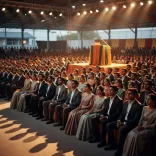
President Murmu Confers 65th Lalit Kala Akademi Awards

Synopsis
President Droupadi Murmu conferred the 65th annual Lalit Kala Akademi Awards at Rashtrapati Bhavan on October 21, 2026. Culture Minister Gajendra Singh Shekhawat live-streamed the ceremony, spotlighting India's premier state honour for visual arts practitioners.
Key Takeaways
President Droupadi Murmu presided over the 65th Lalit Kala Akademi Awards ceremony at Rashtrapati Bhavan on October 21, 2026 .
The Lalit Kala Akademi was founded in 1954 and functions as an autonomous body under India's Ministry of Culture .
Union Culture and Tourism Minister Gajendra Singh Shekhawat broadcast the ceremony live on X , expanding public access.
President Murmu is the first tribal woman to hold the office of President of India, elected in 2022 .
The full list of 65th edition recipients is expected to be released by the Akademi following the ceremony.
The awards recognise excellence in painting, sculpture, printmaking, and other visual art forms across India.
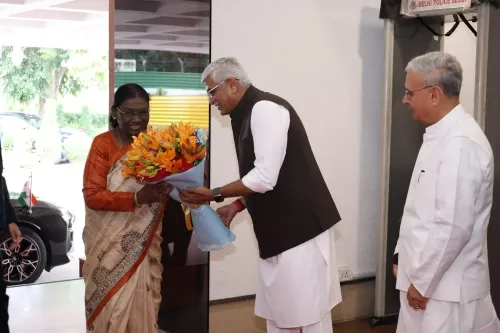
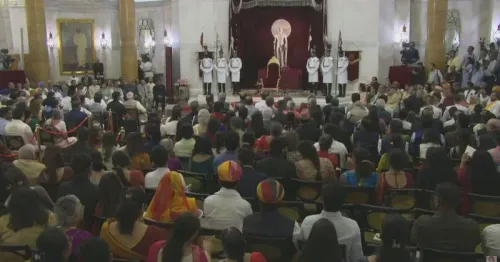
At Rashtrapati Bhavan on Wednesday, October 21, 2026, President Droupadi Murmu conferred the 65th annual Lalit Kala Akademi Awards — India's highest institutional honour for visual arts — in a live ceremony that Union Culture and Tourism Minister Gajendra Singh Shekhawat broadcast to the nation in real time.
India's Premier Fine Arts Honour, Seven Decades On
The Lalit Kala Akademi, established in 1954 as an autonomous body under the Ministry of Culture, has been the custodian of India's fine-arts tradition for over seven decades. Its annual awards recognise excellence across painting, sculpture, printmaking, and other visual disciplines — making them the country's most prestigious state-conferred recognition for practising artists.
The conferment by the President at Rashtrapati Bhavan is a long-standing ceremonial practice, embedding the awards in the highest register of national life. That President Murmu — the first tribal woman to hold the office, elected in 2022 — presides over this edition carries its own resonance, given her personal journey from Odisha's Scheduled Tribe communities to the grandeur of the presidential palace.
Shekhawat's Live Broadcast and the Ministry's Cultural Mandate
Minister Shekhawat's decision to stream the ceremony live on X signals the Ministry of Culture's push to widen public access to institutional cultural events beyond the traditional invite list. As the minister administratively responsible for the Akademi, Shekhawat's presence — and his real-time amplification — underlines the government's framing of the awards as a national, not merely sectoral, moment.
The Ministry of Culture oversees a constellation of autonomous akademis — Lalit Kala, Sangeet Natak, and Sahitya — each charged with a distinct artistic domain. The annual awards cycle across all three represents the government's most visible act of patronage toward practising artists.
What the 65th Edition Means for India's Visual Arts Community
The full list of recipients of the 65th Lalit Kala Akademi Awards is expected to be released by the Akademi following the ceremony. Artists, curators, and galleries will watch closely — not just for the names, but for any fellowships, exhibitions, or acquisition programmes the Akademi announces alongside the honours. For many recipients, the award is career-defining: a state imprimatur that opens institutional doors and international exposure.
India's visual arts ecosystem — spanning regional schools from Madhubani to Mysore, contemporary abstraction, and public sculpture — finds in the Akademi its single most authoritative national platform. Each edition of the awards, in that sense, is a snapshot of where the Indian fine-arts establishment places its highest bets.
The 65th edition lands at a moment when India's soft-power projection — through culture, heritage, and the arts — has become an explicit plank of government policy. A live-streamed presidential ceremony is, quietly, part of that larger architecture.
Point of View
Embedding institutional arts patronage into the government's broader public-diplomacy narrative. Under the current administration, the autonomous akademis — long seen as low-visibility bureaucratic bodies — have been repositioned as flagships of India's civilisational identity. President Murmu's personal significance as the first tribal Head of State conferring these honours adds a dimension that the Ministry is unlikely to leave unexploited in its outreach. The 65th edition thus becomes not just an arts event but a data point in a longer argument about inclusive cultural nationhood.
NationPress
21 Oct 2026
Frequently Asked Questions
What are the Lalit Kala Akademi Awards?
The Lalit Kala Akademi Awards are India's highest state-conferred honour for visual arts, awarded annually by the National Academy of Fine Arts established in 1954 under the Ministry of Culture. They recognise excellence in painting, sculpture, printmaking, and related disciplines.
Who conferred the 65th Lalit Kala Akademi Awards?
President of India Droupadi Murmu conferred the 65th annual Lalit Kala Akademi Awards at Rashtrapati Bhavan on October 21, 2026.
What is the Lalit Kala Akademi and who runs it?
The Lalit Kala Akademi is India's National Academy of Fine Arts, an autonomous body under the Ministry of Culture. It was founded in 1954 and is responsible for promoting and preserving visual arts in India.
Who is Gajendra Singh Shekhawat?
Gajendra Singh Shekhawat is the Union Minister of Culture and Tourism and a senior BJP leader. He is a Lok Sabha MP from Jodhpur, Rajasthan, and is administratively responsible for the Lalit Kala Akademi.
Where are the Lalit Kala Akademi Awards held?
The awards are traditionally conferred at Rashtrapati Bhavan, the official residence of the President of India in New Delhi, in keeping with long-standing ceremonial practice for national cultural honours.