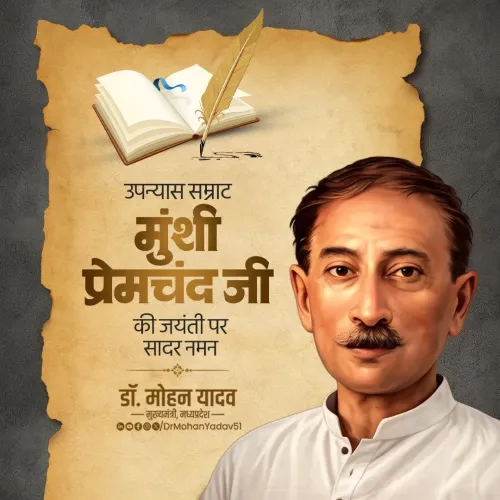
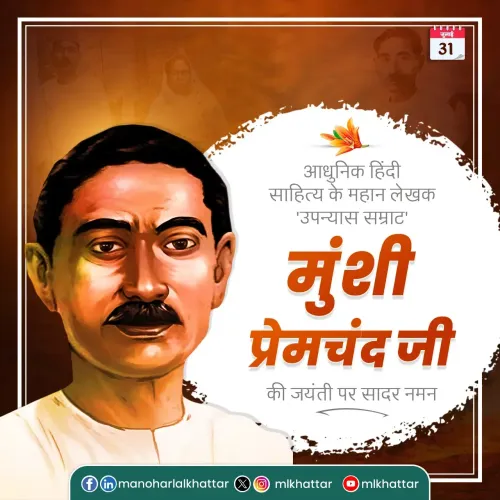
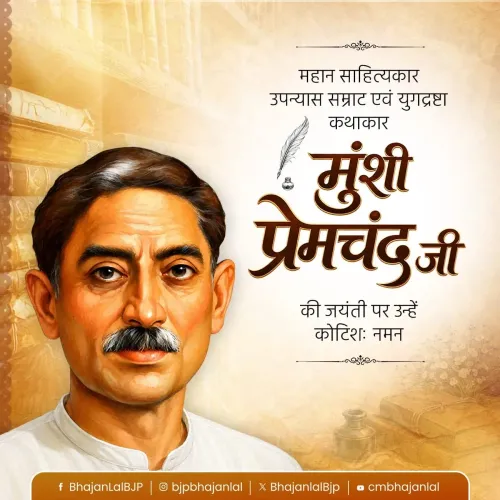
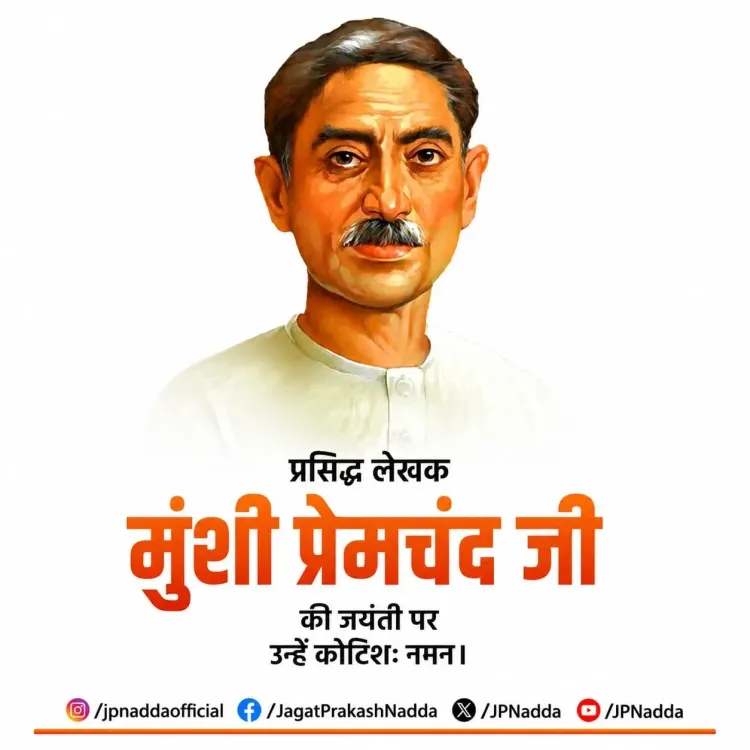
Nadda pays tribute to Munshi Premchand on birth anniversary
Synopsis
On Munshi Premchand's birth anniversary, Union Health Minister and BJP president J. P. Nadda paid tribute to the legendary Hindi writer, citing six iconic works and calling his legacy an enduring inspiration for building a just and humane society.
Key Takeaways
Nadda posted a tribute on July 31, 2026 marking Munshi Premchand's birth anniversary .
Nadda named six specific works: Godaan, Gaban, Nirmala, Panch Parameshwar, Namak ka Daroga , and Boodhi Kaki .
He described Premchand as having delivered a 'powerful blow against social evils, inequalities, and injustice' through his writing.
Premchand, born Dhanpat Rai Srivastava on July 31, 1880 in Lamhi near Varanasi , wrote over 300 short stories and more than a dozen novels.
Nadda credited Premchand with connecting Hindi literature to the concerns of ordinary people and giving direction to social awakening.
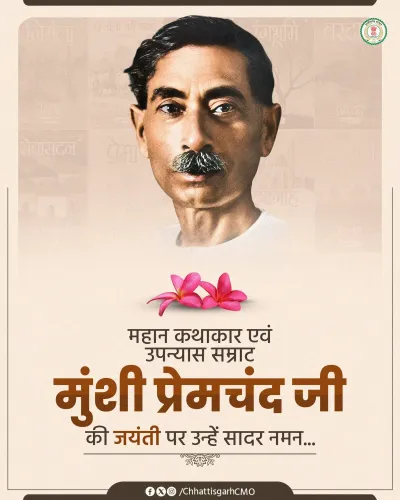
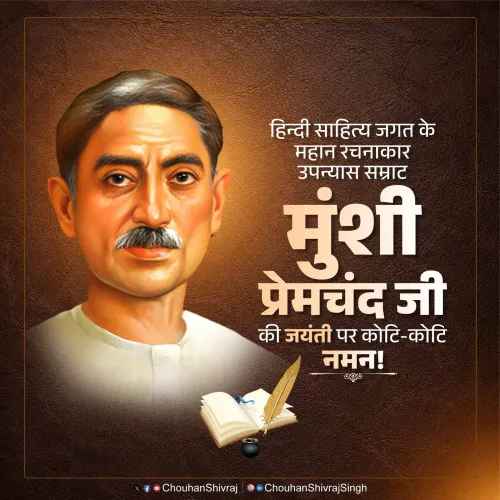
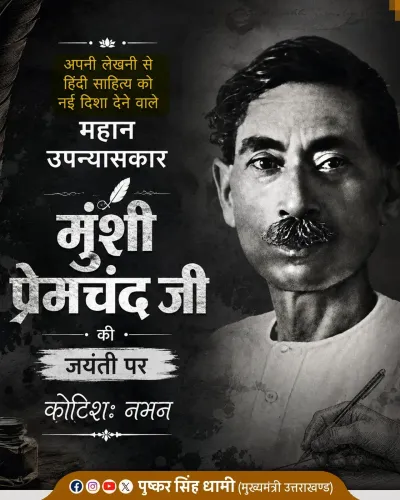
The voice of India's villages and the conscience of its forgotten millions — Munshi Premchand was born 131 years ago and has never really left. On Friday, July 31, 2026, Union Health Minister and BJP national president J. P. Nadda joined the nation in marking the birth anniversary of the legendary writer with a heartfelt tribute on X.
Nadda wrote: 'हिन्दी साहित्य को अपनी कालजयी कृतियों से अमरत्व प्रदान करने वाले महान कथाकार... मुंशी प्रेमचंद जी की जयंती पर उन्हें कोटि-कोटि नमन करता हूँ' — 'I bow in reverence countless times to the great storyteller who gifted immortality to Hindi literature through his timeless works, on the occasion of Munshi Premchand's birth anniversary.'
The works Nadda named — and why they still cut deep
Nadda singled out six works by name: Godaan, Gaban, Nirmala, Panch Parameshwar, Namak ka Daroga, and Boodhi Kaki. The selection is not incidental. Each title is a precise strike at a different social wound — Godaan on the crushing debt that swallowed the Indian peasant; Nirmala on the violence of child marriage; Namak ka Daroga on the lone honest official standing against a corrupt system. Premchand did not write parables. He wrote portraits, and his readers recognised their own faces in them. In his tribute, Nadda described Premchand as having delivered 'a powerful blow against social evils, inequalities, and injustice' — and credited him with connecting literature to the concerns of ordinary people while giving 'new direction to independent consciousness and social awakening.'Premchand's place in the Hindi literary canon
Born Dhanpat Rai Srivastava on July 31, 1880, in Lamhi village near Varanasi, Premchand wrote in both Hindi and Urdu and produced more than a dozen novels and roughly 300 short stories over his lifetime. He died in 1936, leaving behind a body of work that became the bedrock of the modern Hindi literary tradition. The honorific 'Upanyas Samrat' — Emperor of Novels — which Nadda invoked in his post, was not bestowed by any institution. It was earned by readers across generations. His writing arrived at a moment when India was still under colonial rule, and his insistence on centering the rural poor, Dalit communities, and women in serious literary fiction was a quiet act of radical empathy.A ritual of remembrance that transcends party lines
Every July 31, India's political class — across ideological lines — pauses to acknowledge Premchand. The tributes are annual, the language reverential, and the references consistent: social reform, human dignity, the power of the written word. Nadda's post fits squarely within that tradition, closing with the observation that Premchand's literary legacy 'will continue to inspire us to build a sensitive, egalitarian, and humane society.' That sentence, in the end, is both tribute and aspiration — a reminder that the problems Premchand wrote about have not entirely disappeared from the landscape he described so precisely.Point of View
Pro-poor literary values at a time when the party's social-justice credentials are under scrutiny. The choice to name six specific works — rather than offer a generic salutation — projects intellectual engagement with the Hindi literary tradition, a key cultural constituency. Across parties, July 31 tributes to Premchand have become a soft-power ritual, and Nadda's post reinforces that consensus. The closing line about building a 'sensitive, egalitarian, and humane society' is aspirational language that serves as much as a political signal as a literary one.
NationPress
31 Jul 2026
Frequently Asked Questions
Why is July 31 celebrated as Premchand Jayanti?
July 31 is Munshi Premchand's birthday , marking his birth on July 31, 1880 in Lamhi village near Varanasi. It is observed annually by literary organisations, schools, and public figures across India as a day to honour his contribution to Hindi and Urdu literature.
What did JP Nadda say about Munshi Premchand?
J. P. Nadda described Premchand as a 'great storyteller who gifted immortality to Hindi literature,' credited him with delivering a powerful blow against social evils and injustice, and said his literary legacy would continue to inspire the building of a humane and egalitarian society.
Which books by Premchand did Nadda mention?
Nadda specifically named Godaan, Gaban, Nirmala, Panch Parameshwar, Namak ka Daroga , and Boodhi Kaki as Premchand's timeless works.
Who was Munshi Premchand?
Munshi Premchand , born Dhanpat Rai Srivastava on July 31, 1880 , was a pioneering Hindi-Urdu novelist and short story writer known for portraying rural Indian life, caste discrimination, and social inequality. He wrote over 300 short stories and is called Upanyas Samrat — Emperor of Novels. He died in 1936 .
What is the significance of Premchand's Godaan?
Godaan , published in 1936 , is considered Premchand's masterpiece and one of the greatest Hindi novels ever written. It tells the story of a poor farmer crushed by debt and feudal exploitation, and is widely regarded as a definitive portrait of rural India under colonial rule.