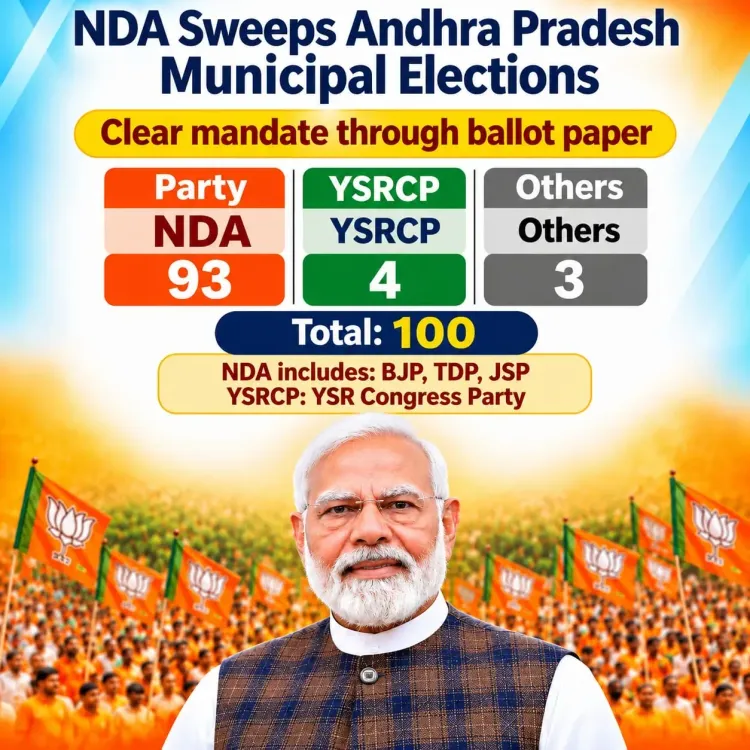
NDA Sweeps AP Municipal Polls: 93 of 100 Seats via Ballot Paper
Synopsis
Union Minister G. Kishan Reddy announced the NDA's BJP-TDP-JSP triple-engine alliance won 93 of 100 Andhra Pradesh municipal seats via ballot paper on 5 November 2026, using the result to rebut persistent opposition claims of EVM manipulation.
Key Takeaways
The NDA alliance (BJP, TDP, JSP) won 93 out of 100 seats in the Andhra Pradesh Municipal Elections .
The elections were conducted using ballot papers , not EVMs — a detail central to Minister Kishan Reddy's framing.
Union Coal and Mines Minister G.
Kishan Reddy said the result 'completely shreds' the opposition's EVM-rigging narrative.
The win extends the NDA's triple-engine control across Centre, state, and local bodies in Andhra Pradesh.
The BJP-TDP-JSP alliance had already secured a decisive majority in the 2024 Andhra Pradesh assembly elections .
Kishan Reddy framed the municipal sweep as a voter endorsement of 'progress, transparency, and good governance.'
Ballot papers, not EVMs — and the result was a landslide. Union Coal and Mines Minister G. Kishan Reddy declared on Thursday, 5 November 2026 that the NDA alliance had clinched 93 out of 100 seats in the Andhra Pradesh Municipal Elections, conducted entirely through ballot paper, calling it a 'reiteration of public trust.'
93 Seats, Ballot Paper, No Escape Clause
The significance of the method is impossible to separate from the result. For years, opposition parties — including Congress and the broader INDI alliance — have questioned the integrity of Electronic Voting Machines, making 'EVM rigging' a persistent refrain after electoral defeats. These municipal polls used ballot paper throughout. The NDA walked away with 93 of 100 seats.
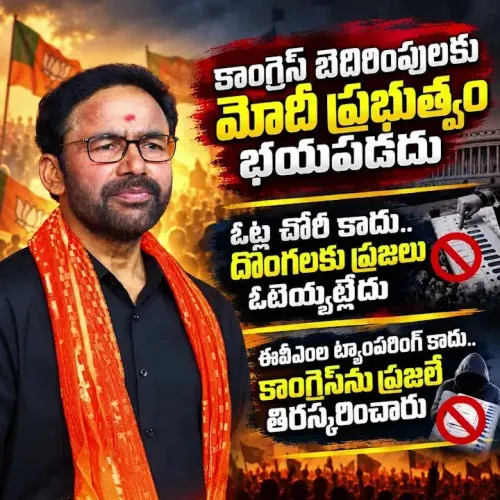
Kishan Reddy did not let the irony pass quietly. 'Congress and the INDI alliance's favorite narrative of EVM rigging lies completely shredded today,' he posted, framing the sweep as empirical proof that the mandate is real, the machinery irrelevant.
The Triple-Engine Alliance in Andhra Pradesh
The victory belongs to all three partners of what Kishan Reddy calls the 'triple-engine alliance' — BJP, Telugu Desam Party (TDP), and Jana Sena Party (JSP). The coalition had already delivered a decisive majority in the 2024 Andhra Pradesh assembly elections, establishing a government that now controls the state executive, its parliamentary seats, and, as of today, its municipal bodies in bulk.
That layered dominance — Centre, state, and now local — is precisely what the minister means by 'triple-engine.' Each tier is meant to reinforce the others: central schemes flow through a friendly state government into municipally administered delivery on the ground. A sweep at the municipal level completes the circuit.
Local Body Wins as Governance Report Cards
Municipal elections are notoriously difficult to win on national narratives alone. Voters weigh garbage collection, water supply, and road repair — the unglamorous last mile of governance. An alliance that wins 93 of 100 urban local body seats is signalling something beyond party loyalty: it is signalling that the delivery machinery is working, or at least that voters believe it is.
Kishan Reddy framed the result in exactly those terms — 'progress, transparency, and good governance' — extending his gratitude to the people of Andhra Pradesh for 'choosing' those values. The language is deliberate: it converts a local poll result into an endorsement of a governing philosophy.
The EVM debate in Indian politics has never really been about the machines — it has always been about legitimacy. Today in Andhra Pradesh, that debate ran out of room to hide.
Point of View
Kishan Reddy is pursuing a dual objective — validating the state result and pre-emptively neutralising the same argument in future EVM-based polls. The triple-engine framing is equally strategic; it positions local body victories not as isolated civic outcomes but as proof that multi-tier alliance governance delivers, reinforcing the case for the coalition model ahead of other state cycles. For the INDIA bloc, a 93-of-100 defeat on paper ballots is an uncomfortable data point with no easy rebuttal.
NationPress
5 Nov 2026
Frequently Asked Questions
What were the results of the Andhra Pradesh municipal elections 2026?
The NDA alliance — comprising BJP, TDP, and JSP — won 93 out of 100 seats in the Andhra Pradesh Municipal Elections, according to Union Minister G. Kishan Reddy's post on 5 November 2026.
Were the Andhra Pradesh municipal elections held with ballot papers or EVMs?
The elections were conducted using ballot papers, not EVMs. Minister Kishan Reddy highlighted this specifically to counter opposition claims that NDA victories in past polls were due to EVM manipulation.
What is the triple-engine alliance in Andhra Pradesh?
The triple-engine alliance refers to the coalition of BJP, Telugu Desam Party (TDP), and Jana Sena Party (JSP) that governs at the Centre, in the Andhra Pradesh state government, and now dominates local bodies after the municipal results.
Why do opposition parties question EVMs in Indian elections?
Congress and the INDIA alliance have repeatedly alleged that EVMs can be manipulated, raising doubts after electoral losses since 2019. The NDA argues that paper-ballot results, such as the latest Andhra Pradesh municipal sweep, disprove these claims.
Who is G. Kishan Reddy?
G. Kishan Reddy is the Union Minister of Coal and Mines and the BJP's Telangana state president. He is a senior BJP leader who frequently comments on political developments across Andhra Pradesh and Telangana.