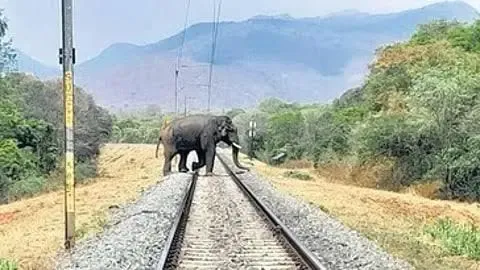
How are NFR’s tech-driven initiatives saving elephants and enhancing train safety?
Synopsis
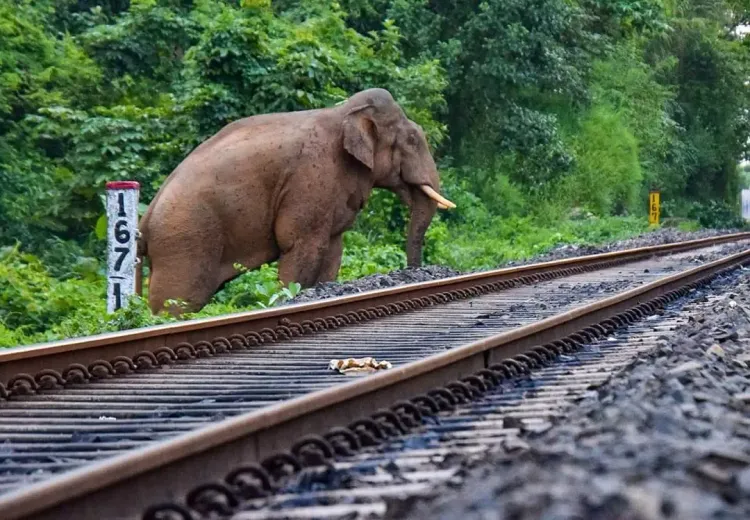
The Northeast Frontier Railway's innovative measures, including AI technology and unique systems like 'Plan Bee', are successfully protecting elephants and ensuring safer train operations. In 2025, over 160 elephants were safeguarded, showcasing NFR's commitment to wildlife conservation amidst railway operations.
Key Takeaways
NFR has implemented advanced technology to protect elephants.
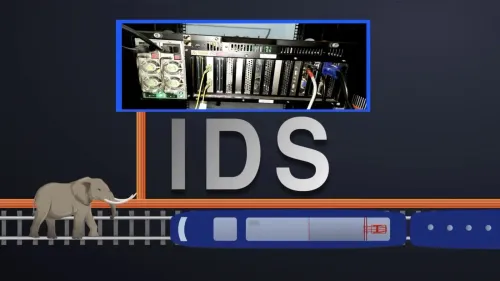
The Intrusion Detection System provides real-time alerts for train operators.
Over 160 elephants were safeguarded in 2025 alone.
NFR collaborates with the Forest Department for enhanced safety measures.
The 'Plan Bee' initiative successfully deters elephants from tracks.
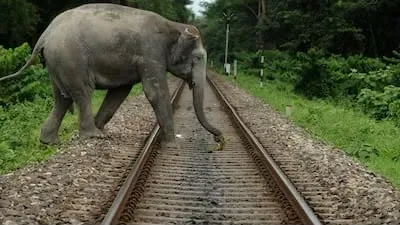
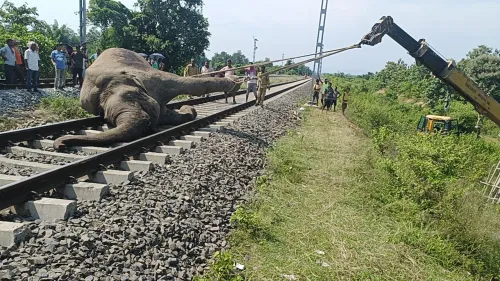
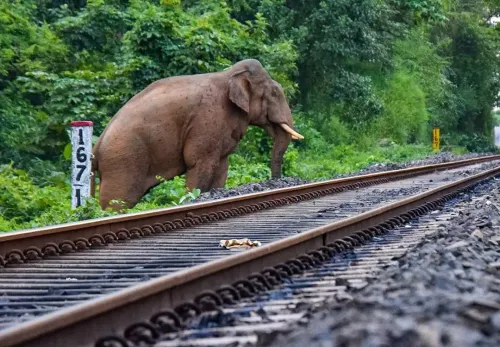
Guwahati, Dec 25 (NationPress) The Northeast Frontier Railway (NFR) has initiated a range of proactive, technology-oriented strategies aimed at averting incidents of wild elephants colliding with trains, thereby ensuring safe and uninterrupted railway operations throughout its network. In 2025 alone, these measures have successfully safeguarded over 160 elephants.
On Thursday, Chief Public Relations Officer (CPRO) Kapinjal Kishore Sharma highlighted the commendable outcomes of NFR's continuous efforts, which have led to the preservation of more than 160 elephant lives in 2025, underscoring the railway zone's unwavering dedication to wildlife conservation.
A significant advancement in this initiative is the installation of the Intrusion Detection System (IDS), an advanced technology powered by Artificial Intelligence that employs Distributed Acoustic System (DAS) methodologies. This system identifies elephant movements near railway tracks and promptly sends real-time alerts to train operators and control rooms, facilitating immediate preventive measures and bolstering operational safety.
As per the official statement, the IDS has already been effectively established in critical areas of NFR that traverse elephant corridors. Presently, the system is active in four major sections, including the 24 km Kamakhya-Azara-Mirza segment within the Rangiya Division, the 32 km Habaipur-Lamsakhang-Patharkhola-Lumding section in the Lumding Division, the 23 km Titabar–Mariani–Nakachari segment under the Tinsukia Division, all located in Assam, and the 52 km Madarihat-Nagrakata segment in the Alipurduar Division of West Bengal.
Collectively, these implementations cover 62.7 km of elephant corridors and 131 km of block sections, significantly enhancing safety in critical wildlife areas, as stated by the NFR CPRO.
Building upon this success, installation of the IDS is currently in progress across various divisions, including 92 km in Alipurduar, 25 km in Katihar in Bihar, 174 km in Rangiya, 110 km in Lumding, and 12 km in the Tinsukia Division.
As noted by Sharma, upon completion, the system will encompass all elephant corridors within the NFR jurisdiction, covering a total of 146.4 km with an overall block section length of 413.42 km, thereby establishing a comprehensive safety framework.
Furthermore, NFR has implemented innovative measures to minimize interactions between trains and elephants. The ‘Plan Bee’ system, installed at high-risk level crossings, utilizes amplified honey bee sounds that can be heard up to 400 metres to deter elephants from approaching the tracks.
In collaboration with the Forest Department, NFR has also improved safety through real-time information dissemination, imposing nighttime speed limits in elephant corridors, temporary speed restrictions based on sightings, training for train crews, installation of warning signs, and vegetation clearance to enhance visibility.
On a national scale, Indian Railways has bolstered wildlife protection by deploying an AI-enabled Intrusion Detection System using Distributed Acoustic System technology to detect elephants and other wildlife near railway tracks.
Having been successfully piloted on the Northeast Frontier Railway, this system is now set to be rolled out in other regions across the country, covering an additional 981 route kilometres, bringing the total coverage to 1,122 route kilometres within Indian Railways, thereby reinforcing its commitment to wildlife preservation and safe railway operations.
It is noteworthy that since 2017, over 2,000 elephants have been safely protected while crossing railway tracks within the NFR, according to the CPRO.
The NFR operates in the Northeastern states and in seven districts of West Bengal and five districts of north Bihar, managing more than 7,362 Track Kilometres (TKM) within its jurisdiction.
Point of View
I assert that the Northeast Frontier Railway's proactive measures reflect a sincere commitment to wildlife conservation while maintaining essential train operations. This unique blend of technology and environmental awareness showcases a model for others to follow.
NationPress
30 Sept 2026
Frequently Asked Questions
What is the purpose of the Intrusion Detection System?
The Intrusion Detection System (IDS) is designed to detect elephant movements near railway tracks and provides real-time alerts to prevent potential collisions, ensuring safety for both wildlife and train operations.
How many elephants have been protected by NFR since 2017?
Since 2017, over 2,000 elephants have been safely protected while crossing railway tracks under the jurisdiction of the Northeast Frontier Railway.
What is the 'Plan Bee' system?
'Plan Bee' is a safety initiative that uses amplified honey bee sounds to deter elephants from approaching railway tracks, particularly at vulnerable level crossings.
What areas does NFR cover?
The Northeast Frontier Railway operates across Northeastern states and in seven districts of West Bengal and five districts of north Bihar, managing more than 7,362 Track Kilometres.
How is Indian Railways contributing to wildlife conservation?
Indian Railways has implemented an AI-enabled Intrusion Detection System nationwide to detect wildlife near railway tracks, enhancing safety measures across the entire railway network.